Smart Tech
How Ag Retailers Evaluate Smart Tech Adoption

To best serve their grower-customers, ag retailers must keep up with an ever-evolving array of technologies. In addition to providing fertilizers, pesticides, seeds, and other key products, retailers also offer services such as custom application, recommendations, and data support. Adopting a new technology offering often requires substantial investment, operational changes, employee training, and involves the risk that it may not succeed. Not adopting, however, may result in reduced efficiency, loss of competitiveness, or growers choosing to manage technologies on their own.
View all
 Tech Hub LIVE 2026: Where Ag Tech Meets Action
Discover the latest ag retail innovations, precision technology, and AI insights at Tech Hub LIVE this July in Des Moines. Learn more >>
Understanding how other ag retailers make their technology decisions can be key to developing profitable business strategies. A recent survey distributed through CropLife® Magazine explored how retailers make these decisions.
Staying Informed
Retailers rely on different sources to stay informed about new technologies, but common patterns emerged. Most ag retailers learned about new tools through agricultural publications and the media (25% of responses), followed by industry peers (22%), and trade shows (20%). Technology providers were another common source (16%), while grower-customers (7%), and equipment manufacturers (5%) played smaller roles. These trends underscore the lasting value of trusted media, professional networks, and in-person events.
The Road to Adoption
Once an ag retailer becomes aware of a commercially available technology, deciding to adopt is often a lengthy process. For most organizations, the decision timeline is measured in months rather than weeks. The most common decision periods are more than 12 months (42%), followed by six to 12 months (22%), and three to six months (16%). Shorter decision timelines (less than three months) are relatively uncommon (less than 14%). A subset of organizations, 5%, reported having no formal evaluation process at all, illustrating that decision-making varies across ag retailers. Adoption often requires meaningful investment not only in equipment or software, but in staff training, customer education, and the time needed to adjust to internal processes.
How Dealers Evaluate Technologies
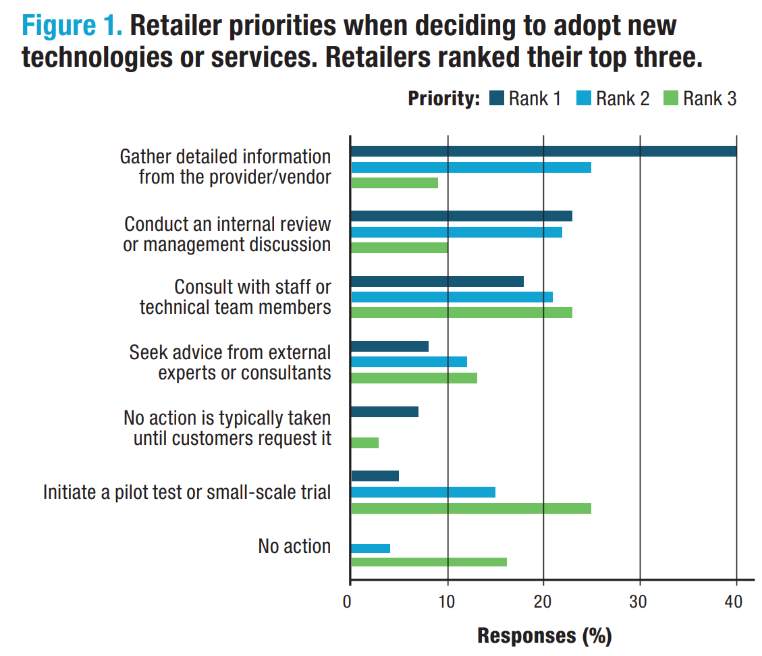
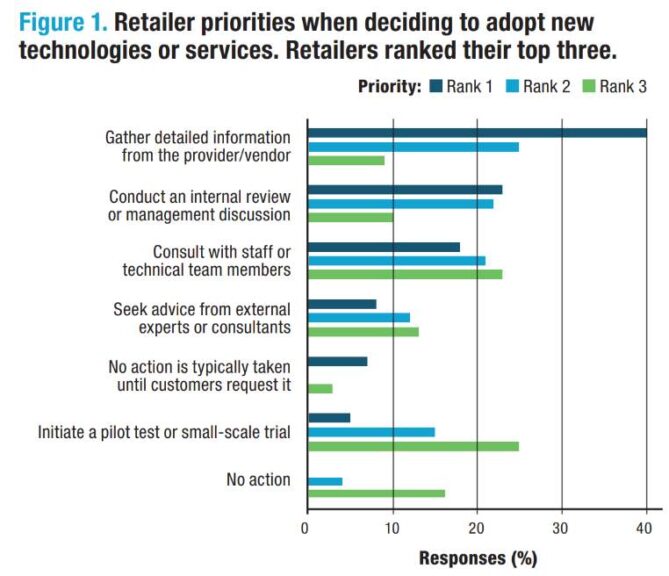
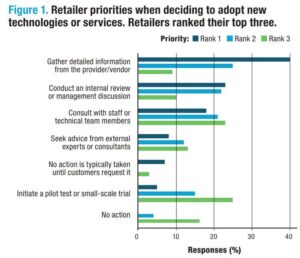
When deciding whether to adopt a new technology or service, ag retailers follow a clear hierarchy of actions. Retailers prioritize gathering detailed vendor information and internal consultations with management and staff over pilot testing or consulting external experts. This process can help individual retailers benchmark their own evaluation approaches and identify the importance of credible data and team buy-in (Figure 1).
What Matters Most
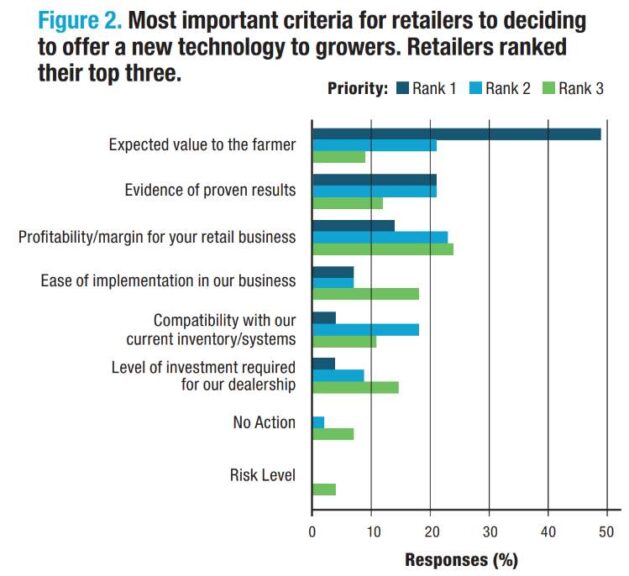
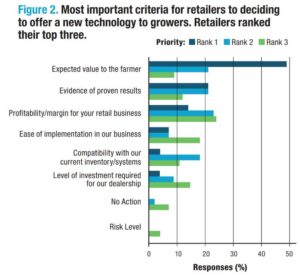
Retailers take a grower-first approach when choosing technologies to offer, prioritizing tools that improve agronomic performance, decision-making, and profitability, while ensuring practical reliability, local fit, and internal support capacity (Figure 2). Technologies that do not provide visible value to growers are unlikely to gain traction, regardless of their novelty or sophistication.
This prioritization reflects a practical, market-driven approach to technology adoption.
Measuring Success
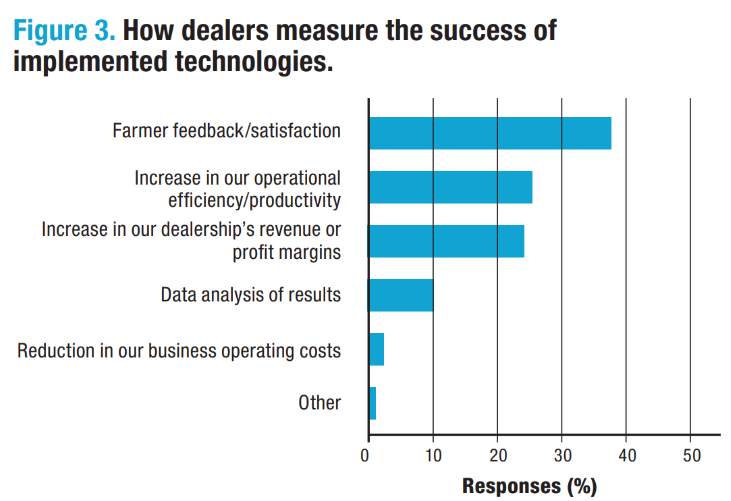
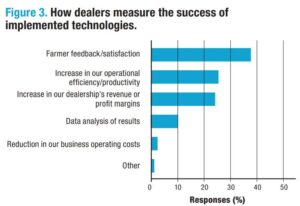
After a technology offering has been implemented, dealers still need to determine whether it is working. The survey shows that growers remain central to this evaluation. Ag retailers mainly assess the success of the technology through grower satisfaction and continued use, as well as gains in efficiency, productivity, and revenue. This pattern underscores the importance of a grower-focused, results-driven approach over cost or data-only metrics (Figure 3).
Communicating Value to Customers
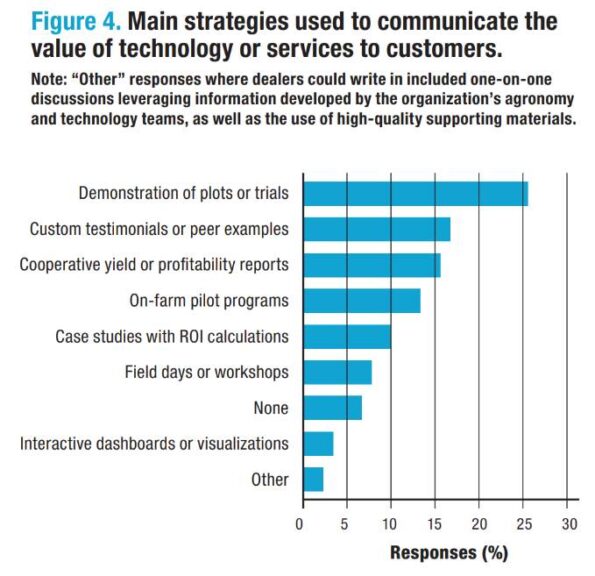
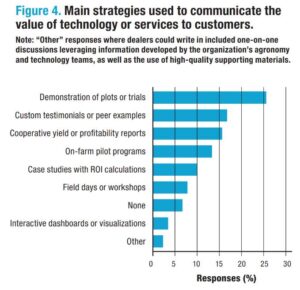
Ag retailers tend to build grower trust by showcasing real world results through demonstration plots (25%) and grower testimonials/peer examples (16%). These consistently emphasize local performance and credible evidence over technical claims or marketing materials (Figure 4).
Most ag retailers use a hybrid revenue model for precision agriculture, combining direct service fees with indirect value through increased input sales and stronger customer relationships. This approach reflects the diverse ways in which precision agriculture has been integrated into retail operations.
Implications for Industry
The survey results provide a benchmark for understanding the current state of the ag retail industry relative to technology adoption. In summary, several main themes were identified:
- Time is required. Most retailers report that technology adoption decisions typically take more than 12 months.
- Information is king. Gathering detailed vendor information ranks as the top action in the evaluation process.
- Growers drive decisions. Grower value and satisfaction are paramount.
- Seeing is believing. Demonstration plots and trials remain the most effective strategy for showing value.
- Business models must be flexible. The variety of revenue approaches suggests that dealers are still refining how best to capture value from precision and digital services.
As precision agriculture continues to evolve with new technologies such as artificial intelligence and autonomous systems, the fundamental principles revealed in this survey — gather information, focus on grower value, demonstrate results, and measure success through customer satisfaction — are likely to remain central to successful technology adoption in ag retail.

For more Smart Tech topics, click here.
Subscribe Today For