Smart Tech
Ag Drones: Building Upon a Decade of Innovation — With More on the Way


It’s been more than a decade now since unmanned aerial vehicles — more commonly referred to as drones these days — first made their market debut across the agricultural landscape. And during this time, the marketplace acceptance of drones has continued to steadily grow.
In particular, Taylor Moreland, Founder and CEO at Agri-Spray Drones, last year represented something of a milestone for the sector.
“In 2024, we kind of entered a new era for drones,” says Moreland. “Most growers and ag retailers now have some kind of spray drones in their operations or at least have experimented with them in some way. And drones last year were much more sophisticated than they have been up until now, and I think you are seeing this reflected in the adoption numbers for the industry.”
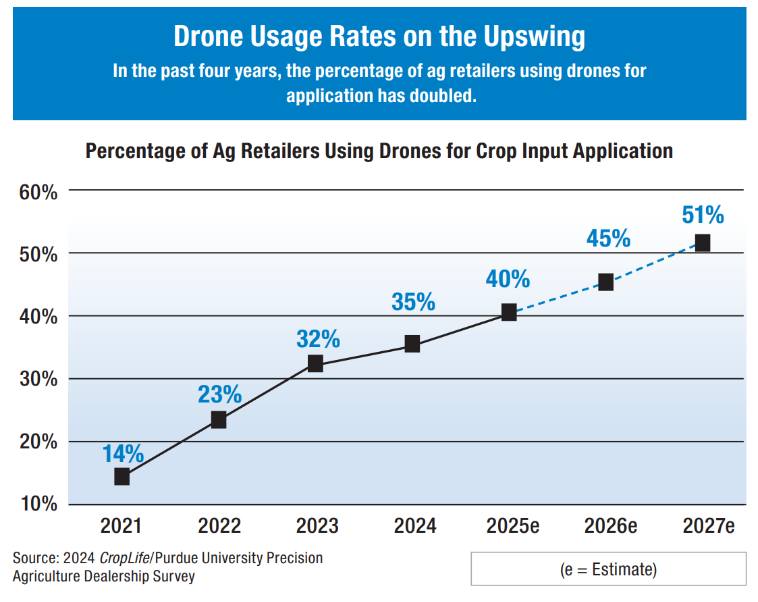
For ag retailers, the numbers bear this assessment out. According to data from the 2024 CropLife/Purdue University Precision Agriculture Dealership Survey, the percentage of ag retailers using drones for in-field applications increased from 32% in 2023 to 35% last year. As recently as 2021, this percentage was under 15% — meaning the sector’s usage rate has more than doubled in only a few short years’ time.
 According to Nicole Green, Field Agronomist at Beck’s Hybrids, there are several reasons why drones are becoming more popular across agriculture for application work. This includes no running over already growing plants, increased control over active ingredients per droplet being applied, and the ability to apply using drones in wet fields, allowing users to immediately return to fieldwork.
“Drones are also a good way to add datapoints to farm information, tying into things such as aerial imagery,” said Green during a presentation on drone economics presented at the 2025 National Farm Machinery Show in mid-February.
Then, of course, there’s the advantage of deeper canopy penetration. “When we were using drones to apply fungicides, we were getting coverage on the bottom of the leaves because of the downdrift,” she said.
William Fellmeth, Chief Remote Pilot for Nutrien Ag Solutions (NAS), agrees. “Using drones for application, can help efficiently target hard-to-reach parts of the field,” says Fellmeth.
Bigger is Better
In addition to efficiencies, Fellmeth also points to larger capacity/physical drones coming into the marketplace. “There are bigger birds out there, with bigger tanks,” he says. “These are able to cover more area in single flight than has ever been possible before.”
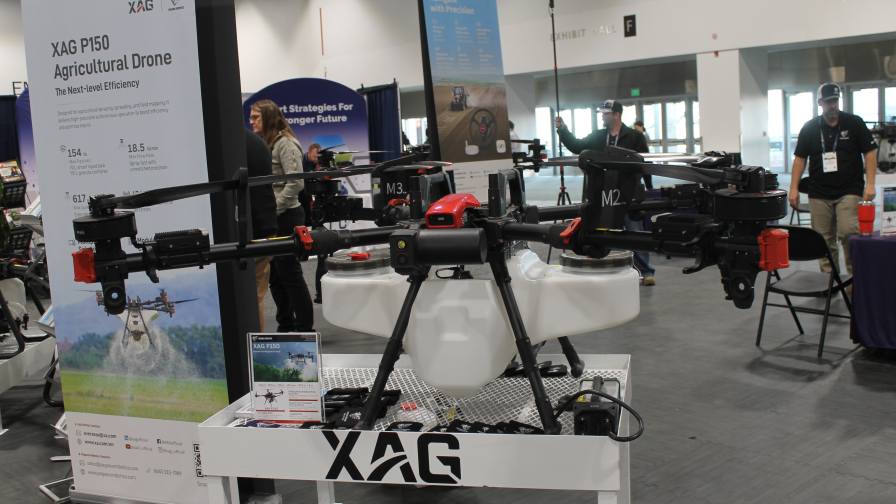
XAG P150 drone has a maximum flight speed of 30-plus miles-per-hour and an 18.5-gallon product tank.
As evidence of this trend, Fellmeth says NAS is upgrading its drone fleet with XAG P150 drones from Pegasus Robotics from the XAG P100 models. “The reason is simple,” he says. “The P150s are bigger.”
Drones supplier Rantizo also high-lighted this “bigger” aspect of the XAG P150 when it announced the company was offering this model to its customers for the 2025 growing season.
“To meet the growing demand for spray drone services, we strive to provide the best available technology at an affordable price point,” said Eric Ringer, Chief Field Operations Officer at Rantizo, in press release. “We’re excited to offer the XAG P150 to our spray drone operator network and will also fly them in our own regional hub locations this season.”
According to Ringer, the XAG P150 is built to help operators cover more ground in less time, giving operators the ability to spray ground quickly and efficiently at higher gallons-per-acre rates while maintaining higher speeds. With maximum flight speeds of 30-plus miles-per-hour and an 18.5-gallon tank, “the XAG P150 is the largest and fastest spray drone currently available on the market,” he said.
Another company offering a larger drone for 2025 is Hylio. Earlier this year, the company introduced the HYL-150 ARES to the market. Manufactured in Texas, this drone features a 40-foot spray swath, 110-pound liquid capacity, and application rates of 50-plus acres per hour, allowing operators to cover hundreds of acres per day.
Then, of course, there is the cost differential between drones and ground rigs. “For someone looking to accomplish field application, there’s a big difference in price,” said Beck’s Hybrids’ Green. “A typical ground rig will cost a user between $500,000 and $750,000. For a typical drone, this initial cost of purchase would range between $30,000 and $50,000, including a trailer to transport it between jobs.”
Future Developments
According to the 2024 CropLife/Purdue University Precision Agriculture Dealership Survey, the percentage of ag retailers using drones to apply crop inputs is projected to grow from 35% today to more than 50% by 2027. Based upon the information from industry insiders, this growth will be driven by a number of new breakthroughs, both technical and regulatory.
On the technical side, Agri Spray’s Moreland foresees one of the ag technology industry’s other big innovations — artificial intelligence (AI) — playing a role in drones going forward.
“You are already starting to see this happen,” he says. “Some operators are collecting data from their fields and putting it into AI systems to identify where specific weeds are in the field. Drones can then be sent out to apply to these spots only rather than broadcast spraying.”
Another company working with this kind of collaborative effort between drones and other ag technologies is Sentera. According to Joe Walsh, Chief Growth Officer at the company, Sentera is launching a program called SmartScript Weeds. “Using high-resolution drone imagery and Sentera’s advanced sensors, SmartScript Weeds can accurately detect and map weeds in the field,” said Walsh, speaking at the 2025 Commodity Classic in early March. “This information can then be used by farmers and ag retailers to offer targeted spray prescriptions, potentially reducing postemergence non-residual herbicide costs by up to 70%.”
“Drones provide a high-resolution assessment of field conditions at a low cost with on-demand usage dynamics,” said Eric Taipale, Founder and Chief Technical Officer for Sentera, He added that the company would be testing the SmartScript Weeds program during the 2025 growing season, with plans for a more widespread launch to happen in 2026.
Looking further down the road for drones, NAS’ Fellmeth predicts the regulatory environment will also become more “friendly for operators” over the next few years.
“The number one thing I foresee is a loosening of the regulations on how drones can be operated,” he says. “I think you will see the ability for operators to implement larger swarms — possibly with five to 10 aircraft. I also think there will be bigger drones comparable to fixed wing manned aviation aircraft entering the market and being approved for operations.”
Indeed, Hylio is already touting this ability for its HYL-150 ARES unit. In operation, this drone can become swarm-enabled using AgroSol Ground Control Software to maximize efficiency and reduce labor demands,” said the company.
“With multi-drone swarm capabilities, the HYL-150 ARES allows farmers to treat, seed, or fertilize thousands of acres with pinpoint accuracy, cutting waste and optimizing resources,” Hylio said in a press release. “As agriculture faces mounting pressures to do more with less, this cutting-edge drone provides a powerful, American-made solution to help farmers increase yields and streamline operations.”

For more Smart Tech topics, click here.
Subscribe Today For
