
For the past several years now, the fertilizer category has witnessed as many ups-and-downs as an out-of-control bungee jumper. And based upon the evidence — particularly at the global level — at least one market watcher believes this rollercoaster ride of market turmoil will continue well into 2026.
In terms of importance, the fertilizer category is one of the major sectors for agriculture. Growers need crop nutrients to keep their yields high and (in theory) receive more revenue for their harvested crops when the fall rolls around.
For the past few growing seasons, however, this hasn’t played out quite as expected, said Josh Linville, Vice President, Fertilizer at StoneX, a financial services company that tracks global markets such as fertilizer.
“The market is not acting naturally,” said Linville, speaking at the 2025 Agricultural Retailers Association (ARA) Annual Meeting this past December. “It has been lower prices for outputs and higher prices for inputs.”
For example, crop prices throughout much of 2024-25 remained very low versus historic norms. Corn per bushel prices ranged between $3 to $4 throughout much of the year, with soybeans hovering around $7 to $8 per bushel. As recently as 2021-22, these prices were in the $6 to $7 range for corn and $12 to $14 range for soybeans per bushel.
Meanwhile, crop nutrition prices have kept climbing year-over-year. For instance, this past January, one ton of diammonium phosphate (DAP) cost $500. By the middle of 2025, this price had risen to more than $800 per ton. Today, a ton of DAP still costs between $650 to $850 per ton.
To illustrate this disparity in revenue between crop and fertilizer prices, Linville told ARA attendees about the costs associated with fertilizer usage during the 2024 growing season.
“Normally, it cost about 55 bushels of corn for growers to pay for one ton of urea,” he said. “But in 2024, this same one ton of urea cost 155 bushels of corn to buy.”
Naturally, ag retailers have to deal with both of these market issues simultaneously. According to data collected in the 2025 CropLife 100 Survey, the fertilizer category saw its overall revenues remain flat for 2025. Sales for the year came in at $19.9 billion — the identical sales figure that the category recorded during the 2024 growing season.
Despite this fact, plenty of ag retailers reported that their grower-customers were very concerned with their fertilizer costs during 2025. In fact, according to the 2025 CropLife 100 Survey, almost three-fourths (71%) listed price volatility as the major issue they dealt with from customers during the 2025 growing season.
Based upon his ARA talk, these facts don’t surprise Linville.
“Let’s face it — fertilizer prices are too high,” he said, speaking to the assembled ag retailers. “I know you are hearing it from every single farmer-customer you have. And we hear it every single day as well.”
Dealing with a Global World
For a time during 2025, Linville said the trade tariffs being proposed by the Donald Trump Administration against other countries had the fertilizer industry worried about increased prices. However, in November 2025, the administration added important macronutrients such as phosphates and potash to its list of critical minerals, exempting them from tariffs.
“Thankfully, tariffs no longer apply to these fertilizer products, and that’s a great win for agriculture,” he said.
Still, according to Linville, one of the biggest reasons for this disparity between agricultural outputs (crops) and inputs (fertilizer) is the global situation itself. As he pointed out, the U.S. imports many of the crop nutrition products it uses annually from other countries. Unfortunately, some of these are engaged in geopolitical (or in some cases, armed) conflicts that make trading goods such as fertilizer with them problematic.
“With fertilizer, there are some pretty big overarching issues we have in the world today, and a lot of the drivers of these higher prices are not domestic, such as tariffs and import duties,” said Linville. “They really are international problems that are well outside the sphere of our influence.”
For example, two of the largest fertilizer importers – Russia and China — are currently at odds with U.S. In Russia’s case, it’s because of the country’s ongoing war with Ukraine, now entering its third year. In China’s case, the U.S. and the country remain at odds over disputed trade policies and concerns over intellectual property rights regarding technology, to name a few items.
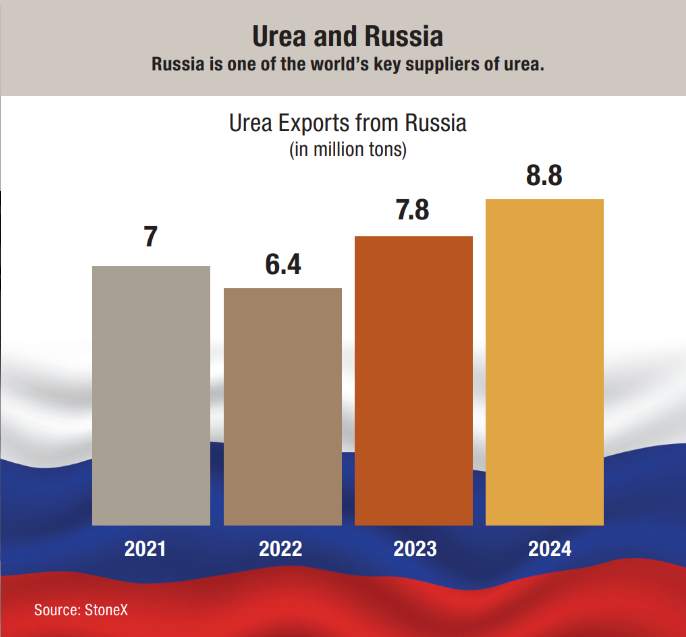
Looking specifically at Russia, Linville had this to say at the ARA meeting: “The worry is that without an agreement to end the Ukraine war, the U.S. could start putting new tariffs on Russian fertilizer. Russia supplies a lot of urea to the U.S. In fact, during the past few years, they’ve been our No. 1 supplier of urea. And although Canada is the biggest supplier of potash to the U.S., Russia is No. 2.”
UAN Worries
Geopolitical conflicts with Russia have already had a major impact on nitrogen production in Europe, he said. Because of disruptions to natural gas pipelines between Russia and the European Union, “nitrogen production basically stopped across the region,” said Linville.
Urea ammonium nitrate (UAN) is an even bigger concern among nitrogen-based fertilizers. “This is the one product that sanctions on Russia I’m scared to death of,” he said. “One out of every two tons of UAU originates in Russia. If you halt UAN from Russia, there’s nowhere else to get it. This is the one thought that keeps me up at night.” Based upon the numbers, Russia supplied 49% of the world’s UAN needs in 2025 at 1.1 million tons.
Besides Russia, the globe’s other major supplier of UAN is Trinidad and Tobago. In 2025, this pair of islands produced 29% of the world’s UAN (600,000 tons).
“But with European production down, the first place European farmers are going to replace their missing UAN is Trinidad and Tobago,” said Linville. “This is why UAN prices have stayed propped up.”
It’s a similar story with another important nitrogen-based fertilizer, anhydrous ammonia (NH3).
“Globally speaking, the NH3 market is a mess,” said Linville. “In 2021, Russia was the world’s largest exporter of NH3 at 4 million tons. Last year, Russia was down to No. 8 because the Ukraine war disrupted its ability to export more. Europe is also buying a lot of NH3 globally to replenish its lost domestic supply, which is keeping these prices higher than normal.”
Phosphates Update
As messy as the nitrogen-based fertilizer markets are, Linville told ARA attendees that the situation for phosphorus is even worse. According to StoneX data, five countries supply 90% of the world’s phosphorus — Morocco, Saudi Arabia, Russia, the U.S., and China.
From a historical perspective, China has been the world’s largest supplier of phosphates. “Typically, the country has exported between 8 million and 10 million tons of phosphates to the rest of the world for many, many years,” said Linville.
However, starting in 2021, the Chinese government began to make it a priority to have its growers produce more of the country’s own food supply. Therefore, China began hoarding phosphate fertilizers for domestic use only. This severely limited the amount of phosphorus China was exporting to the rest of
the world.
According to Linville, the effects of this becomes obvious to any observer looking at the numbers.
“In 2024, Chinese phosphates exports came in very, very low,” he said. “In all, the country shipped only 262,000 tons. That’s the equivalent of one large vessel, for the whole year.”
Furthermore, this “keep phosphate at home” policy stayed in place for much of the 2025 growing season as well. “Based upon the numbers, China didn’t even ship any phosphates for export until after June 2025,” said Linville. “That’s the reason phosphorus fertilizer prices have remained as high as they have been for the past few years and probably will remain high throughout 2026.”
If there’s one macronutrient that Linville isn’t worried about going into the 2026 growing season, it’s potash. For U.S. growers, the main supplier of this fertilizer is Canada.
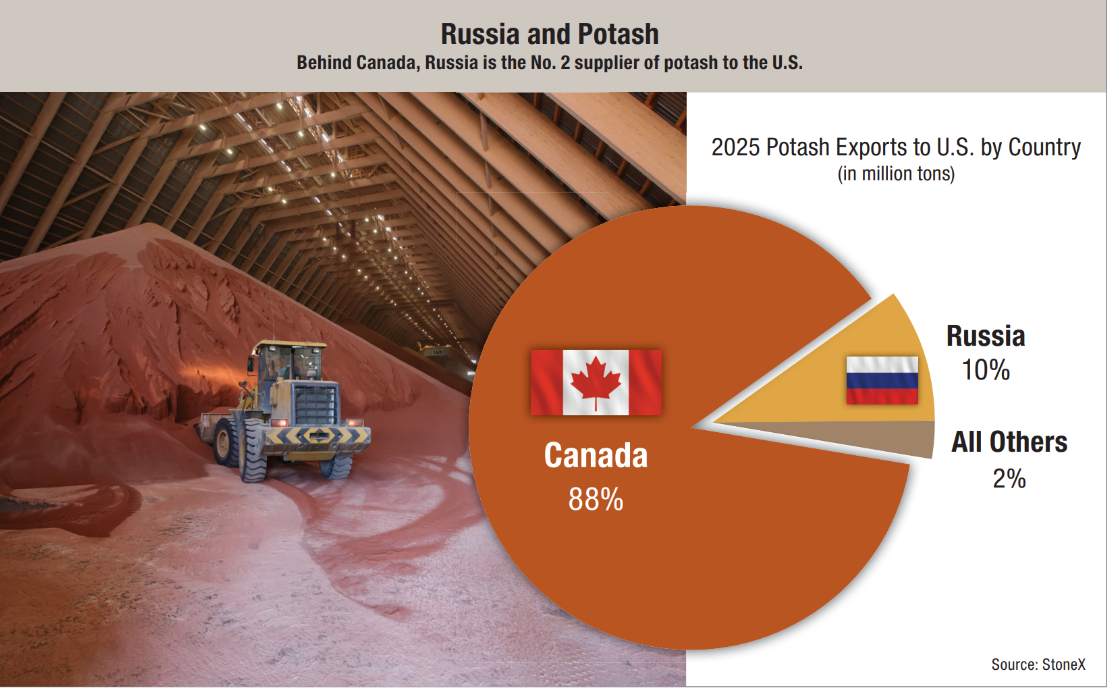
“Canada is an ally and close neighbor, so there’s no real issues there for getting potash in 2026,” he said. “I’m not terribly concerned about potash.”
As for the whole of the fertilizer marketplace in 2026, Linville said that the price differential between crops and inputs is finally becoming more manageable.
“Today, farmers are back to having it cost around 75 bushels of corn to pay for one ton of urea,” he said. “That’s high, but something closer to normal — a sign that the fertilizer market is starting to heal.”
Still, Linville advised ag retailers and their grower-customers to get used to the global state of affairs influencing prices for some time to come.
“Prices are high around the world,” he said. “It’s a global problem. Volatility is the only constant. It’s the nature of the world we are in right now.”