Smart Tech
Why Bayer’s Agronomic AI Isn’t Just Smart — It’s Trusted

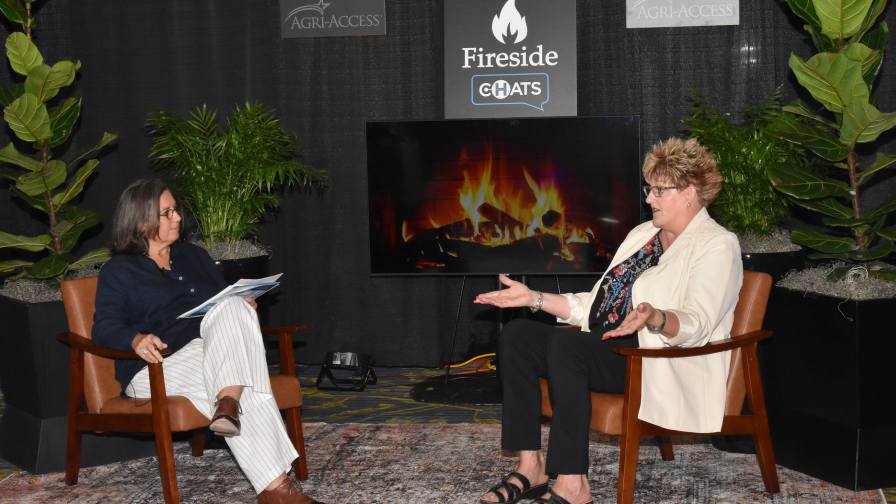
Tami Craig Schilling (right), former Vice President and Agronomic Digital Innovation Lead at Bayer, joined CropLife Editor Lara Sowinski for a Fireside Chat at the 2025 Tech Hub LIVE in Des Moines, IA.

At Tech Hub LIVE 2025, Tami Craig Schilling — then with Bayer — joined CropLife’s Lara Sowinski for a Fireside Chat to share the story behind E.L.Y., Bayer Crop Science’s innovative small language model built specifically for the agronomic space. With a farmer-first mindset and a deep understanding of both agricultural operations and digital technologies, Tami and her team helped reshape how agronomists and sales reps deliver insights in the field—one question at a time. Shortly after Tech Hub LIVE, Tami retired from Bayer and is now a Consulting Partner at DeepRoot Strategies.
As the Vice President and Agronomic Digital Innovation Lead at Bayer, Craig Schilling brought a unique perspective to ag tech: she’s not only worked in agriculture for 35 years, but she’s also a farmer’s wife and mom. That intersection — between high-level corporate strategy and boots-on-the-ground farming — is what inspired the creation of E.L.Y., Bayer’s internal generative AI tool built to deliver fast, accurate agronomic answers.
“The rest of my story, and really the beginning of our generative AI product at Bayer named E.L.Y., comes from being a farmer’s wife,” said Craig Schilling. “I’ve spent 35 years of my career calling on ag retailers, working with seed dealers, and farmers — trying to provide the best products and help them through their production challenges.”
From her vantage point, Craig Schilling could see how hard it still is for farmers and agronomists to get timely, region-specific answers about products, timing, chemistry, and field conditions.
“When we looked at market research, we saw that product and agronomy information is still a big pain point. It’s not the volume — it’s figuring out what’s needed for a specific area, and when,” she explained. “A farmer makes hundreds of decisions a year.”
Building Smarter Systems with AI — and Farmers in Mind
With that challenge in mind, Craig Schilling and a small team at Bayer began experimenting with ways to reduce friction in accessing agronomic knowledge. But the realities of corporate funding cycles and limited in-house tech resources made traditional development difficult.
“Building in-house is hard. Once the original developers move on, who maintains it? Who knows the bugs or how to fix them?” she said.
Everything changed in late 2022 with the release of ChatGPT. Craig Schilling and her team quickly pivoted to explore how generative AI could be applied to agronomic data, without reinventing the wheel.
“We thought, what if instead of building our own system, we used a generative AI tool to work with our data — hybrid information, location, weather, chemistry, labeling, insects, fungicides, and so on?”
Using the Microsoft Azure platform and collaborating with integrators like EY, they launched a 90-day proof of concept using only publicly available agronomic data. The results were striking.
“In 90 days, we proved we could be 40% more accurate than ChatGPT out of the box.,” she said. “That told us we were onto something.”
E.L.Y. in Action: Trust, Testing, and Transformation
By fall 2023, Bayer had deployed E.L.Y. internally to 120 agronomists, then expanded to 800 sales reps with around 500 active users. The feedback from the field was immediate and enthusiastic — though not without some concern.
“Some were worried — ‘Will this take my job?’ But we believe they offer much more value, and farmers still want a human connection,” Craig Schilling said. “This tool augments the job; it doesn’t replace it.”
To date, E.L.Y. has fielded more than 20,000 user-submitted questions, helping Bayer teams respond 60% faster and save up to four hours per week. Key to its success has been a focus on accuracy, simplicity, and relevance, especially in regional contexts.
“There’s an art to asking the right questions — what we call prompts,” she said. “So, we focused on making it easier to use and improving accuracy. It won’t be perfect — humans aren’t perfect either — but we aim for high reliability.”
While E.L.Y. is currently an internal-only tool, Bayer has plans to expand its availability and continue building upon its core technology — starting with more product formulations and geographic reach.
A Small Model with Big Impact
E.L.Y. is not a massive AI engine trying to do everything — it’s a small language model, laser-focused on agricultural performance.
“It’s not a large one like ChatGPT, Bard, or LLaMA. That was never the goal. We built on top of existing models,” said Craig Schilling. “And the content we put in doesn’t go out into the public domain. With tools like ChatGPT, if you put in private data, it can stay in the system. But if you build on a secure platform, like we did with Microsoft, your data stays your data.”
Final Takeaway: Domain Knowledge Still Wins
Craig Schilling closed the conversation by reinforcing the importance of agricultural expertise in shaping AI tools that work in the real world.
“If you have an ag background — farming, retail, or just grew up around it — your domain knowledge matters,” she said. “Understanding the complexities of rural agriculture, no matter where you are in the world, is incredibly valuable.”
With E.L.Y., Bayer is showing how trusted relationships, tested data, and targeted technology can deliver smarter, faster, and more personalized agronomic support — without losing the human touch.

For more Smart Tech topics, click here.
Subscribe Today For
