The Rise of Agentic Agriculture: AWS’ Karen Hildebrand on AI’s Growing Role in the Field
 July 21, 2026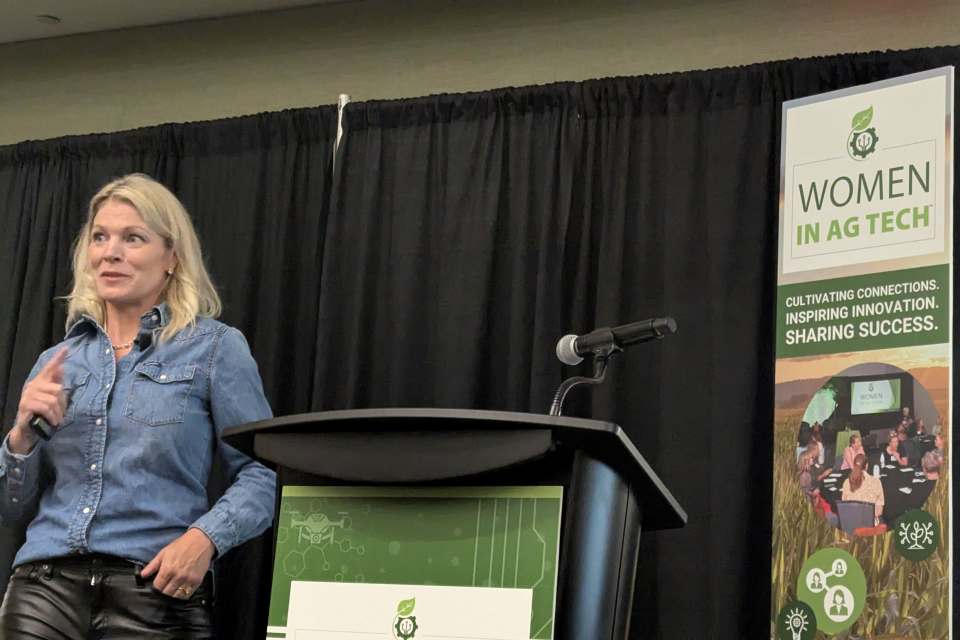
Karen Hildebrand, Global Head of Industry and Partner Solutions for Amazon Web Services, gave this year’s keynote speech at Women in Ag Tech. She also presented the keynote address on day two of Tech Hub LIVE.

Ag tech gathered and produced a lot of data, which many struggled to understand how to analyze…up till now. The industry is entering a new phase. Karen Hildebrand, Global Head of Industry and Partner Solutions for Amazon Web Services (AWS), says artificial intelligence can help transform these large data storages into productive ag business recommendations.
Hildebrand covered this important topic during keynote presentations at this week’s Tech Hub LIVE Conference in Des Moines, IA.
“Your agronomy data lives in one system. Your equipment data is really in another. Your grain contracts are generally in a third,” she says. “An AI that can see across all of that can give us a more correct answer.”
The move from precision agriculture to agentic agriculture — a future where AI-powered systems can reason through complex information, provide recommendations and support human decision-making is at hand.
“AI has really changed from describing the field to actually reasoning, and in some cases, being able to actually recommend what the action is — and doing that responsibly,” she says.
Turning AI Into Business Value
While much of the conversation around artificial intelligence focuses on capabilities, Hildebrand believes the true opportunity lies in solving practical business challenges for farmers and agricultural professionals.
With commodity markets facing continued uncertainty and producers managing tighter margins, every decision has greater financial impact.
“When margins are thin, the value of every decision being right goes up, not down,” Hildebrand says. “That’s the business case for the technology.”
One area where she sees AI making an impact is helping growers better evaluate return on investment for field decisions.
For example, rather than simply recommending a spray application, AI can help determine whether the potential yield benefit justifies the cost.
“If that spray application is costing you $14 per acre, how many more bushels or yield do you have to protect for that decision to make sense?” she says. “That’s the type of conversation that we’re seeing AI being enabled in 2026 in the field.”
Building the Next Generation of Agriculture’s Workforce
Beyond improving decision-making, Hildebrand believes technology will play a major role in shaping agriculture’s future workforce.
She recalls an early conversation at AWS where a customer described a vision for a future where operators could remotely manage equipment from anywhere in the world, regardless of language barriers.
“I thought to myself, I’ve come to the right place if I’m working with people with a vision that big,” she says.
While that vision continues to evolve, Hildebrand believes the goal of technology should not be replacing people — it should be amplifying human expertise.
“Our job is to make the most intelligent tools that they’ve ever used be the ones that are waiting for them in the field,” she says. “We want them to take over an operation that removes drudgery but really amplifies their judgment.”
For the next generation entering agriculture, those tools could help create more accessible and attractive career opportunities.
“Agriculture is an ecosystem of careers,” Hildebrand says. “We need to be thinking about whether we are leaving a legacy and a generation that is going to make that something that sustains itself.”
Recognizing Women’s Role in Leadership
As a part of the workforce, women play an important role.
“I think women have always been in leadership positions on the farm,” she says. “Maybe they didn’t get recognized for it, but they certainly have always been there.”
Hildebrand believes emerging technologies can create new opportunities by allowing people to contribute based on their individual strengths and expertise.
“I think that’s where women are finding a seam right now — being able to understand how to take data and make decisions more easily with a better corpus of data,” she says.
She also points to low-code and no-code technology platforms as tools that can help expand participation by making advanced technology more accessible across the agricultural ecosystem.
Subscribe Today For
