Smart Tech
Beyond Prototypes: Why 2025 Is the Year Ag Autonomy Moves from Research to Reality
 August 12, 2025
In some form, agriculture has been experimenting with autonomous vehicles since at least the early 2000s when John Deere displayed its first version of an autonomous tractor. However, according to market watchers, 2025 represents an extraordinary moment for this category — partially driven by a number of outside influences.
“We are entering a new era of agriculture defined by technology,” says Kendal Quandahl, Precision Segment Lead, North America for Case IH. “We’ve had amazing gains in iron technology over the years, but now we get the opportunity to take this precision technology and build it into all of the products we use.”
Dinen Subramaniam, Product Launch Manager for Autonomy at PTx Trimble, agrees, giving credit to the technological advances being made in another “iron-oriented” industry for helping autonomy development to expand in agriculture.
“We are on the cusp of innovation because of the automotive industry,” says Subramaniam, citing the advanced vision/machine learning systems now being incorporated into automotive designs. “There have been several attempts to get autonomous vehicles adoption going over the past 10 years, but most of them were not viable products. The new advances have driven the technology to such a point that it is in a much more viable place to become a useful solution for agriculture.”
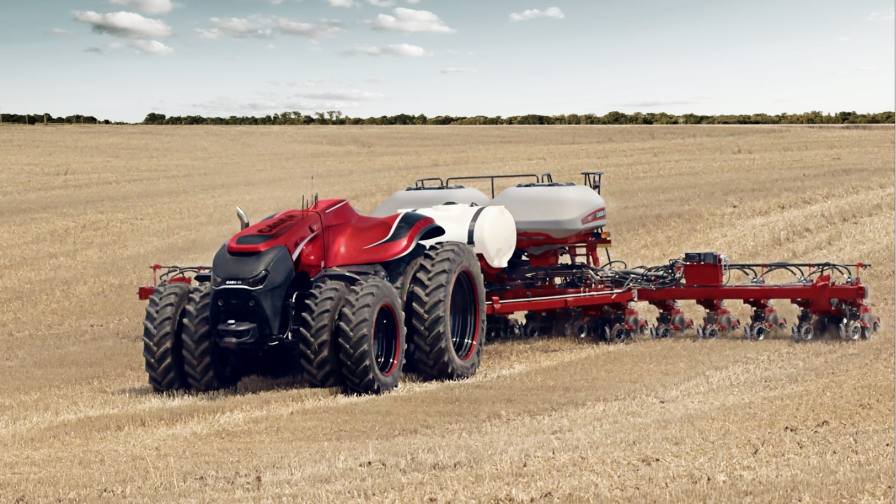
The Autonomous Concept Vehicle (ACV) was introduced by Case IH in 2016. Photo courtesy of Case IH
Up until now, say market watchers, the development and innovation of autonomous vehicles in agriculture have been what could be called “exploratory” or “research” efforts. “These tended to be one-off products that targeted very niche segments of agriculture or were concept vehicles,” says Subramaniam. An example of this would be the Autonomous Concept Vehicle (ACV) showcased by Case IH back in 2016.
However, according to Case IH’s Quandahl, the ACV did serve an important role in the evolution of today’s autonomous vehicle movement for agriculture. “When we introduced the ACV in 2016, we as a company were planting our flag in the ground when it came to autonomous vehicle development,” she says. “That product told the world where we thought agriculture was headed in terms of technological development.”
The Challenges of Today
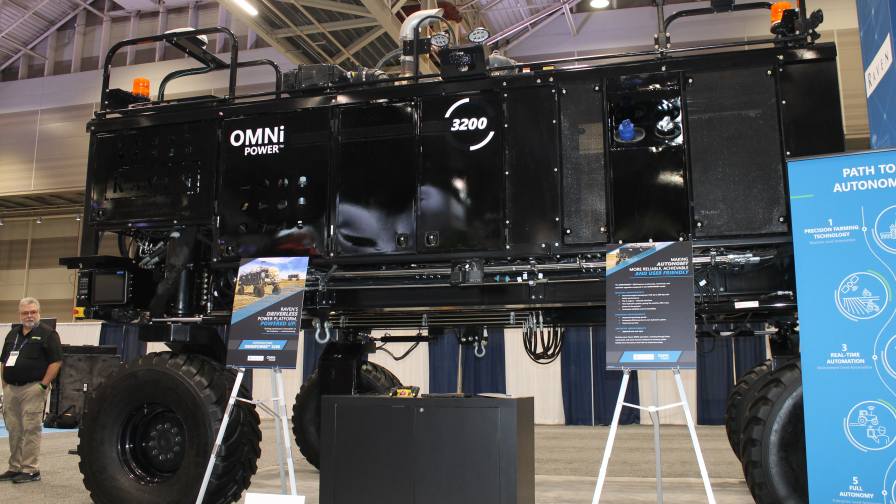
The OMNiPower 3200 spreader from Raven Industries was an early example of autonomy in agriculture.
Since the introduction of the ACV, other manufacturers have attempted to launch autonomous vehicles for agriculture — with a few specifically targeting the ag retailer sector. Examples of this trend include the OMNiPower 3200 spreader from Raven Industries (which debuted at the 2022 Commodity Classic) and the Trident 5550 applicator with Raven Autonomy from Case IH (which was highlighted at the 2022 Farm Progress Show).
According to PTx Trimble’s Subramaniam, there are several reasons why these earlier attempts at autonomous vehicles for agriculture didn’t stick. The first is some of the technology limitations involved.
“In agriculture, you are dealing with a very, very challenging environment in the field,” he says. “You have to deal with having insects and birds cross your paths, multiple hours of operation, applying at night, etc. To be totally successful at autonomy, you have to package all of the technologies to make all these field operations work together.”
Darcy Cook, Head of Autonomous Solutions at PTx Trimble, agrees with this assessment. “You need a lot of technologies to come together for autonomy to work in agriculture,” says Cook. “Luckily, we are seeing that happen now.”
In this case, Cook also credits the automotive industry and its technological advancements for helping move agricultural autonomy forward. “The perception/vision systems being used in cars to see things in front, on the sides, and in back of the vehicles have gotten very sophisticated in the past few years,” he says. “And agriculture is now adapting these systems for its use, too.”
With the technology challenges to autonomy being addressed, Cook says the next big hurdle for the sector to get over is the marketplace itself. “We need to earn the trust of potential customers through awareness and education,” he says. “The big barrier is exposure. We need to have users start using these products so they can see firsthand how they could add value to their operations.”
Today’s Products
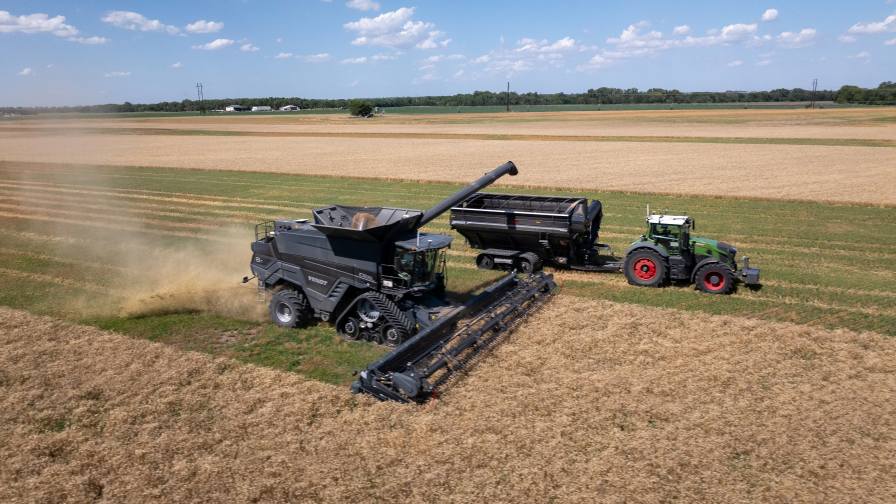
The OutRun Autonomous Grain Cart is being introduced by AGCO/PTx Trimble for the 2025 harvest season. Photo courtesy of AGCO/ PTx Trimble
According to Cook, one of the first of this new generation of autonomous vehicles from AGCO/PTx Trimble is the OutRun Autonomous Grain Cart. This product was introduced in 2024 to a select group of customers, he says, with a more widespread market introduction planned for 2025 harvest season. Next up, AGCO/PTx Trimble is working on autonomous tillage equipment.
However, according to PTx Trimble’s Subramaniam, the OutRun Autonomous Grain Cart and autonomous tillage equipment are only components in a larger autonomous vehicle strategy for AGCO and PTx Trimble.
“Our real strategy is to not only build autonomy for one task, but to build a platform that’s adaptable to multiple uses,” he says. “We have an autonomous platform for retrofit. It will support autonomous grain cart functionality. It will support autonomous tillage functionality. And any other functionality that might come along in the crop cycle operations.”
Speaking of other crop cycle operations, how might autonomous vehicle development in these areas progress as the industry heads towards 2030? According to Case IH’s Quandahl, development will likely continue in segments such as tractors and tillage equipment for the time being.
“These pieces of equipment are involved with repeatable operations,” she says. “That’s where the near future autonomous developments will happen.” Quandahl adds that products such as spreaders, combines, and planting equipment will be on the docket for autonomous development after that.
Regarding the “holy grail” for custom applicators — sprayers — autonomous development might be a little further down the road. “The move towards targeted spraying lends itself to autonomy, but blockage detection systems for these units will have to be rock solid before an autonomous sprayer will be trusted,” says Subramaniam.

For more Smart Tech topics, click here.
Subscribe Today For
