Smart Tech
Tech in the Trenches: How AI and Automation Are Freeing Ag Teams to Focus on Strategy
 August 6, 2025
It took nearly a century before 90% of U.S. homes had telephones. By comparison, the internet took five years to reach that same level. According to the Pew Research Center, “the vast majority of Americans — 98% — now own a cellphone. About nine-in-ten (91%) own a smartphone, up from just 35% in the Center’s first survey of smartphone ownership conducted in 2011.”
How important are phones? According to AcumenIT: “Out of the 7.7 billion people in the world, more than 6 billion people have access to a mobile phone compared to only 4.5 billion people who have access to a working toilet.”
Whether its phones, computers, or pieces of ag IRON, the hardware is driven by millions of lines of code — the software implanted inside that technology.
“Technology is embedded in every part of our operation, supporting countless functions and processes,” says Bradley Schmidt, Director, Fleet Operations for GROWMARK. “One of the most critical challenges it helps us overcome is gaining real-time visibility into driver availability and regional capacity. This is especially important in agriculture, where timing is everything and we must constantly adjust for weather, pricing shifts, same day orders, and terminal congestion.”
The pace of technology seems to grow at an exponential pace. It’s little wonder then that the incorporation of artificial intelligence (AI) will soon impact nearly every aspect of daily life.
“Technology hasn’t replaced people, but it has definitely changed how we work,” GROWMARK’s Schmidt says. “It has shifted our team’s focus from routine paperwork and administrative tasks to more valuable activities like building relationships, communicating proactively, and making strategic decisions with accurate and reliable intel.
“We’re no longer just reacting to procurement needs,” Schmidt continues. “We’re now a forward-looking part of the value chain. The data and visibility we gain through technology allow us to improve financial performance, strengthen service, and help our members gain a competitive advantage. In short, we’re using technology to empower our people and move from transactional work to more transformational results.”
It’s difficult to separate hardware from software. One doesn’t run without the other. Whether it’s IRON, sensors, drones, or another tool, software is critical to successful execution. Companies and research institutions across the ag industry are exploring ways to incorporate AI software into existing and new tools.
“My lab is really focused on developing sustainable management crop production systems for specialty crops which are widely grown by farmers in North Carolina and using various kinds of technology where we use drones, we use ground-based sensors,” says Harmandeep Sharma, PhD, Research Assistant Professor in the Department of Natural Resources and Environmental Design at the North Carolina Agriculture and Technical State University. “And then we also because when we are using these sensors, we do collect real-time data, continuous data. So, we use SAS products to analyze those big data sets.
“We are using various kinds of technology,” Sharma continues. “Each technology has its own applications. For example, we are using a lot of ground-based soil moisture sensors that really help farmers understand how much and what time and what amount of irrigation they need. Some of these are automated. Farmers don’t have to worry about checking it again and again.”
The software will automatically turn on the irrigation system when the sensors detect the soil is too dry.
“That’s like a very simple example,” Sharma says. This is very cost-effective technology. A lot of farmers are already using these sensors.”
In addition to sensors, many growers have adopted drones programmed “to see how the crops are doing,” Sharma says. “They can create a map very quickly, and it will give (growers) an overview of how a crop is doing.”
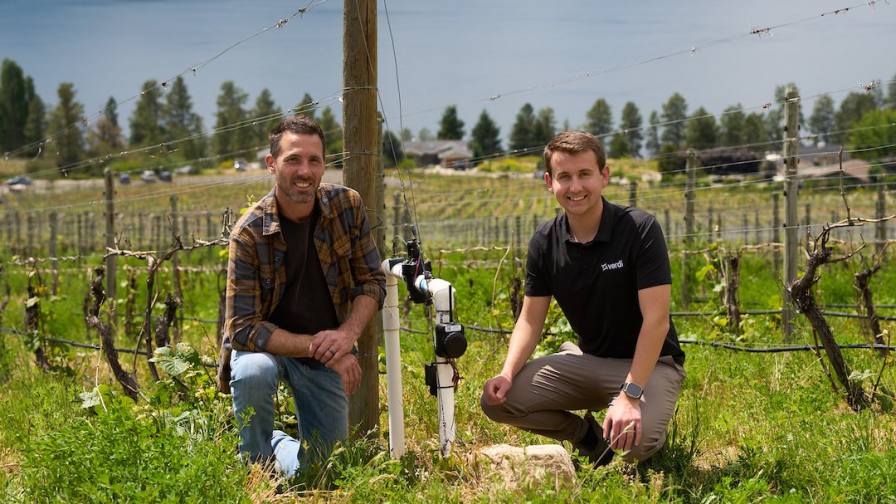
One of our growers using Verdi’s system in a vineyard setting — automating irrigation while maintaining full visibility. Photo: Verdi
Irrigation is another area that smart technology could be able to support, but “actually 95% of viewers today still prefer to irrigate manually instead of using automation,” says Arthur Chen, CEO and Co-Founder of Verdi. “And it’s an interesting step that we found. We dug deeper and we found that it’s because irrigation automation today is expensive. So, these are really big-ticket purchases. It’s complicated infrastructure rollout and it also has a very steep learning curve.”
One benefit of artificial intelligence — it does the thinking for growers.
“Automation is not just about turning equipment on and off,” Chen says. “It’s really about helping growers make the decisions. So, we integrate with about 90% of sensors on the market today, allowing growers to bring in that data — and use that to help them make recommendations. We’ve heard from growers who’ve used automation in the past is that they started a valve 100 miles away, but they still need to send a worker out to check if it worked or not. It defeats the purpose of automation.
“It’s not just about streamlining the dashboard so that it’s easy for them to use,” Chen continues. “The next (step) provides an additional layer on top of all the technical aspects of managing irrigation, so that it’s just a lot simpler for a broker to use. We see farm workers we’re using the platform with minimal training; they’re using it daily.”
Technology Adoption Rates
The rate at which it is adopted seems to increase more quickly with each technological iteration. From landline phones to televisions to computers to mobile phones to the internet, time it’s taken to proliferate into daily life has decreased. It seems artificial intelligence will continue that trend.
That said, there are distinct stages through which technology passes. According to software provider Gainsight, there are five stages of technology adoption:
- Innovators (2.5%) Innovators include those that are eager to try and adopt new products
- Early Adopters (13.5%)
- Early Majority (34%)
- Late Majority (34%)
- Laggards (16%)

For more Smart Tech topics, click here.
Subscribe Today For
