Smart Tech
AI In Agriculture: Amy Asmus On Grower Impact at Tech Hub LIVE
 July 28, 2025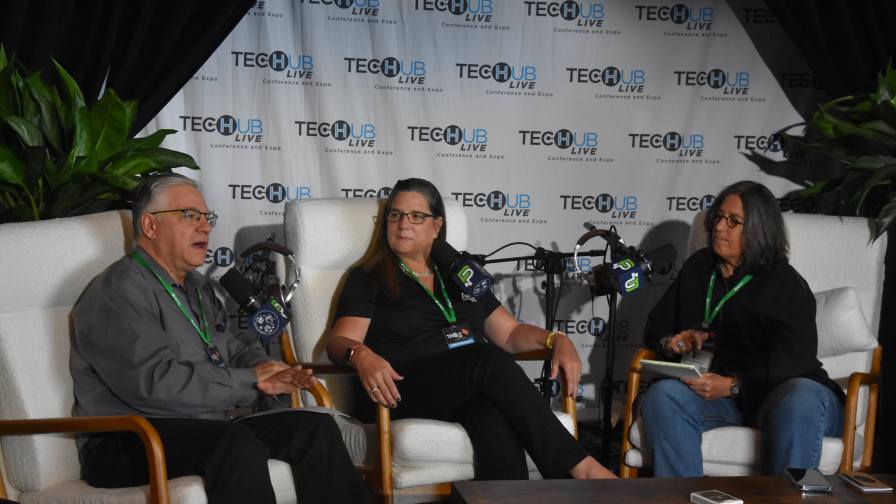
Amy Asmus (middle) of Asmus Farm Supply discusses AI in agriculture with CropLife Editors Eric Sfiligoj and Lara Sowinski during an episode of Retail Week at Tech Hub LIVE.


At this year’s Tech Hub LIVE event in Des Moines, IAI, artificial intelligence (AI) dominated the conversation — and for good reason. As ag tech rapidly evolves, the industry is grappling not only with how to integrate AI, but also how to ensure it delivers meaningful value. One of the voices helping lead this conversation is Amy Asmus, owner of Asmus Farm Supply and current Chair of the Agricultural Retailers Association (ARA), who joined us on a special edition of CropLife Retail Week.
“I always look at technology as a broad umbrella,” Asmus said during the panel discussion. “You have technologies that enhance operations — things like ERP systems and software that streamline back-office work. But I was really looking for tools that help us during the growing season, between planting and harvest. That’s where the gaps still exist.”
From ‘Garbage In, Garbage Out’ to Meaningful Insights
One familiar phrase echoed throughout the event: garbage in, garbage out. It’s a reminder that AI is only as useful as the data it’s fed. Asmus echoed this sentiment, noting that retailers have a responsibility to ensure that what they bring to growers is not just technologically impressive, but also truly impactful.
“Jeff Blair, in the keynote, made a great point: just because we can doesn’t mean we should,” she said. “I ask myself three questions when evaluating any new technology — ‘What is it?’ ‘So what?’ and ‘Now what?’ If we can’t answer those, then we’re probably wasting time and resources.”
Asmus pointed to vendors like Emergent, which showcased a promising Internet of Things (IoT) framework designed to aggregate real-time sensor data to inform decision-making mid-season. “They’re partnering with a lot of sensor providers,” she noted. “If you’ve got a sensor that could benefit growers, you need to talk to them.”
Not All Growers Are the Same
When it comes to AI adoption, Asmus emphasized a critical point: one size does not fit all.
“We often talk about ‘the grower’ like they’re a single type of person. But in reality, growers vary dramatically in their appetite for data and technology,” she explained. “Some are enthusiastic early adopters. Others feel overwhelmed — or even threatened — by the flood of new data.”
She shared a recent experience with a grower who asked to review his field maps. After a detailed walk-through, the grower admitted, “I don’t know if I can do this again next year — it makes me feel unwise.” Asmus said this underscores the need for ag retailers to approach AI adoption with empathy and segmentation.
“You have to tailor your approach. Not every grower wants or needs the same data in the same way,” she said. “As trusted advisors, we should be solving problems — not just selling another revenue stream.”
Small Gains, Big Wins
While much of the excitement around AI focuses on its revolutionary potential, Asmus and others at the event noted that incremental improvements often deliver the biggest impact.
“One speaker shared a great example,” recalled CropLife Editor Lara Sowinski. “They reduced the time it takes a retailer to look up label information from three minutes to 15 seconds using an AI-powered tool. Multiply that across a season and it becomes a huge time saver.”
Asmus agreed: “Sometimes, it’s those ‘cracked black’ efficiencies — those little wins — that really add up.”
Looking Ahead: The AI Journey
Reflecting on how much the conversation around AI has matured since last year’s Tech Hub LIVE, Asmus is optimistic — but realistic — about what lies ahead.
“Last year, AI was still theoretical for many people. Now, it’s being used. But it’s a process,” she said. “We’re figuring out what sticks, what’s useful, and what’s not. The role of the retailer is to be a filter and a guide.”
As AI continues to evolve, Asmus remains focused on the fundamental question: Does it help the grower? If the answer is yes, she’s ready to explore it. If not, she’s not afraid to walk away.
“We’re here to solve problems, not just dazzle with tech,” she said. “At the end of the day, if the grower doesn’t care, why should we?”
Stay tuned to CropLife for more insights from Tech Hub LIVE 2025 and beyond as we continue exploring the intersection of agriculture and technology.

For more Smart Tech topics, click here.
Subscribe Today For
