The CropLife 100 Mid-Year Report: Corn Returns As Star Performer, Smart Tech Steps Into the Spotlight in 2025
 June 18, 2025
 By now, the 2025 growing season is fully underway. But what will this mean for ag retailers and their grower-customers in terms of market forces? Using a Hollywood-style analogy, which crop inputs will be called to “action!” and which ones might end up being “cut?”
To find some possible answers to these questions, CropLife® magazine has once again asked “in-the-know directors” — namely, the nation’s top ag retailers — for their views by conducting our 9th annual CropLife 100 Mid-Year Survey. As always, the answers were equal parts “blockbuster” and “bomb.”
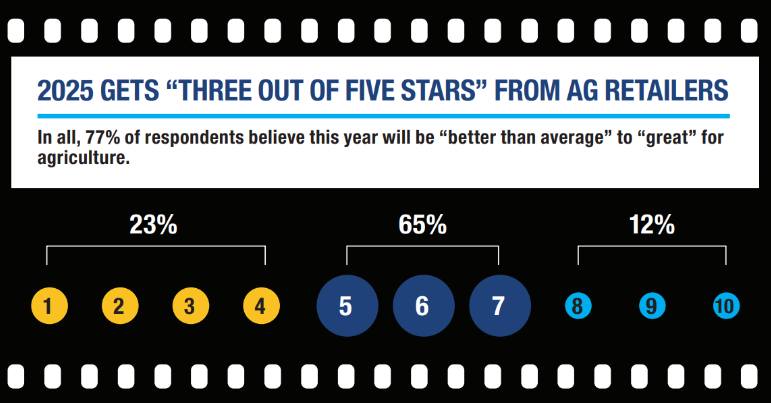
As we have done each year since the inception of this survey, CropLife started out by asking the nation’s top ag retailers their overall outlook on the 2025 growing season based upon the market performance through the spring field work/planting time. This was accomplished by asking respondents to rate the year so far on a scale of one to 10 — with one being “worse than expected” and 10 being “better than expected.” And overall, this year seems like it could be a “hit” with ag retailers. A little more than seven out of 10 (77%) survey respondents rated the year so far between a five and a 10.
Source: 2025 CropLife 100 Mid-Year Survey
Broken down a bit further, 65% of the nation’s top ag retailers said the 2025 growing season rates between a five and seven on their 10-point scale. Another 12% indicated the year so far rates as an eight to 10 in their regions of the country.
Still, compared with the findings from the 2024 CropLife 100 Mid-Year Survey, this represented a 9% decrease from the 86% of respondents that said last year rated between a five and 10. Significantly, 23% of respondents are rating the 2025 growing season between a one and a four — just a hair shy of double the 14% of 2024 survey respondents that believed the growing season would be a “box office bomb.”
The “Actors Pool” Grows a Bit
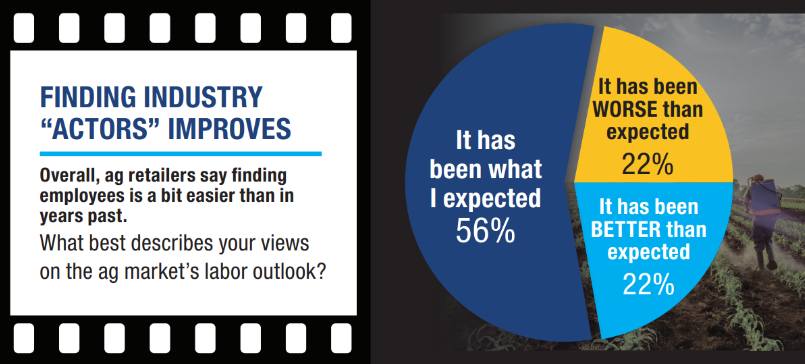
For almost as many years as the CropLife 100 rankings have existed, finding/keeping “industry actors” (a.k.a. labor) has been one of the major issues most ag retailers have faced year in and year out. In fact, according to the 2024 CropLife 100 survey, 26% of respondents rated finding/keeping a workforce as their No. 2 issue of concern during the 2024 calendar year (trailing only price volatility). But it seems things have changed for the better on this front during the current growing season.
Source: 2025 CropLife 100 Mid-Year Survey
When asked to describe the current ag market’s labor, a majority of respondents — 56% — said the situation is “about what we expected” for the 2025 growing season. Still, 22% of respondents said their labor issues were “much worse than expected” thus far for the 2025 growing season. However, this represented a slight downgrade compared with the 2024 CropLife 100 Mid-Year Survey results, when 29% of respondents reported that this was their workers’ quest situation. Even better, 22% of ag retailers said that finding workers to man their operations was “better than we expected” so far this year. This represented an incredible 13% improvement from the 9% in the 2024 survey that said finding/keeping workers was easier than they had anticipated.
Besides labor, one other “industry genre” often viewed during the 2024 growing season was the rapid advancements being made in the area of Smart Tech. For the middle of 2024 onward, many equipment manufacturers have invested heavily in bringing new technologies such as autonomous vehicles, drones, and artificial intelligence (AI)-based systems to the market.
However, despite all these well-publicized advances in Smart Tech, many of the nation’s top ag retailers have remained less than enthusiastic that these products offer “blockbuster potential.”
Until Now, That Is.
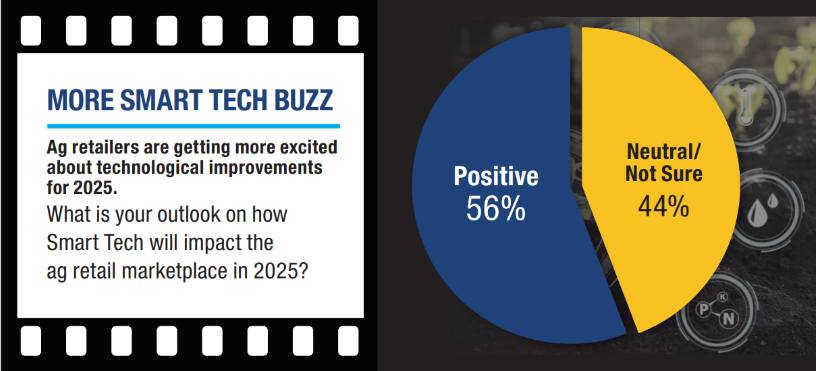
To gauge how the nation’s top ag retailers feel about the prospects these technology systems might offer in the way of innovation and worker assistance, the 2025 CropLife 100 Mid-Year Survey asked what kind of impact these new offerings will have on their company operations during the 2025 growing season. Overall, 44% of respondents remained “neutral” or were “not sure” in their views on this technology. However, a majority of respondents — 56% — believed Smart Tech would have a “positive impact” on their operations this year. Perhaps more significantly, absolutely no respondents to the 2025 CropLife 100 Mid-Year Survey said these new technology innovations would have a negative impact on their companies.
Source: 2025 CropLife 100 Mid-Year Survey
As far as what types of Smart Tech the nation’s top ag retailers plan to invest in during the 2025 growing season, there was one clear “top draw.” Overall, 65% of respondents indicated their companies planned to purchase AI-based systems this year. Another 29% planned to make drones their Smart Tech of choice in 2025. And 6% planned to invest in autonomous vehicles this year.
Source: 2025 CropLife 100 Mid-Year Survey
Fertilizer Winning Box Office; Crop Protection Not So Much
Each year since its inception, the annual CropLife 100 Mid-Year Survey has tried to gauge which of the four key crop inputs/services categories — fertilizer, crop protection products, seed, and custom application — have performed in the early going of a particular growing season. So far, there is one crop inputs “drawing rave reviews” from ag retailers for the 2025 growing season. And the other three are gaining “mixed critical comments.”
According to the majority of 2025 CropLife 100 Mid-Year Survey respondents, one category is leading the way in a positive performance thus far this year. Based upon the survey results, 65% of respondents say fertilizer has been the category that has “performed the best” for them during the 2025 growing season. Placing a distant second and third place were crop protection products at 18% and seed at 17%.
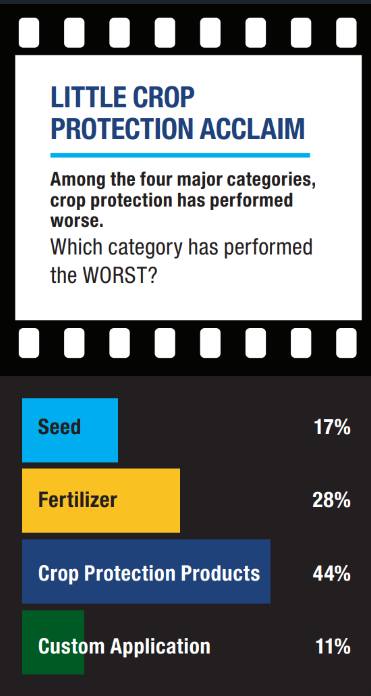
As far as which of the four major categories have performed “worse than expected” so far during 2025, one category has clearly not “resonated with audience” thus far this year. According to 44% of respondents, crop protection product category sales were performing “worse than expected.” The remaining three categories also got votes on this question, with 28% of respondents saying fertilizer sales were “worse than expected” in 2025, 17% saying seed sales were worse than expected, and 11% describing their custom application sales as “down.”
In addition to tracking the performances of the “A listers” among crop inputs, the annual CropLife 100 Mid-Year Survey also looks at how some of the “supporting actors” have performed during the early going of the year. In most years, the micronutrients category tends to be the “Oscar winner” according to respondents.
And this remains the case in 2025. According to the survey, 47% of respondents said that the micronutrients category the “star” for them this growing season. But this is down significantly from the 2024 survey, when 62% of respondents said micronutrients were their best smaller category performer.
Source: 2025 CropLife 100 Mid-Year Survey
In second place among the smaller categories in performance in 2025 is the adjuvants category, mentioned by 23% of survey respondents as their “top performer.” Rounding out the “top smaller category performers” for the nation’s top ag retailers in 2025 are precision agriculture services at 18% and seed treatments at 12%.
Corn Becomes the Lead Actor
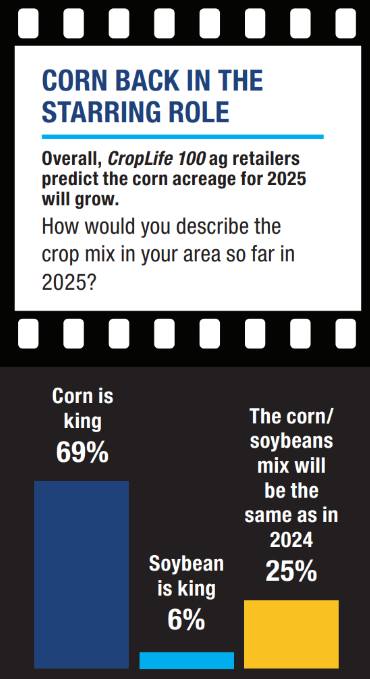
As far as the expected crop mix for the 2025 growing season is concerned, the nation’s top ag retailers believe corn will re-emerge as the “lead actor” among crops. According to the 2025 CropLife 100 Mid-Year Survey, respondents think that corn will once again become the “king” among crop types planted, with 69% foreseeing an acreage increase for maize. USDA statistics would seem to support this fact, with the end of March crop forecast from the government agency predicting 95 million acres of corn being planted during the 2025 growing season.
Significantly, only 6% of respondents to the 2025 CropLife 100 Mid-Year Survey predicted that soybean acreage would surpass corn’s during this calendar year. The remaining 25% forecast no acreage changes from the 2024 crop planting figures.
Subscribe Today For
