Biological Seed Treatments Poised for Growth
 November 10, 2025
 For almost a decade now, biologicals have grown in importance among ag retailers and their grower-customers on the crop protection side of the business. So, it’s only natural that this trend should spill over in the seed treatment category as well.
“As more and more growers search for practices, products, changes in operations, etc., that can bring the next bump in overall yield, a lot of eyes are going to biological products,” says Dr. Wilks Wood, Technical Specialist Representative, East Region, at Verdesian Life Sciences.
Kurt Seevers, Technical Development Manager, Seed Treatments & Inoculants at Verdesian, agrees.
“Opportunities exist in biological seed treatment products that can add that consistent return-on-investment (ROI) for retailers and growers,” says Seevers. “This can come from products that enhance the ability of the plant to utilize nutrients more efficiently or provide access to nutrients that may not be otherwise available.”
However, Seevers acknowledges that interest in biological seed treatments might have suffered a bit during the 2025 growing season. This is due to a pair of issues — lower commodity prices and performance issues for some products.
“Consistency of performance and ROI continue to be factors in adoption of these products,” he says. “There are good products on the market, but it can be difficult for retailers and growers to sort the chaff from the grain.”
Proven Products
To address these concerns, says Seevers, Verdesian does extensive testing on its biological seed treatment products such as Preside Ultra and Accolade.
“Verdesian is producing rhizobia inoculants that interact with legume crops to provide the large amounts of nitrogen needed by these plants,” he says. “Instead of just adding another bug to the mix that the plant has to interact with … we look for ways to provide that enhancement to the basic benefit provided by the primary biological component in the product.”
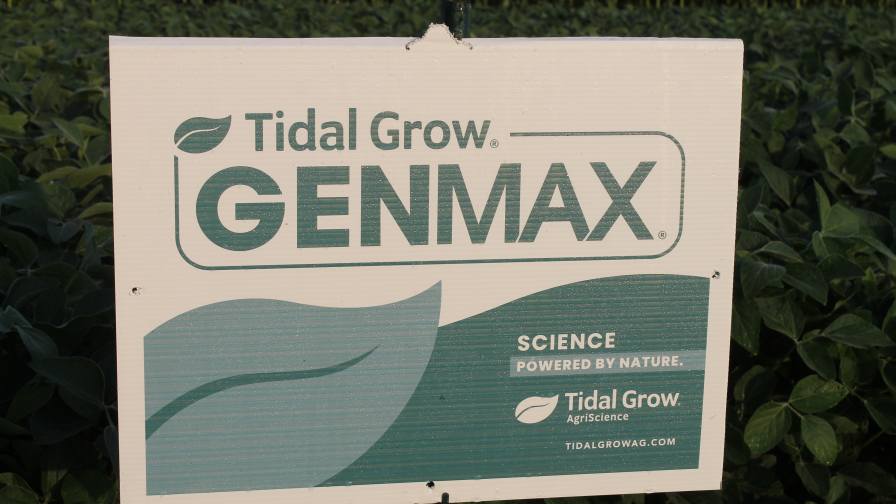
GenMax is formulated using chitosan, an active ingredient derived from shellfish.
Another biological seed treatment is GenMax from Tidal Grow. According to Levi Tipton, Seed Treatment Account Manager, GenMax is formulated using chitosan, an active ingredient derived from shellfish.
“GenMax offers seed treatment users a different mode of action in their seed care programs,” says Tipton. “It can be used to control such diseases as pythium and fusarium.”
From Corteva Agriscience, the company is introducing Lumidapt Valta LS for the LumiGEN corn seed treatment portfolio. According to Brad Van Kooten, Marketing Leader, Seed Applied Technologies, Pioneer Seeds, Lumidapt Valta LS contains lignosulfonates, which are biopolymers derived from the lignin present in the cell walls of all plants.
“The lignosulfonate found in Lumidapt Valta LS is extracted from pine trees,” says Van Kooten. “It’s a biodegradable substance that’s constantly generated by the paper milling industry.” Pending regulatory approval, Lumidapt Valta LS should be available for the 2026 planting season, he adds.
Speaking of the future, Verdesian’s Seevers predicts good things ahead for biological seed treatments.
“The future of biological seed treatments will continue to depend on the ability to provide consistent benefits to customers,” he says. “If more providers of biological seed treatments set realistic expectations and better understand the conditions under which their products will perform, the future will continue to be positive.”
Verdesian’s Wood agrees with this assessment.
“We are still learning so much about the complex system that is soil biology and the different things we can utilize to benefit growing crops,” he says. “Transparency and honesty regarding products is what will be needed to allow this market, and the biological market in general, to grow and flourish.”
Subscribe Today For
