ESA and DRA: Retailers Embrace Drift Tools As Compliance Era Accelerates

Since their initial introduction to agriculture in August 2024, the new requirements tied to the Endangered Species Act (ESA) have dominated the talk in many industry circles. During this time, numerous trade associations and industry publications — including CropLife® Magazine — have devoted much time and effort to helping explain the new ESA rules to the marketplace at large. In particular, the role drift reduction agents (DRAs) will play in this effort has been highlighted.
 2026 ESA Technical Guide to Mitigation Options
Access the full report today and ensure your organization is ready for what’s next. Download the Report >>
“Farmers and retailers have made great strides to precisely apply inputs with no off-site movement of either nutrients or crop protection products,” says Terry Kippley, President and CEO at the Council of Producers and Distributors of Agrotechnology (CPDA). “Before 2025, drift reduction and soil retention adjuvants showed up as tiny blips on a farm’s radar screen. Expect widespread adoption of these exciting new tools moving forward.”
In late 2025, CropLife and CPDA attempted to find out just how widespread the knowledge of ESA and DRAs was among ag retailers and their grower-customers. So, we decided to survey our readers to find out. Overall, the results are encouraging, but they do include some areas that could be improved upon.
Luckily, the overall knowledge of ESA is high. For the past two years, CropLife has published a pair of special reports dedicated to ESA — “The ABCs of ESA” in December 2024 and “The 2026 ESA Technical Guide to Mitigation Options” in December 2025. A third special report in this series is planned for release this December.
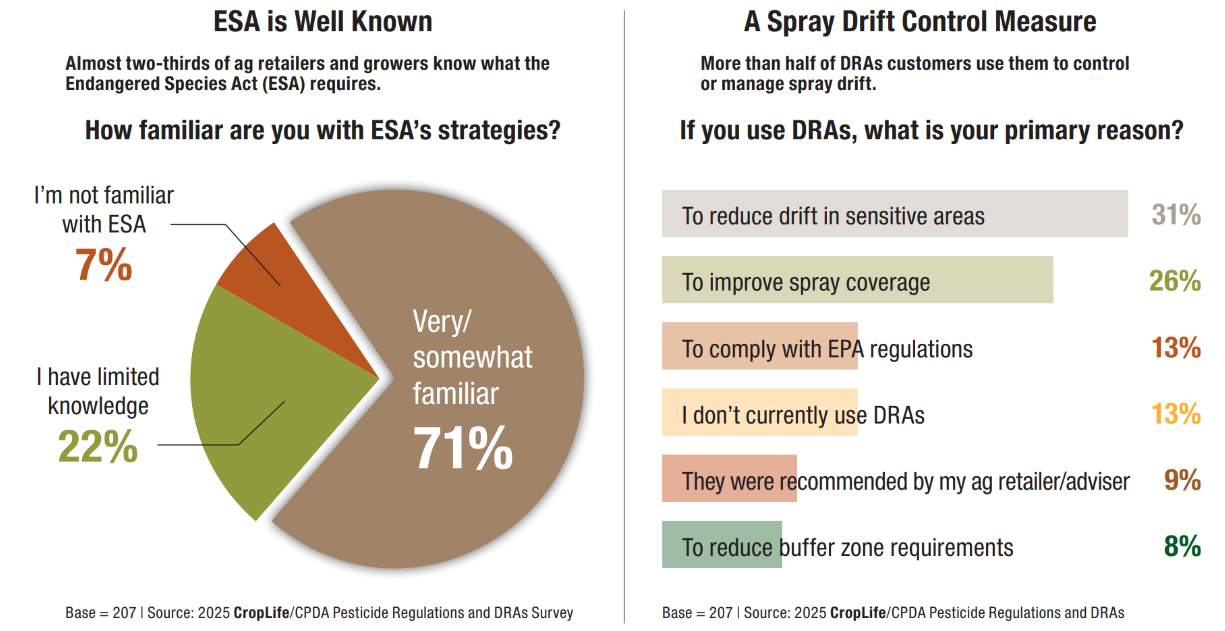
Based upon the data, these special reports and association efforts to educate agriculture about what ESA is and what it means for the industry have paid off. According to the survey, 71% of respondents said that they were either “very familiar with” or “somewhat familiar with” ESA strategies and the additional protection requirements for pesticide application they demand. Another 22% indicated that they had limited knowledge of the ESA requirements. Only 7% of survey respondents said that they were “not familiar with [ESA] at all.”
Drift Concerns Low
Perhaps part of the reason approximately one-third of respondents aren’t that familiar with ESA is that drift for them is not that big a deal. For the majority of ag retailers and their grower-customers polled by the Pesticide Regulations and DRAs Survey, drift challenges remain relatively low. In fact, 68% of respondents described the challenges they’ve faced when it comes to pesticide applications as rarely or never occurring. Only 6% said that drift was a significant issue for their operations. The other 26% described spray drift as a “minor issue.”
As for why most respondents don’t have spray drift concerns, consider the percentages that are familiar with or regularly use DRAs as the reason. When asked in the survey how familiar respondents were with DRAs, 61% said that they were very familiar with them and use DRAs regularly in their application work. Another 32% said that they were somewhat familiar with DRAs (but didn’t use them) or had limited knowledge of them and their benefits. Only 7% didn’t know what DRAs were.
DRA use also seems to be something many ag retailers and their grower-customers regularly have employed for several years without considering ESA mandates. According to the survey, 31% of grower respondents use DRAs to reduce spray drift during application to sensitive areas, while 26% use them to improve overall spray coverage. Thirteen percent of survey respondents said they use DRAs to comply with EPA regulations, while 8% used them to reduce buffer zone requirements.
Interestingly, 9% of survey respondents said that they were using DRAs based upon the recommendations of their ag retailers and crop advisers. The remaining 13% said that they didn’t use any DRAs in their application operations.
Some Barriers Remain
For those ag retailers and growers not using DRAs, the two major reasons cited were cost and a lack of education. According to 31% of survey respondents, cost concerns were their No. 1 reason for not using DRAs in their application work. An equally large percentage — 35% — said that their understanding of how and if such products actually reduce spray drift was their major barrier to adoption. This split between those respondents that were uncertain about the effectiveness of DRAs (20%) and those who said that their lack of knowledge about such products was keeping them from using DRAs (15%).
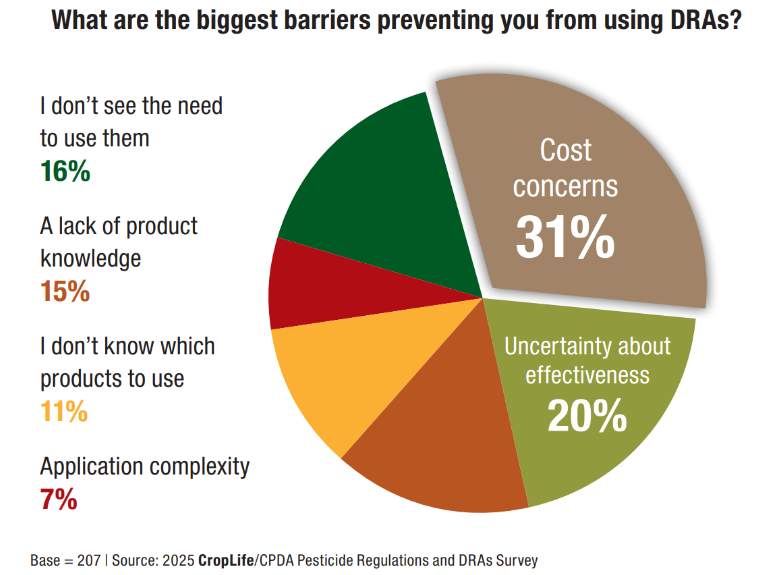
Other reasons cited by survey respondents for not using DRAs included not knowing which products they could use at 11%, and 7% that said application complexity was holding them back. Sixteen percent indicated that they didn’t see the need to use DRAs in their application operations.
In terms of what would convince non-users of DRAs products to give them a try, survey respondents again cited education and cost assistance as prime motivators. According to the survey, 51% of respondents would be more likely to adopt DRAs into their operations if they had demonstrations of their effectiveness presented to them. Twenty-nine percent said that having some kind of cost-sharing program promoting DRAs use would convince them to take a chance on these products. The remaining 20% indicated that their ag retailers or crop advisers recommending DRAs would likely get them to adopt them into their businesses.
In the area of education, survey respondents definitely had plenty of ideas on how they would like to receive this information. The ideal source for this data, said 24% of respondents, was through the use of written product information fact sheets. Not too far behind was having dedicated online webinars provide information on DRAs and their use, which was cited by 19% of respondents. Eighteen percent believed that in-person DRA use workshops would be the way to go for their education of these products.
The remaining 39% of respondents had multiple ideas for how to receive education on DRAs. This included through the use of video demonstrations (13%), field demonstrations (10%), using digital tools such as mobile apps (10%), and one-on-one consultants from suppliers of these products (6%).
About the Survey
The 2025 CropLife Magazine/CPDA Pesticide Regulations and DRAs online survey was sent to readers during the fall of 2025. In total, there were 207 surveys returned with valid answers.
In terms of breakout, 46% of the respondents identified themselves as being ag retailers/agronomists/crop consultants. Another 46% said that they were farmers or producers. The remaining 8% identified themselves as manufacturers or researchers.
In terms of what regions these respondents were located in, 38% said their companies were in the Midwest, 26% were in the Mid-South, 25% were in the West, and 11% were located in the Northeast. In terms of crops serviced (where multiple answers could be chosen), 54% of respondents dealt with corn, 41% with soybeans, and 36% with wheat.
CropLife would like to thank everyone that took part in this survey. Your insights are appreciated!
Subscribe Today For
