
The Fifth R: Why Soil Biology Is the Missing Link in Nutrient Management
For decades, agronomists and growers have relied on the Four Rs—right source, rate, time, and place—to guide nutrient management. However, as Scott McElveen, Business Development Representative at Biome Makers, points out, “Those elements, while indispensable, omit one other essential component.”
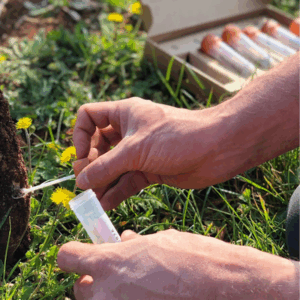
The Fifth R isn’t a gimmick. It’s a necessary evolution in managing nitrogen, phosphorus and potassium. Traditional soil tests show what is in the pantry. They don’t show what is being served to the crop. That’s where DNA-based soil biology testing comes in.
The Problem: Nutrient Loss and Bottlenecks
Nitrogen use efficiency ranges from 30 to 53 percent. That means up to 70 percent of applied nitrogen never reaches the crop. It’s lost through leaching, volatilization, or denitrification. “That’s millions of dollars of crop nutrients we’d rather be getting into the plant,” says Mark Kinsey, US Director of Sales at Biome Makers.
Even when following the Four Rs, yield maps often show inconsistent results. “You’ve got similar organic matter, slope, and CEC, and yet you’re seeing very different responses in yield,” Kinsey points out. The missing variable? Microbial activity.
The Solution: Measuring the Pipeline, Not Just the Supply
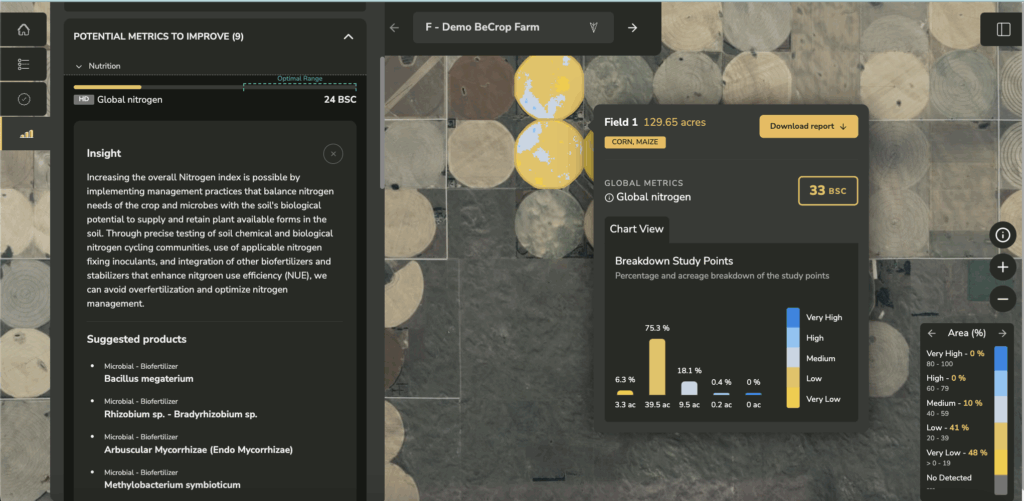
Biome Makers’ BeCrop® Technology assesses the soil’s biological ability to cycle nutrients. It identifies microbial genes involved in nutrient processes—nitrification, mineralization, immobilization—and measures their levels.
McElveen explains it metaphorically: “You can have a five-lane highway, and each car is a nitrogen atom. How many cars can you fit down your highway? Do you have a highway that can accommodate the traffic, or is it a one-lane road where nutrient transport becomes bottlenecked?”
BeCrop® doesn’t measure how much nitrogen is present. It measures how efficiently it can move through the system and into the crop.
Real-World Impact: Subfield-Level Decisions
In a Nebraska popcorn farm case study, BeCrop® identified a significant bottleneck. The southeastern field had a low capacity to mineralize nitrogen into a crop-available form, and high demand from microbes in competition for that soluble supply. “That’s a one-lane road into soluble forms and a five-lane highway back to immobilization,” McElveen notes. “Our nitrogen suppliers are only slowly able to refill the common cup in which both the crop and neighboring microbes have their straws.”
This insight allows consultants to make targeted recommendations where they will be most fruitful, such as split applications, foliar feeding, microbial inoculants, and ameliorating root causes, based on actual biological capacity, not guesswork.
Beyond Nitrogen: Phosphorus and Potassium
Phosphorus is even more elusive. Only 12.6 percent of applied phosphorus reaches crops, while the rest becomes fixed in the soil. BeCrop® identifies solubilizers that can unlock this bound phosphorus. “If you’ve got high soil test phosphorus and poor crop response, more fertilizer isn’t the answer,” Kinsey says. “There’s something else going on in the system.”
Potassium follows a similar pattern. Soluble potassium makes up only 0.1 to 0.2 percent of the total soil potassium. The rest is trapped in minerals. Microbes can release it, but only if they are present and active.
Precision Meets Biology
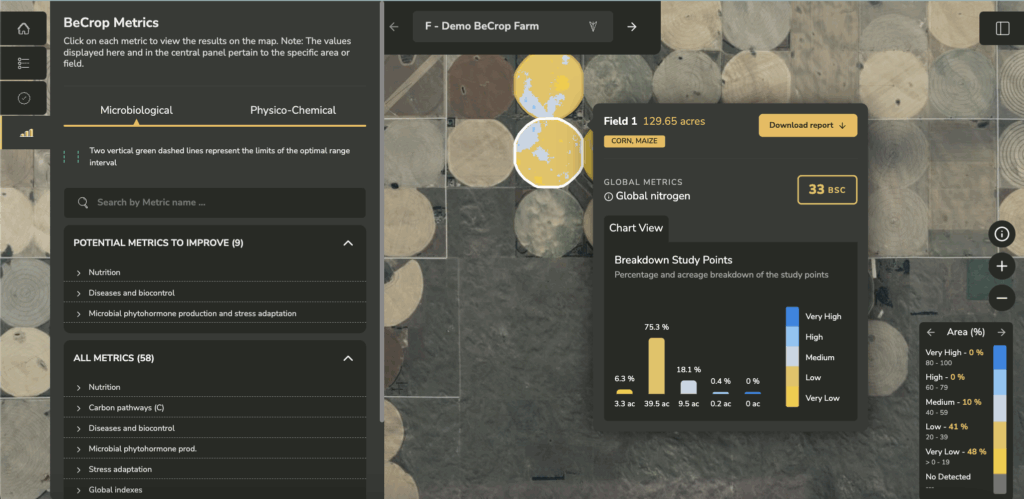
BeCrop® enables subfield prescriptions. Consultants can now identify which acres will respond to biologicals, which can more safely handle input reductions, and which need new strategies in terms of source, placement, and timing. “Every farmer manages biology whether they intend to or not,” McElveen notes. “Now we can measure it in order to manage it with open eyes.”
What to Do Next
If you’re making NPK recommendations, it’s time to integrate biology. Use BeCrop® to:
- Identify bottlenecks in nutrient cycling
- Optimize timing and placement based on microbial activity
- Reduce unnecessary inputs and improve ROI
- Target biologicals where they’ll actually work
Get started with BeCrop® Farm. Run a test. Compare fields. Make decisions based on biology, not assumptions.
Learn more here: https://info.biomemakers.com/the-missing-r-leveraging-soil-dna-for-more-efficient-npk-management