
Soil Biology Is Rewriting the Retail Playbook
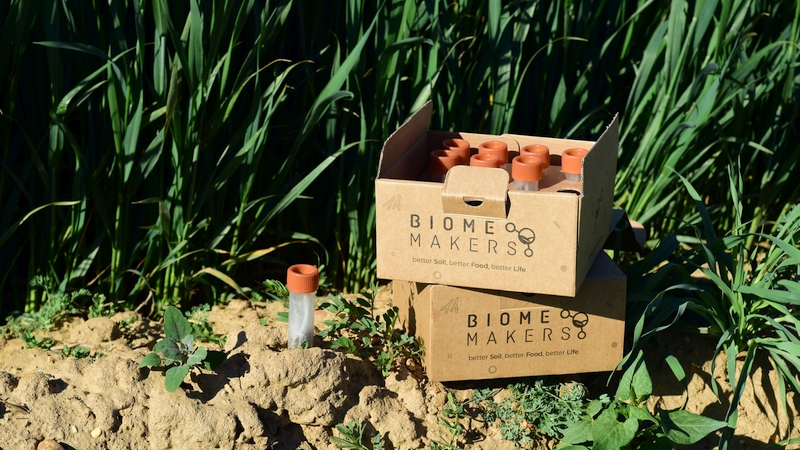
Retailers used to lead with chemistry. Today, biology and predictive analytics are changing how they advise growers and run their businesses. Mark Kinsey, Director of Sales at Biome Makers, sees it firsthand. He outlines why soil biology has moved from a niche topic to a core lever for better recommendations, stronger grower relationships, and new revenue.
Why Biology Is Driving Change
“Costs are high. Margins are thin,” Kinsey says. “Simply cutting fertilizer isn’t the answer. Getting away from fertilizer isn’t the answer either. The question is how to marry what we know about chemistry with what we can now measure in biology.” He points to long-familiar agronomy concepts like mineralization and immobilization. Those terms have floated around for decades. What is different now is the ability to quantify the underlying processes. “For the first time, we can examine how nitrogen and phosphorus move and interact in the soil, and translate that into specific, measurable metrics,” he explains.
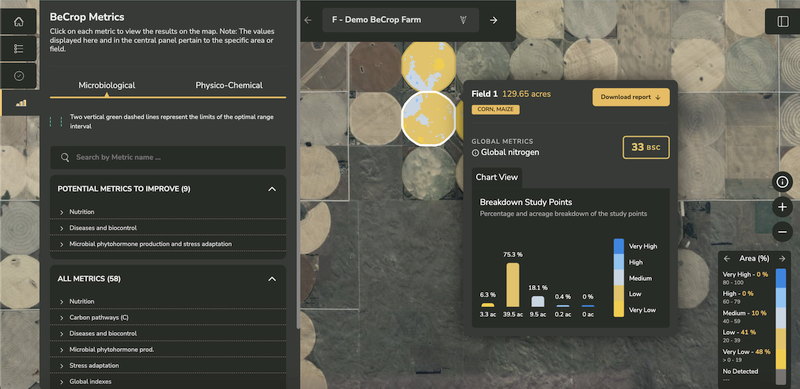
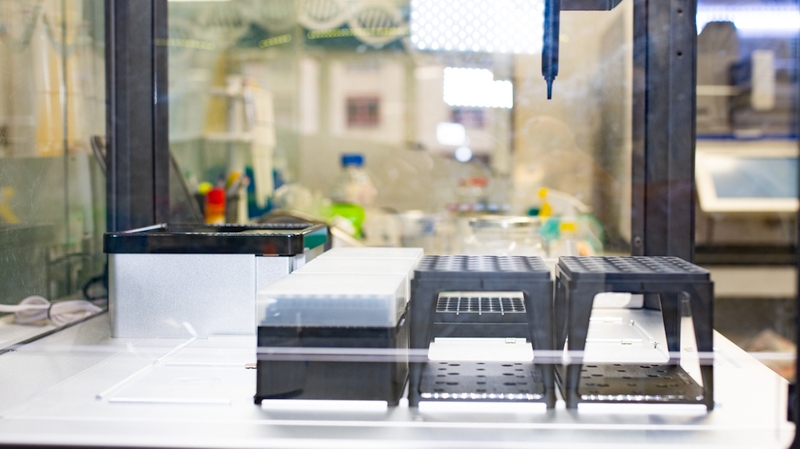
This capability comes from BeCrop® Technology, Biome Makers’ proprietary platform that uses DNA sequencing and AI to decode the soil microbiome. It identifies functional pathways for nutrient cycling, disease suppression, and soil health, giving retailers and growers actionable insights they can trust.
Sorting Signal from Noise in a Crowded Market
That shift matters because the market for biological inputs is crowded and uneven. Some products are proven; others are not, putting retailers in the crosshairs. “One retailer told me they had six people knocking on their door in a single week with a new biological,” Kinsey notes. “It has become imperative to understand how the biological works, what it is affecting, and to make sure it is a good fit on the acre.”
BeCrop® Trial helps solve this problem by scientifically validating product performance. Retailers can trial biologicals and measure their impact on soil function before scaling recommendations. This evidence-based approach reduces risk and builds confidence in product placement.
Predictive Analytics and Placement
To make sense of options, Kinsey emphasizes trialing and placement, not blind adoption. He compares the process to hybrid selection. “You might have twenty hybrids in a lineup. The value is not only knowing where the best hybrid goes, but it’s also knowing where not to put something, so you avoid a lack of return.” Predictive analytics help retailers match inputs to the field conditions where they perform, down to subfield zones. “We have a very clear, demonstrable way to bring cloud computing, AI, and machine learning together so growers and retailers can place products where they make the most sense,” he says.
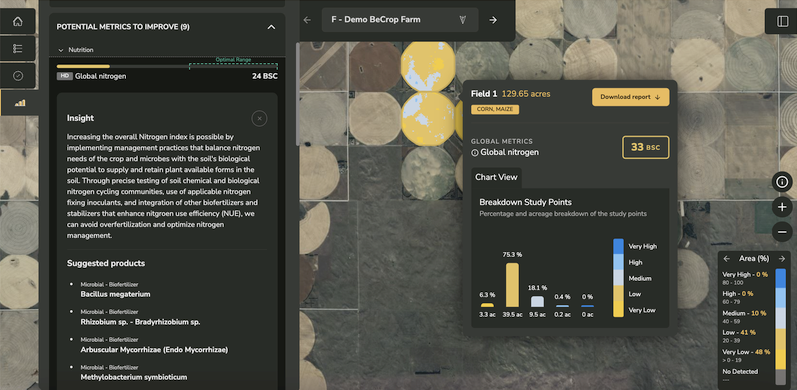
BeCrop® Farm operationalizes this concept. It combines microbiome data with predictive models to deliver prescriptive maps and recommendations at the subfield level. Retailers can use these insights to optimize fertility, disease management, and biological input placement for maximum ROI.
Data as Relationship Currency
Data is not just technical fuel; it is relationship currency. Retailer-grower trust rises or falls on transparency. Kinsey is direct on this point. “Honesty is the cornerstone. We are going to try things, and in some places they won’t work. That is not a loss, it is a learning moment.” The key is a shared process for reviewing conditions, hypotheses, and outcomes. Did a practice reduce fertilizer use at the same yield? Did it improve yield? Did it reduce disease risk? “There are a whole host of ways to define success,” Kinsey notes. “Set realistic expectations, be honest with each other, and if it didn’t work, figure out why.”
How Recommendations Are Changing
That approach is reshaping recommendations. Retailers are moving beyond chemistry-only models to integrated fertility and disease strategies. Kinsey gives a practical example from fields where yields lagged without a clear cause. Traditional tests did not flag a fertility issue, and good hybrids were already in place. “Our DNA testing identified disease loads and pathogens that were potentially causing problems,” he says. With that clarity, retailers could target disease management rather than overcorrecting with nutrition.
He also describes how pairing biology with traditional soil tests can simplify decisions at the field level. Think of a simple four-quadrant view. Fertility good, biology good. Fertility good, biology limited. Fertility limited, biology good. Fertility limited, biology limited. “The reality is that three of those quadrants are where most acres sit,” Kinsey says. “Some need fertilizer and a biological amendment. Some truly need fertilizer. Others have acceptable fertility, and it is a biological limitation holding the next yield level back.”
Commercial Upside for Retailers
For retailers, this is not just an agronomy upgrade. It is a business model shift. When they bring quantified insights to placement and performance, they earn trust and create repeatable service value. That translates to stickier relationships and more resilient margins. Products stop being one-off transactions. They become parts of a data-driven plan tied to measurable goals and documented results.
Kinsey believes the near-term commercial opportunities are straightforward. Start with nutrient use efficiency and cost control. “If we manage fertilizer better, we get better use efficiency and better control of costs,” he says. From there, add practices and inputs that align with the field’s biology, not just generalized recommendations. As teams become fluent in the interplay between soil biology and chemistry, other decisions improve. “Hybrid and variety recommendations, seed treatments, the whole system,” Kinsey notes. “As we learn that, soil health and regenerative practices get pulled along because you are solving real problems.”
Practical Steps to Get Started
The practical question for retailers is where to begin and how to scale. Kinsey’s guidance is to stay focused on evidence and placement. Trial inputs in representative zones. Measure biological and agronomic responses. Share the data openly and review it with growers. Identify the situations in which a product delivers positive ROI and those in which it does not. Use that clarity to position inputs with confidence, then build service programs that combine sampling, analytics, and season-long decision support. Over time, codify patterns into your advisory playbook so new reps and new growers can benefit without starting from scratch each season.
Retailers who take this path also build a defensible advantage in a noisy market. They can sort high-value products from hype. They can defend recommendations with field-level metrics. They can maintain margins by selling outcomes rather than discounts. Most importantly, they can strengthen relationships by leveraging shared data and clear expectations rather than vague promises.
Kinsey keeps returning to the discipline that makes this work. Try. Measure. Learn. Decide. “Every year, something on the farm has to lose,” he says. “Not every hybrid is going to be number one. The important thing is to be honest about the outcome and understand if it worked in a subset of the field that was underrepresented.” That level of nuance is exactly what predictive analytics and soil biology insights are built to expose.