
Beyond Chemistry: The Future of Soil Testing
For decades, soil testing has relied on chemical extracts and tables of nutrient availability. Those tools advanced agriculture and helped growers make decisions, but they also left critical gaps. Farmers often asked the same questions: Why do crops sometimes fail to respond to applied fertilizer? Why do deficiencies appear even when test numbers look sufficient?
The evolution of soil testing is beginning to answer those questions. As Lance Gunderson, President and Co-Owner of Regen Ag Lab, LLC, explains, “Doing it wrong the same way every time is not helping either. The extracts we’ve used got us a long way, but the question is, what’s the next step?”
That next step combines chemistry with biology, then layers in predictive technology to give growers a clearer picture of what is happening in their fields.
The Chemistry Foundation
Soil fertility testing emerged commercially in the years after World War II alongside the expansion of the fertilizer industry. Extractants like Bray P1, Olsen, and Mehlich 3 were designed to pull nutrients out of soil so labs could measure plant-available forms.
“These methods absolutely progressed agriculture,” Gunderson notes. “They helped producers understand what they had in the soil and make decisions on what to apply.”
But every extract had limitations. Mehlich 3, for example, became dominant in the United States but cannot accurately measure nitrate and ammonium because it is itself made of ammonium nitrate. Labs had to add separate tests for nitrogen. On high pH soils, Mehlich 3 often overestimated phosphorus availability.
That drove researchers like Dr. Rick Haney to explore new approaches. He developed the H3A extract with a simple goal: mimic the natural soil environment. Instead of forcing nutrients out with strong acids, H3A uses organic acids that plants themselves release into the rhizosphere. “Haney wanted an extract that would not overpower soil pH and would include nitrate and ammonium in a single test,” Gunderson explains.
The Haney test evolved through multiple versions until it achieved strong correlations with conventional extracts while avoiding the distortion of soil chemistry. It does not provide the same absolute numbers but reflects what plants and microbes access.
That shift matters. “If you run Mehlich 3 on a calcareous soil, phosphorus might look adequate,” Gunderson says. “But the crop shows deficiency. H3A gives you the number that explains why.”
Adding Biology to the Picture
Chemistry alone cannot explain why two fields with the same nutrient levels perform differently. Biology is the missing link.
 “Microbes are the gut of the soil system,” Gunderson explains. “They are the forklift operators and truck drivers moving nutrients from the warehouse to the plant.” Fertilizer may stock the warehouse, but without microbial activity, distribution stalls.
Scott McElveen, Business Development Representative at Biome Makers, emphasizes that DNA sequencing has opened a new window into this microbial workforce. “With soil DNA testing, we can identify the organisms present and, more importantly, what functions they perform,” he says. “We can tell you which organisms are solubilizing phosphorus, which are cycling nitrogen and which are suppressing disease.”
That functional mapping turns long lists of microbial names into actionable insights. Instead of knowing that a particular genus is present, growers learn whether their soils have the capacity to mobilize potassium or protect roots from pathogens.
The Predictive Leap
Even with advanced biology tools, one challenge remained: spatial variability. How can a handful of soil samples represent hundreds of acres with different slopes, textures, and microclimates?
Biome Makers approached that problem with machine learning. Using thousands of geo-referenced soil samples and over a thousand environmental data layers, they developed algorithms to cluster fields into biologically similar zones. Sampling then strategically targets those zones, representing a field’s variability with fewer, more meaningful points.
“It’s like clustering movies by genre,” McElveen explains. “The algorithm groups similar 10-by-10-meter patches of soil together. Then we sample proportionally from each cluster. That lets us characterize an entire landscape at a manageable cost.”
Field validation shows that the method works. In one example, 11 targeted samples produced results that were 98 percent consistent with a traditional 26-point sampling grid.
“This could not have been done five years ago,” McElveen says. “The computing power and the database just weren’t there. Now it is possible to provide sub-field level biological insights at scale.”
Why This Matters Now
Commodity prices remain volatile. Fertilizer is expensive. Growers cannot afford wasted applications or unexplained crop failures. Precision matters more than ever.
The Haney test offers a way to see what nutrients are truly accessible. Biome Makers’ BeCrop® platform shows which microbes are present and what they are doing. Predictive spatial tools bring that insight down to the acre and zone.
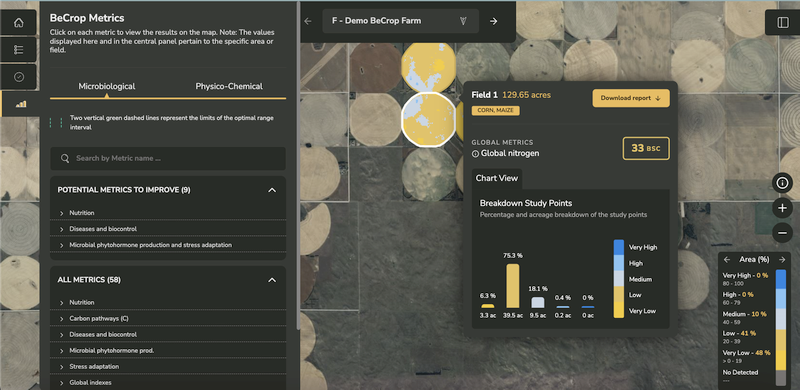
“The Haney test evaluates what you have in the warehouse and how many employees you’ve got,” Gunderson summarizes. “BeCrop® tells you what those employees actually do. You can have 10,000 forklift drivers, but if you don’t have anyone moving phosphorus, you still have a problem.”
Together, chemistry, biology, and prediction provide a fuller picture. Fertility decisions are no longer just about adding inputs. They are about understanding availability, distribution, and the biological workforce that drives yield.
The Takeaway for Growers
Soil testing is not static. It is evolving as agriculture demands more precision and efficiency. The integration of predictive biology into fertility management is no longer experimental. It is being deployed on farms now with measurable results.
Growers planning fall soil sampling should consider adding biological and predictive testing alongside conventional chemistry. The data provide clarity on when fertilizer is truly needed, when microbes are doing the heavy lifting, and where resources should be allocated.
Action step: If you are preparing to sample this season, talk with your agronomist or lab about running the Haney test and BeCrop® analysis in addition to your standard fertility test. Upload your fieldshape files to see how predictive sampling can save cost while increasing resolution.
The science is clear. Fertility is not just about what is in the soil. It is about what plants can actually use and what microbes can move. By combining chemistry, biology, and prediction, growers can put every acre to work more efficiently.
Learn more here: https://info.biomemakers.com/the-evolution-of-soil-testing