Smart Tech
From Skepticism to Savings: How AI-Powered Spraying Is Winning Over Farmers and Applicators
 July 30, 2025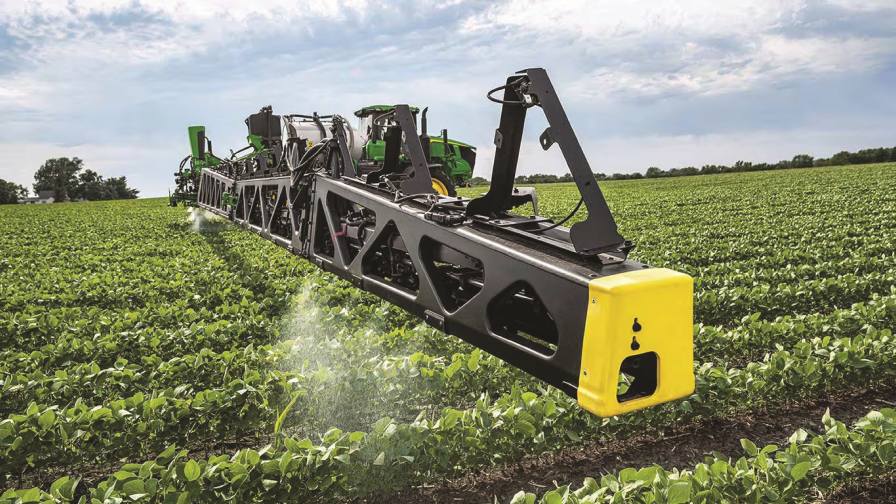
With deep learning, targeted spraying, and upgrade kits, tools like See & Spray are transforming crop protection practices across the industry.

John Deere’s launch of See & Spray technology in 2021 was an innovative milestone in AI-powered technology that activates individual spray nozzles to target weeds that boom-mounted cameras can “see.”
Since then, the company has continued to improve its technology. Meanwhile, performance upgrade kits (PUKs) that retrofit existing equipment help to support wider adoption, affordability, and accessibility of See & Spray.
The introduction of similar technologies by other OEMs are providing more options to the market while at the same time helping drive additional technology innovations.
Farmer, Applicator Feedback
RDO Equipment Co. reports that more farmers and applicators are adopting John Deere’s See & Spray to increase savings, reduce herbicide use, and achieve a quick ROI.
Over the course of one year’s time, RDO saw an increase of seven customers trying See & Spray to about 60 doing See & Spray field trials the following season.
RDO’s Mark Schaffner, Regional Sales Manager based in South Dakota, says farmers experienced a 60% to 70% savings during field trials.
North Dakota grain farmer Jared Billadeau trialed See & Spray Ultimate, the factory installed system available for John Deere’s 410R, 412R, 612R and 616R sprayers.
See & Spray Ultimate detects weeds among corn, soybean, and cotton plants. It features cameras, processors, a carbon-fiber truss-structure boom, and a dual product tank. It can also be used for traditional broadcast application, as well as targeted and traditional spray combined.
Billadeau tested the sprayer to its highest level of sensitivity.
“I might’ve been a little more skeptical on this, so I headed to the most aggressive settings you could, spraying the most it could,” he explained. “We were at about a 50-50 savings.”
As Biladeau became more familiar with the machine, he adjusted the settings and decreased the number of acres sprayed, saving about 60% of the spraying application.
“The default settings alone are going to save you a lot and there’s not going to be any skips out there, because the cameras on the sprayer are precise,” he says.
The ability to test different nozzles and sprayer calibrations for even coverage also helped Billadeau to reduce overall stress on crops.
He notes that, “I discovered that different sprayer tips may change your application.” So, “Talk to your dealer about the different options and test it out.”
For farmers and applicators who want to upgrade their current equipment, one option is the See & Spray Premium performance upgrade kit for John Deere self-propelled sprayers.
With See & Spray Premium farmers can tap into advanced See & Spray technology that targets weeds with non-residual herbicides in corn, cotton, soybeans and fallow fields. In addition, they can still use their sprayer all season long to make broadcast applications at standard operating speeds.
See & Spray Premium can be factory-installed on model year 2025+ Hagie and 400/600 series sprayers and is available as a precision upgrade on model year 18+ R-series and 400/600 series sprayers.
When the See & Spray Premium performance upgrade kit is installed on a sprayer, users can cover more acres than before on a single tank – while using targeted spray – making fewer stops to fill and using less chemical. When activated, See & Spray also generates an as-applied map that shows exactly where product was applied in the field.
Getting Smarter and Faster
Precision ag spraying systems are using deep learning for crop recognition and identification in the field, with extensive comparison of YOLO (You Only Look Once) based models for crop detection.
Over time, the systems are getting better at distinguishing between crops and weeds by analyzing thousands of images and identifying subtle differences in leaf shape, color patterns, growth characteristics, and spatial relationships. This training enables the systems to make split-second decisions about where to spray.
AI-powered systems can also process visual information at speeds that allow effective operation at normal spraying speeds (10 to 15 mph), scanning and making spray decisions for thousands of plants per minute.

For more Smart Tech topics, click here.
Subscribe Today For
