Smarter Spreading: How Precision Tech Is Redefining Fertilizer Application
 April 20, 2026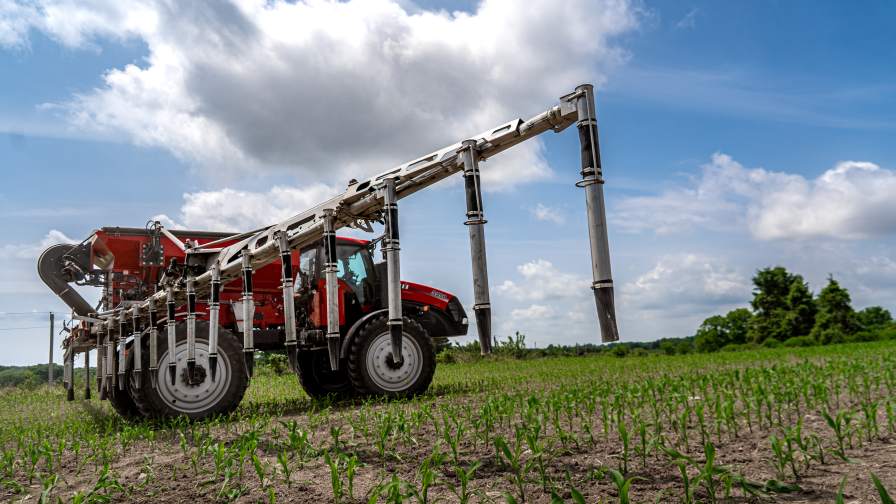
Drop tubes for the Salford AB230CD spreader are just one of the innovations the company has introduced in recent years. Photo: Salford Group
Across all of agriculture, the key buzzwords for technology involve such terms as artificial intelligence (AI), autonomy, and internet of things (IoT).
In the world of fertilizer spreaders, smart tech has also been at work for a couple of years now. In fact, during the early 2020s, companies such as Raven Industries did dabble in autonomous spreaders with its OMNIPower model.
Technology is also expected to play an important role in fertilizer spreader development going forward as well.
“Advancements in precision ag are fundamentally changing how growers think about fertilizer — from a fixed cost to a controllable lever,” says Cole Daily, President of New Leader Manufacturing. “With access to high-resolution field data, yield maps, soil sampling, and advanced precision tools, growers are moving away from uniform application and toward targeted nutrient placement. The mindset is shifting from ‘apply by average’ to ‘optimize by zone.’”
Still, according to Anson Boak, Manager of Marketing at Salford Group, many components that currently make up the Smart Tech segment are not necessarily where fertilizer spreaders manufacturers are focusing their efforts.
“At Salford, our priority isn’t adding AI directly to spreaders. It’s ensuring our machines can accurately execute the increasingly detailed prescriptions generated by today’s advanced rate control and mapping systems,” says Boak. “Our focus is on mechanical precision, responsiveness, and consistent performance across operators — giving retailers dependable accuracy, stronger as applied documentation, and fewer reapplications.”
Irregular Fields
Salford’s new fertilizer spreaders, including the SS400+ spinner spreader, feature 12-section swath control.
“Our latest applicators use independent left and right side metering to increase application accuracy and match the prescription as closely as possible, even in irregular fields,” says Boak. “This improves field uniformity, reduces overapplication on headlands, and helps operators of any experience level deliver consistent results.”
However, down the road, Boak foresees more smart tech becoming part of the fertilizer spreader products marketplace.
“We expect wider, more precise, and more automated application to continue becoming the norm as retailers push for efficiency, labor support, sustainability, and better documentation,” he says. “While we refine today’s systems, we’re already developing our next leap forward to ensure dry spreaders keep pace with the precision demands of modern fertilizer businesses.”
At New Leader, Daily says the company is focused on making fertilizer spreaders such as its NL7 more in tune with smart tech requirements.
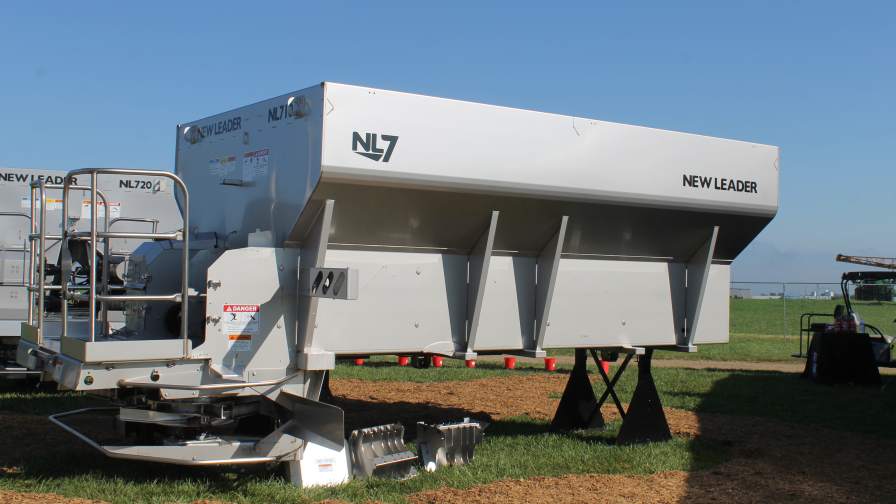
The NL7 offers precise rate control, applying nutrients exactly as intended, according to New Leader.
“Spreader platforms like the NL7 act as the execution layer of precision agriculture,” he says. “They translate digital prescriptions into consistent, repeatable field performance. With precise rate control, stable spread patterns, and accurate placement, nutrients are applied exactly as intended, reducing variability and giving growers confidence that their data-driven decisions are being realized in the field.”
Down the road a bit, Daily believes that smart tech will become a much bigger part of the fertilizer spreaders marketplace.
“The next wave of impact will come from integration and intelligence,” he predicts. “Real-time sensing, machine-to-machine communication, AI-driven prescriptions, and greater automation will tighten the feedback loop between crop response and application decisions. Over the next five to 10 years, these technologies will significantly improve efficiency in fertilizer use and overall crop input management.
Subscribe Today For
