Smart Tech
Why 2026 Must Be Agriculture’s Physical AI Tipping Point
 January 25, 2026
 Editor’s note: “Cultivating Tomorrow” is a special series that shares insights from C-suite executives at leading AgTech companies, presented by AgTech PR. Its aim is to highlight the experiences of AgTech leaders driving agricultural transformation today. In this installment, Tim Bucher, CEO & Co-Founder at Agtonomy, discusses why 2026 must mark agriculture’s physical AI tipping point, scaling autonomy from demos into food infrastructure.
For decades, CES was about bigger TVs and thinner phones. Now, the most consequential “consumer electronics” on the floor are tractors and implements running physical AI — intelligence that doesn’t just live in the cloud but rides on steel, rubber, and hydraulics to get real work done. In 2025, physical AI in agriculture proved it could work; 2026 is the year we run out of excuses not to deploy it at scale.
While prototypes are celebrated under the Vegas lights, the farmers who need them most are too often stuck waiting in line back home. At the same time, more than 280 million people face acute food insecurity in nearly 60 countries. Physical AI on farms isn’t a cool demo — it’s part of whether agriculture can keep up with demand as skilled labor shrinks and climate volatility rises.
As 2026 begins, the question is no longer whether autonomy works in agriculture, but whether leaders — OEMs, ag retailers, input companies and agtech startups — will scale it responsibly and fast enough. This should be remembered as the moment agtech stopped “experimenting” with physical AI and started treating it as core food infrastructure.
To keep pace, agtech leaders should:
- Frame physical AI as critical food infrastructure; measure progress in production acres autonomously managed, not prototype counts.
- Build deep partnerships with OEMs and growers so solutions are robust, financeable, and serviceable.
- Design for real jobs first — the repetitive, labor-intensive tasks that crush budgets and morale — then expand into more delicate operations.
- Invest in people, creating clear pathways for agtech operators and new rural tech careers so autonomy becomes a magnet for younger talent — that is so desperately needed in ag — and not a threat.
Physical AI: Critical Infrastructure for Future Food Production
Most people know AI from the generative side — systems that write emails, answer questions, or create images. Physical AI puts that intelligence to work in advanced equipment deployed in the real world — in fields, orchards, and vineyards — where conditions change by the second.
When AI can see, think, and act through machines on the farm, growers gain a 24/7 partner that helps them do more with less while improving consistency and sustainability. On a tractor, that means perceiving the environment — rows, posts, trees, people, animals, obstacles — deciding how to respond by changing the behavior of the machine, and executing the work (mowing, spraying, hauling) while continuously adjusting for quality, safety, and efficiency.
These “on‑farm copilots” don’t just perform tasks; they capture rich data on every pass, building a feedback loop that improves decisions over time. The future of food production will be driven by physical AI that is trusted, safe, and designed hand‑in‑hand with farmers — not something that expects growers to become software engineers or vice-versa.
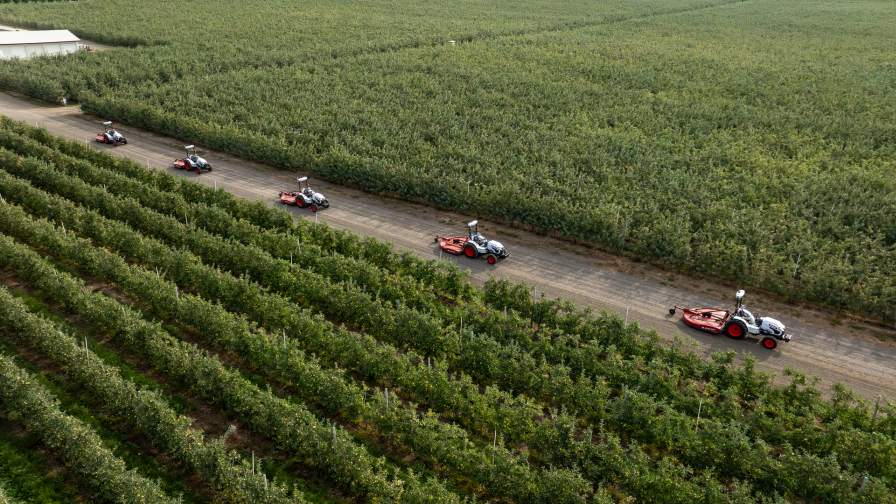
Physical AI in specialty crop automation is now on the main stage as a pillar of sustainable, resilient food systems from farm to fork.
Specialty crop growers are under pressure from every direction: labor shortages, extreme weather, rising input costs, and expectations to produce more with fewer resources.
The news from CES 2026 is that agriculture is no longer an afterthought in this conversation. Physical AI in specialty crop automation is now on the main stage as a pillar of sustainable, resilient food systems from farm to fork.
How Incumbents and Startups Win Together
The most interesting booths at CES this year belonged to companies many of us have known our whole lives: Kubota, John Deere, Caterpillar, Doosan Bobcat, and others. They are no longer “iron companies.” They are technology companies, too.
That matters for agtech founders because tier‑one OEMs bring three things the sector cannot scale without: incredibly designed and manufactured equipment built to survive real farm abuse, dealer networks that understand uptime is the difference between profit and loss with service and parts support, and financing that makes advanced equipment accessible to growers.
Our strategy at Agtonomy is to be an ingredient brand — “Agtonomy-Enabled” — providing the physical AI stack that turns proven platforms like the Kubota M5N-112 specialty crop tractor into fully autonomous “robots.” This model lets us stay focused on what we do best while leveraging the reach, manufacturing, and support capabilities of established players. For founders, the message is simple: you won’t win by trying to be everything; you’ll win by knowing exactly what you do better than anyone and partnering for the rest. Agtonomy‑Enabled tractors are already managing thousands of acres autonomously from a single operator.
From Tractor Drivers to Agtech Operators
One of the most encouraging surprises in our journey has been who shows up to run this equipment. At a recent grower meeting, every operator of the autonomous fleet was in their twenties — and not one of them called themselves a tractor driver. They all introduced themselves as an “agtech operator.”
They love agriculture, but they also love technology. They don’t want a career of bouncing around on a tractor in the heat and cold, breathing dust; they want to orchestrate fleets of intelligent robots and see the results in real time. For them, this is Farmville for real. If we want a next generation that chooses agriculture instead of leaving it, this is one of our strongest recruiting tools — all enabled by physical AI that are now impacting these industrial markets for real.
The next wave of physical AI is not just smarter tractors, but smarter “hands” on those tractors. Think about an autonomous platform that mows and sprays all season, then, with a hand‑like end effector as a new type of implement or attachment one hooks up to that same platform, carefully picks premium apples from the same rows a few months later. For agriculture, this will be a game‑changer. Harvest automation has always been one of the hardest problems to automate, especially for delicate crops like apples and other specialty fruit where you need gentle, precise motion rather than brute force so as not to damage the end product
The encouraging part is that this is not a 20‑year sci‑fi story. With the pace of progress in manipulation and perception, there is a realistic path for these capabilities to become field‑ready within the next few years, building on the autonomy that’s already rolling today.
For agtech leaders, the opportunity is bigger than automating passes — we are laying the foundation for a full stack of physical AI that can handle everything from pre‑harvest groundwork to the most delicate harvest jobs, all on the same intelligent infrastructure. This will only become a reality through partnerships and speed rooted in preserving farmer trust.
The takeaway for leaders is blunt: you will not win by trying to be everything — manufacturer, distributor, bank, and autonomy stack — on a startup budget. The companies that thrive will know exactly what they do better than anyone, partner aggressively for the results — and move faster than their competitors to turn physical AI from a demo into a day‑to‑day advantage.

For more Smart Tech topics, click here.
Subscribe Today For
