Smart Tech
A Chinese Puzzle for U.S. Ag Drone Application
 March 2, 2026
Economic battles between countries often involve collateral damage to other segments of their respective markets. In recent years, the globe’s two largest economic powerhouses — the U.S. and China — have frequently engaged in economic warfare in one form or another. According to Ryan Crumpler, Founder and CEO at Meredian535 Strategies, a strategic advisory firm, agricultural drones look like they might be one of the casualties of this battle, unfortunately.
“There is increasingly emotional decision-making in Washington, DC, about all things China that doesn’t follow a lot of rational thought,” said Crumpler, speaking as part of a recent webinar on agricultural drones hosted by the Agricultural Retailers Association (ARA). “The results of these proposals on our industry are not being fully considered.”
However, to fully appreciate why Crumpler would make such a statement, a little background on the state of agricultural drones is needed. Another speaker on the ARA webinar, Eric Ringer, Vice President of Strategy and Partnerships at American Autonomy, Inc. (formerly Rantizo), pointed out just how important application drones are becoming to agriculture.
“In 2024, 10.3 million acres of farmland in the U.S. were sprayed by drones,” said Ringer. “That figure was up from 5 million to 6 million acres in 2023.”
In addition, he said, these spray drones added much economic value to the ag communities in which they were operating.
“It is estimated these activities added $215 million of economic value to the rural communities they took place in,” said Ringer. “And that doesn’t include the cost of the drones themselves.”
Also, ag retailers are increasingly embracing drone use. “According to the annual CropLife Magazine/Purdue University Precision Ag Survey, 50% of ag retailers have a way to offer a spray drone option for application to their growers,” he said.
Made in China
The bigger problem for agricultural drones isn’t their market acceptance among growers and ag retailers. It’s their point of origin.
“The U.S. agricultural industry remains reliant on drones that are built in China,” Ringer said. “We know that the U.S. needs to get better at producing its own drones, but we are not there yet.”
To appreciate just how much Chinese-made agricultural drones dominate the U.S. market, consider the number themselves. According to Ringer, there were approximately 9,000 spray drones sold in the U.S. during the 2024 growing season. Of these, 93.5% (more than 8,400 units) were manufactured in China. Only 5% (approximately 450) were made in the U.S.
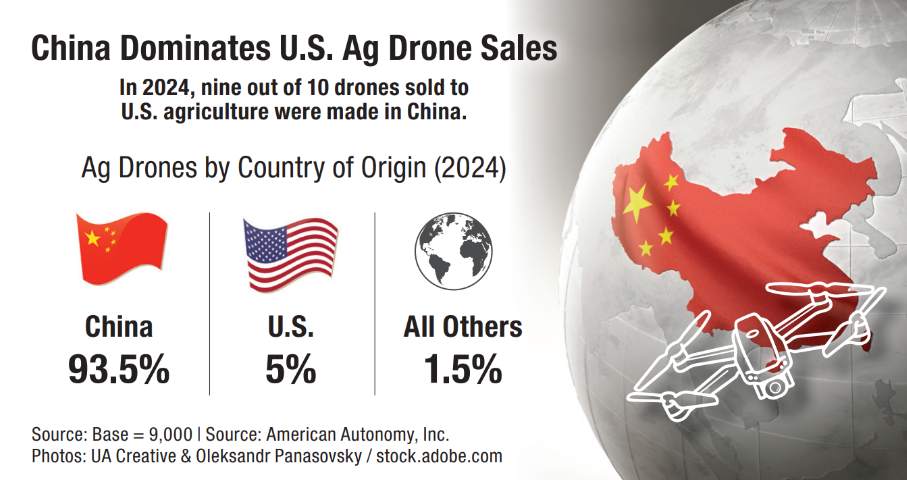
Part of the issue for drone purchasers, he said, is the cost differential between Chinese and U.S.-made drones. “U.S.-made drones are 2.7 times more expensive than Chinese-made drones,” said Ringer. “So, for many buyers, it’s not a matter of just switching to U.S. drone models. It’s about producing U.S. models at a more competitive price.”
According to Meredian535’s Crumpler, there is some attempt at correcting this issue in the so-called “One Big Beautiful Bill” recently passed by Congress.
“The bill includes $1.5 billion to help U.S. drone manufacturers either scale up or set up more domestic production capabilities,” he said. “However, much of this funding is targeted at defense department drone makers, not necessarily agriculture drone companies.”
The Legislative Climate
In the meantime, drone manufacturers and affiliated trade organizations have spent the past several months dealing with a legislative climate on Capitol Hill “where no one wants to appear like they are soft on China,” said American Autonomy’s Ringer.
This is evidenced by one bill in the House of Representatives in particular, he said — H.R. 4213. “This bill includes a rider — Section 214,” said Ringer. “This restricts the use of aerosol-dispensing drones from foreign adversary countries such as China.”
In part, the restrictions proposed by Section 214 are already appearing in the U.S. drone marketplace, he added. “Since the end of 2025, the U.S. Customs and Border Protection Patrol has stopped Chinese-made drones, especially those manufactured by DJI, from entering the U.S.,” said Ringer.
Another piece of legislation from the Senate also targets Chinese-made drones. S. 2168, also known as the Drones for America Act, includes a tariff tax on foreign-made drones entering the U.S., provisions that no major drone components such as flight controllers, radio/data links, or operating software are made in China, and a complete ban on the use of Chinese-made drones in the country starting on January 1, 2028.
This syncs with at least one comment made at the 2025 Tech Hub LIVE event, organized by CropLife’s parent company Meister Media Worldwide, last July. There, during the show’s drone workshop, Taylor Moreland, Founder and CEO at Agri Spray Drones, said this about the future of Chinese-made spray drones for agriculture: “I believe that within five to seven years, there will not be any more Chinese drones coming into the U.S. This means we will see more U.S. drone manufacturers stepping up, and a few Chinese manufacturers will likely set up factories here in the U.S.”
As these proposed pieces of legislation targeting Chinese-made drones make their ways through Congress, U.S. drone dealers have taken what steps that they can think of to continue supplying in-demand Chinese-made drones to their customers. “Many companies are taking drones components made in China and importing them for assembly in the U.S.,” said Ringer.
Another possible approach to addressing the concern surrounding Chinese-made spray drones, said Meredian535’s Crumpler, could be for the industry to follow the example of Apple Computer when it comes to its popular iPhones.
“Maybe U.S. suppliers can put their own software on Chinese-made drones, similar to what Apple does with iPhones,” he said. “iPhones are manufactured in China, but they all run on U.S.-made software. This same method could be used as a low-cost fix for agricultural spray drones, too.”
No matter what, Ringer said, drones should be allowed to continue expanding their market presence within the agricultural market.
“It’s important for our users to have access to this technology, to further the competitiveness of the ag community,” he concluded. “Drones will play an important role in safeguarding farmer choice.”

For more Smart Tech topics, click here.
Subscribe Today For
