The Future Is Being Built Now: 5 Trends Driving Ag Retail Facility Design
 September 16, 2026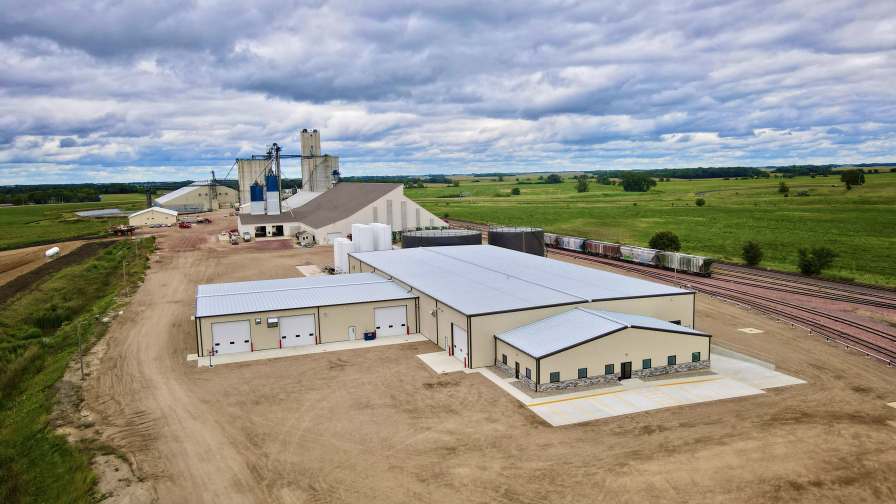
Retailers are investing in automation, logistics, customization, and resilience to strengthen operations, improve service, and position for long-term growth. Pictured is Crystal Valley Cooperative’s facility in Madelia, MN. Photo courtesy of Greystone Construction
Ag retailers have always invested in facilities to improve storage, blending, and service capabilities. But a review of the projects featured in CropLife’s 2026 Retail Facilities Special Report reveals something larger at work. Today’s facility investments are no longer focused solely on adding capacity. They are increasingly centered on long-term growth, automation, supply chain advantages, customized crop input solutions, and operational resilience.
Taken together, these projects offer a glimpse into how ag retailers are preparing their businesses for the next decade and beyond.
1. Building for the Next 20 Years, Not the Next Season
A common theme among the featured facilities is long-term thinking.
At Superior Ag’s new Ohio River facility in Rockport, IN, the focus was not simply on meeting current demand. According to AGI Fertilizer Systems, the project was designed to ensure the cooperative remains competitive while maintaining reliable access to supply and service for member farmers over the next “20 to 30 years.”
Similarly, Intermountain Farmers Association (IFA) in Trenton, UT, developed a centralized agronomy hub designed to support growing demand across northern Utah. The retailer had not built a new agronomy facility in more than 15 years and viewed the project as an opportunity to create a scalable operation capable of supporting future growth.
The trend reflects a broader shift in retail strategy. Rather than making incremental improvements, many retailers are pursuing transformational projects designed to serve larger trade areas, accommodate future product lines, and support expanding customer bases.
2. Automation Is Becoming the New Standard
If there was one trend woven throughout the 2026 projects, it was automation.
Retailers are increasingly using automation to address labor shortages, improve accuracy, and dramatically increase throughput.
At Mott Equity Exchange in North Dakota, Agronomy Manager Tom Irwin described the impact of Easy Automation’s system in striking terms.
“The impact on our facility’s efficiency has been nothing short of monumental,” he said. “Customers who once waited in line simply pull up, load, and go. Our ability to meet their needs has increased exponentially.”
Irwin noted that the facility is now loading fertilizer “five to six times faster with 50% less manpower” than its previous operation. Customers who once waited in line can now load and leave much more quickly.
River Valley Cooperative in Iowa reported similar results. Regional Project Manager Pat Lee said operators found the centralized system easy to use and that it had “dramatically improved daily operations.”
Meanwhile, Kahler Automation’s work with Nebraskaland Aviation in Nebraska showcases how sophisticated automation has become. The facility uses mobile-access controls, simultaneous blender operation, multiple impregnation systems, and facility-wide connectivity to maximize efficiency while reducing manual labor.
What was once considered advanced technology is rapidly becoming expected infrastructure.
3. Logistics Infrastructure Is a Competitive Advantage
Another notable trend is the growing importance of transportation and supply chain access.
Several featured projects were designed around rail service, barge access, or other logistics advantages that improve product availability and purchasing flexibility.
Superior Ag’s Rockport location uses its Ohio River position to support large-scale fertilizer receiving and handling. The facility incorporates barge unloading capabilities and high-capacity material movement systems designed to maximize throughput from inbound product to final loadout.
At IFA, rail access was a central reason for developing the new facility. The cooperative saw the opportunity to procure products more competitively and move them more efficiently to customers throughout the region.
Nebraskaland Aviation also identified direct rail access as essential to improving supply chain reliability while supporting growth in both dry and liquid fertilizer operations.
For many retailers, facilities are evolving from storage assets into logistics hubs. The ability to receive, store, blend, and deliver products efficiently may prove to be one of the biggest competitive differentiators in the years ahead.
4. Customization Is Driving Facility Design
Growers increasingly expect more customized crop input solutions, and facility design is evolving to match those expectations.
Today’s facilities are being built to handle specialty blends, micronutrients, stabilizers, liquid products, and other value-added offerings.
AGI’s project for Superior Ag includes precision blending systems, micro-ingredient handling capabilities, liquid impregnation systems, and advanced controls designed to improve blending accuracy.
Nebraskaland Aviation wanted the flexibility to provide customer-specific fertilizer blends as well as specialty products tailored to local grower needs. The resulting facility can operate dual autobatch blenders simultaneously while managing multiple impregnation products at the same time.
Likewise, facilities built for Nutrien Ag Solutions in Tipton, IN, and Crystal Valley Cooperative in Madelia, MN, feature expanded liquid fertilizer infrastructure, specialized loadout systems, and chemical storage capabilities designed to support increasingly sophisticated agronomy programs.
The message is clear: modern agronomy facilities are becoming more like custom manufacturing operations than traditional fertilizer plants.
5. Resilience and Safety Are Moving Higher on the Priority List
The final trend may be the most revealing.
As weather events become more disruptive and regulatory expectations continue to evolve, retailers are placing greater emphasis on resilience, safety, and risk management.
Hutchinson Co-op’s experience illustrates why. In June 2025, straight-line winds exceeding 80 mph destroyed the Minnesota facility’s warehouse, collapsing walls and damaging inventory. The rebuilding effort became an opportunity to rethink the site’s design and operational capabilities.
FarmChem used a full-scale 3D rendering process to design the replacement facility, allowing the cooperative and contractors to visualize operations before construction began. Agronomy Manager Chris Plamann praised the approach, saying: “The 3D drafting part worked out very, very well for us.”
Across multiple projects, retailers incorporated features such as containment systems, dedicated crop protection storage areas, improved traffic flow, covered loadout facilities, automated controls, and enhanced safety infrastructure.
These investments reflect a growing recognition that protecting assets, employees, inventory, and customers is every bit as important as increasing capacity.
Looking Ahead
While the projects featured in CropLife’s 2026 Retail Facilities Special Report vary in size and geography, they point toward a common future. Retailers are building larger, smarter, and more connected facilities that emphasize efficiency, flexibility, and long-term value. Automation, logistics, customized agronomy solutions, and resilience are no longer optional enhancements. They are becoming foundational elements of the modern ag retail business.
The newest facilities are more than construction projects. They are a blueprint for where agricultural retail is headed next.
Subscribe Today For
