Sustainability Is a Start, Stewardship Is the Future in Agriculture
Many conversations around agricultural “sustainability” are frustratingly narrow in scope. A hyper-focus on specific products or practices often fails to include the economic factors that determine whether a farmer is able to embrace those practices or products.
Sustainable farming practices are unobjectionable – in theory, at least. Everyone benefits from practices that make it possible for a farm and its operators to thrive for the long term and continue to produce food.
So what’s the alternative? Instead of focusing on “sustainability,” let’s make the conversation about “stewardship.” This framing expands the concept of sustainability to include the people responsible for making it happen. This has powerful implications for ensuring a thriving long-term food system.
The Power of Stewardship
Stewardship is a more expansive concept than sustainability: it includes not just sustainable ag products and practices but also the strong connection to and understanding of the land that farmers are expert in and that’s required to do the hard work of farming. It encompasses economic stability from season to season, preservation of the land as an asset, and the concept of land as legacy.
This stewardship framing is particularly powerful in our current economic climate, with high interest rates, high input prices, and low commodity prices. This hierarchy of sustainability (below) roughly captures how many farmers prioritize various aspects of sustainability / stewardship in day-to-day farm operations.
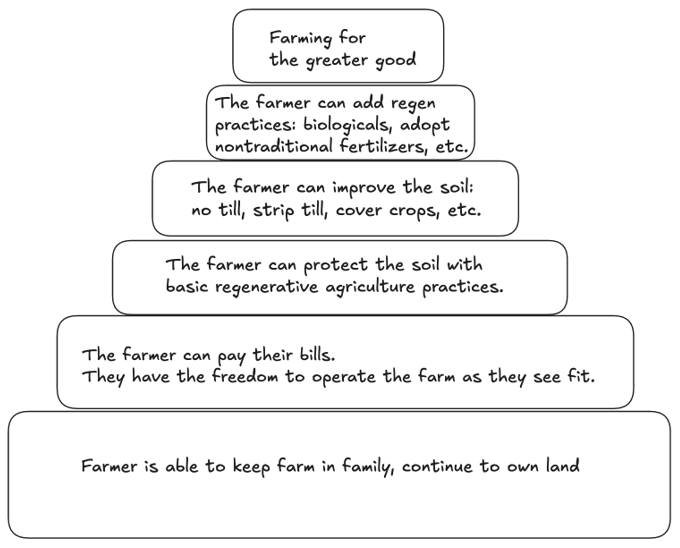
What Farmers Need to Incorporate More Sustainable Practices and Products
Broadly speaking, farmers need the following to incorporate sustainable practices and products:
- Guidance from trusted advisors about which products and practices make sense for their land. These advisors are often agronomists working for ag retailers. Knowledgeable about both the newest products and individual farmers’ land, agronomists can eliminate the information overload farmers might otherwise have to navigate to help them choose the best inputs for their farms (e.g., by considering the “four Rs” of nutrient stewardship – right source, right rate, right time, right place).
- Economic support in the form of risk-sharing for farmers willing to embrace sustainable inputs. For example, retailers can fund warranties attached to the most innovative inputs that provide cash payments if yields don’t meet expectations. This kind of support can help growers overcome the psychological barrier known as “loss aversion” that makes us more attuned to the pain of potential financial loss than the positives of potential gain.
- Shared risk from retailers or CPG companies that are asking farmers to implement certain changes in practice. Farmers are inundated with sustainability programs and offers. When retailers or CPG companies offer to share risk (via programs like warranties, for example), they show that they too have a financial stake in the crops’ performance.
Now let’s take a look at how these might look in practice.
Practical Ways to Drive Adoption: Share in the Risk!
In 2023, we ran two warranty pilot projects with The Nature Conservancy and retailers in Iowa and the Chesapeake Bay region.
Farmers were invited to participate in the program at no cost to them. They chose between a number of sustainable products and practices, including a combination of biologicals, N stabilizer, biostimulants, soil amendments, starter formulation promoting P availability, and cover crops.
If the products and practices didn’t help the farmer meet or beat their harvest yield benchmark, they received a per-acre credit (the warranty) of up to $45 per acre depending on the practice or product they chose.
From these pilots, we found that the following strategies worked best for driving adoption:
- Farmer-led strip testing. This let farmers observe first hand the performance of sustainable products and practices versus conventional alternatives.
- Farmer choice in products and practices. Providing a menu of sustainable options let farmers choose what was best for their land and farming needs.
- Yield warranties when incentivizing straightforward practices with clear success metrics. For practices that are harder to implement and measure (like cover crops), a benefit / establishment warranty in place of or in combination with a yield warranty might better serve farmers.
In short, the pilots were most successful when farmers retained autonomy for the work of farming while sharing the risk of undertaking new products and practices – i.e., when sustainable practices existed within and validated farmers’ role as stewards of the land.
Stewardship Offers a Pragmatic Framework for Sustainability
Farmers want their land to be fertile for the future generations that work it. They want the farm itself to endure as both a business and an asset. And everyone who depends on them – which is to say, all of us – want the same.
When it comes to agriculture, sustainability (avoiding long term depletion of resources) needs to let stewardship (the responsible management of something entrusted to you) lead. This will enable us to get further faster by centering the people most important to these efforts.
Subscribe Today For
