
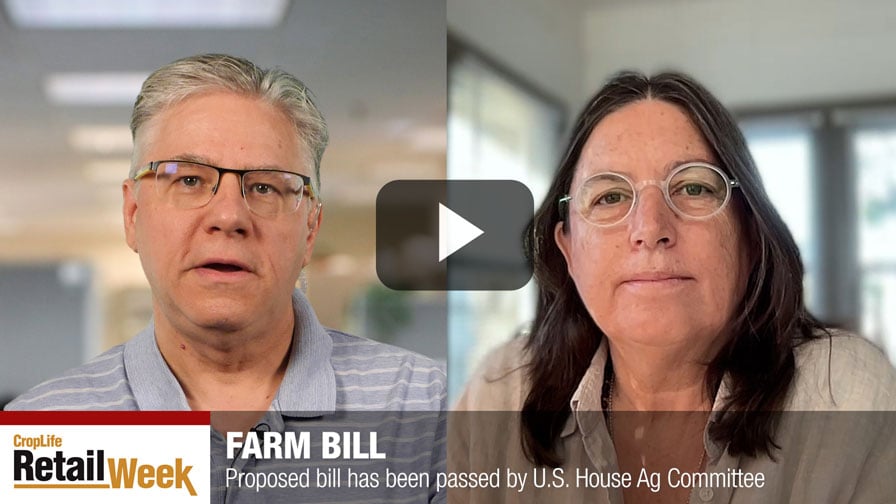
Eric Sfiligoj and Lara Sowinski discuss another ag retail merger, some movement on a new Farm Bill, and how often bridges in the country suffer impacts from cargo ships.
Subscribe to CropLife Retail Week
*This is an edited and partial transcript
Eric Sfiligoj: Hello. Welcome to another edition of CropLife Retail Week. I’m Editor Eric Sfiligoj Editor, back in studio with my friend Lara. Welcome back.
Lara Sowinksi: I was going to say I’m laughing because, when I did the guest hosting last week with my terrific guest, Erin Hightower from RDO Equipment, and I started thinking, you know, I don’t really have the spiel down that Eric does every time formally. But, it was a blast. Glad to be back with you.
ES: We have a bunch of stuff that is pending in the marketplace we’re going to be talking about news wise. First and foremost, of course. you know, consolidation in the retail space. Earlier this year, we had two Indiana cooperatives, Ceres Solutions and Co-Alliance formerly merged, and as of March 1st they are now known as Keystone Cooperative. And as we say that at that time and they, you know, they were both ranked in the teens on our CropLife 100 so combined, they’re now probably in the top eight, in the over $1 billion club.
And this week we found out another merger is in the offing. There was a letter of intent to merge signed between our friends at CHS, which was number six on the 2023 CropLife 100 with more $1 billion sales, with West Central Ag Services. which was number 31.
So, those two cooperatives are both based in Minnesota. And like I said, they’ve signed a letter of intent, and they’re hopeful that if, the membership votes in the affirmative, that the formal merger will take place later this year. So we’ll have to keep an eye on that.
One thing that we’ve been talking about a lot since September 2023 when it formally expired, of course, is the farm bill. Every five years you’re supposed to get a new farm bill. But, you know, in Congress, there hasn’t been a lot of movement on the farm bill. And most of the programs that run under the 2023 expiring farm bill were simply extended without a new farm bill in place.
But I’m happy to report that, the U.S. House Agricultural Committee has now passed a $1.5 trillion farm bill legislation, that passed about a week ago. And it now goes to the Senate committee to vote on. The bill increases the farm safety net payments for some commodity crops, expands eligibility for disaster assistance and increases funding for specialty crops.
Everything I’ve read indicates that the farm bill must pass because it defines the US food supply we’re talking about here. So, again, hopefully now that this has made it through one committee, it’ll get through the rest pretty quickly and go to the full Congress for a vote.
And fingers crossed, maybe by, the fall of this year, your late, we will finally see a new farm bill in place for our friends in agriculture. Yeah, I’m really encouraging to see some positive movement on that front. Getting the bill, ushered through the House and and and Senate both.
LS: The Port of Baltimore has postponed the full opening of the channels. Some vessels are getting through. There’s still one piece of the bridge, however, that does need to be cleared from the channel. So now, they’re looking at June 8th, maybe the 10th for the channel to be completely open. But, in part because of the collapse of the Key Bridge, a team from the Johns Hopkins school of Engineering is embarking on a nationwide investigation and study of bridges at key gateways and ports to evaluate their safety and what needs to be done.
One of the engineers is reporting the U.S has seen 17 incidents of major bridge collapse between 1960 and 2011, averaging one every three years between the exponential growth of mega freight ships and surge and global shipping traffic. Many of our bridges simply weren’t built to withstand the pressures of today’s maritime landscape.
So, yeah, I think that’s the big thing. I mean, not only the the volume, but certainly the size of the vessels, these days. So, good news on that front. Small delay.
The other pending news, if you will is contract negotiations between longshoremen on the U.S. East Coast and Gulf Coast, are underway. The current contract expires on the 30th of September. So, waterfront employers and longshoremen are hoping to hammer out details for a new, six year contract. And hopefully, everything goes smoothly so we don’t see any work stoppages.