From Data to Dirt: Bridging the Gap in Precision Nutrient Management

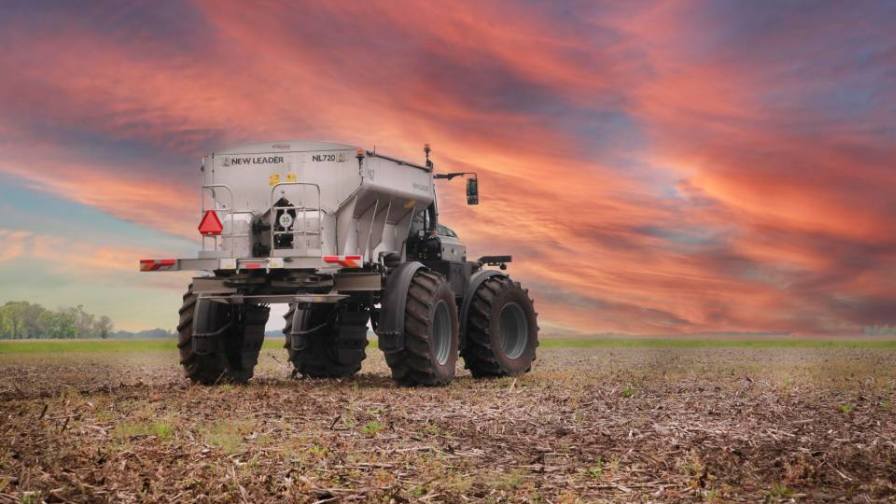
Next-generation spreader technology, like the NL7 platform from New Leader Manufacturing, is bridging the gap between digital prescriptions and dirt-under-the-nails reality. Photo: New Leader
Precision agriculture isn’t just evolving — it’s rewriting the playbook on how growers feed their fields. Fertilizer has shed its “fixed cost” label and become a strategic weapon, with data steering every pass and real-time precision replacing guesswork. High-resolution maps now guide targeted applications, turning blanket spreading into surgical nutrition.
In this conversation, New Leader Manufacturing President Cole Daily explores how next-generation spreader technology — anchored by their NL7 platform — is bridging the gap between digital prescriptions and dirt-under-the-nails reality. We dig into how smarter machines are boosting productivity, protecting margins against soaring input prices, and proving that profitability and environmental stewardship aren’t opposing forces — they’re the same harvest, viewed from different angles.
CropLife: How are advancements in precision agriculture and smart technology changing the way growers approach fertilizer application?
Cole Daily: Advancements in precision ag are fundamentally changing how growers think about fertilizer — from a fixed cost to a controllable lever. With access to high-resolution field data, yield maps, soil sampling, and advanced precision tools, growers are moving away from uniform application and toward targeted nutrient placement. The mindset is shifting from “apply by average” to “optimize by zone.” That shift in thinking is a big reason we’ve seen significant adoption of the NL7 in the marketplace over the past two years.
CL: What roles do tools like the NL7 spreader play in supporting more accurate, data-driven nutrient management?
CD: Spreader platforms like the NL7 act as the execution layer of precision agriculture. They translate digital prescriptions into consistent, repeatable field performance. With precise rate control, stable spread patterns, and accurate placement, nutrients are applied exactly as intended, reducing variability and giving growers confidence that their data-driven decisions are being realized in the field.
CL: With rising crop input costs, what strategies are you seeing growers adopt to optimize fertilizer use while maintaining yield and profitability?
CD: Rising input costs are pushing growers to be more disciplined and data-driven. Rather than just cutting rates, many are focusing on better information — through more frequent soil testing, variable-rate strategies, and in-season adjustments. The goal is to maximize return on nutrient investment by avoiding over-application while protecting yield potential in high-response areas.
CL: How do you see innovations in spreader technology impacting productivity in the field?
CD: Innovations in spreader technology, like the NL7, are boosting both speed and confidence. Improvements in material handling, distribution uniformity, and throughput, combined with easier-to-use controls, allow growers and applicators to cover more acres per day, reduce downtime, and operate effectively across a wider range of conditions and materials.
CL: Sustainable nutrient management is increasingly important for both growers and regulators. How can precision spreaders help balance crop performance with environmental stewardship?
CD: Precision spreaders are key to sustainable nutrient management. By improving placement accuracy and reducing off-target application, they help minimize runoff, leaching, and volatilization. This supports regulatory compliance and environmental stewardship while maintaining crop performance — an increasingly important balance for modern operations.
CL: Which emerging technologies or innovations do you think will have the biggest impact on fertilizer application and overall crop input efficiency over the next 5-10 years?
CD: The next wave of impact will come from integration and intelligence. Real-time sensing, machine-to-machine communication, AI-driven prescriptions, and greater automation will tighten the feedback loop between crop response and application decisions. Over the next 5-10 years, these technologies will significantly improve efficiency in fertilizer use and overall crop input management. Our ongoing investment in Research and Development reflects this philosophy — both in people and technologies.
Subscribe Today For
