Smart Tech
AcreBlitz: Modern Technology for Modern Agriculture
 June 16, 2026
When Corey Fransen and Kim Brown founded AcreBlitz, their mission was a simple one: Use the latest technology and software to address challenges that aerial applicators face in today’s agricultural world. However, as the requirements tied to the Endangered Species Act (ESA) became more prevalent, this goal changed.
 2026 ESA Technical Guide to Mitigation Options
Access the full report today and ensure your organization is ready for what’s next. Download the Report >>
“What started as a simple idea quickly evolved as EPA’s mitigation strategies rolled out and more labels picked up ESA language,” says Fransen, Co-Founder and Lead Developer. “It became clear that ESA compliance was going to require a much broader approach and would fundamentally change how pesticide applications take place in the future and the responsibility applicators have in complying.”
He adds that the backgrounds of both AcreBlitz founders uniquely positioned them to address these challenges. For 10 years after college graduation, Fransen worked as an aerial applicator, licensed in more than 20 states, spraying everything from Midwest row crops to Pacific Northwest forestry and California specialty crops. Meanwhile, Brown worked for multiple universities in pesticide safety education.
“We bring the perspective of someone who has been in the cockpit, at the legislature, and on the ground dealing with these issues directly,” says Fransen of the AcreBlitz leadership. “That closeness to the problem is what drives the way we build.”
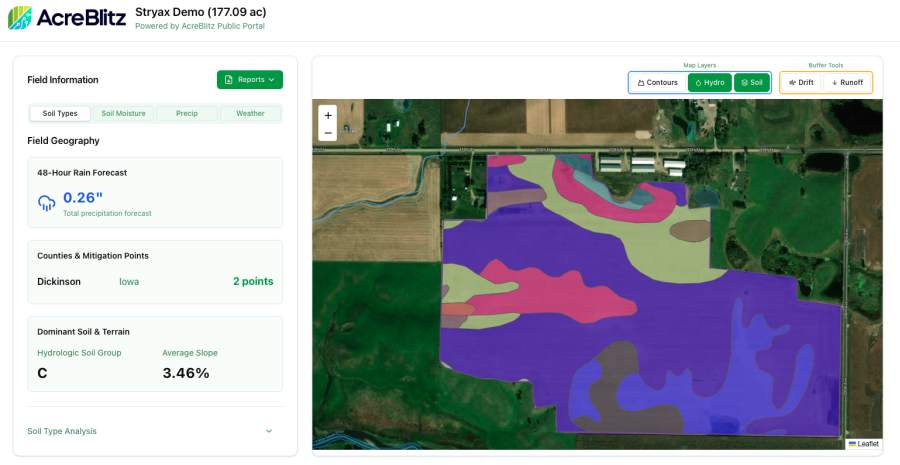
A screenshot of the kind of information AcreBlitz can offer to users. Photo courtesy of AcreBlitz
ESA-Oriented Products
Right now, AcreBlitz has built two different products for customers. These are designed to work together to connect the grower and the applicator.
The first is called ESA Check API. This is a turnkey solution that retailers, cooperatives, and other agricultural software providers can use to connect directly to manage their ESA compliance needs.
ESA Check API allows customers to send an application or recommendation and its associated data such as tank mix and field boundaries to the system. This is then assessed against the ESA requirements on the pesticide label and/or EPA’s online Bulletins Live! Two for any limitation areas.
“From there, the system calculates the required mitigation points and drift buffers,” says Fransen. “If a field doesn’t meet the minimum runoff point requirement, we provide a portal where the user can interact directly or share with their grower-partner to assign additional mitigations such as cover crop, tillage practices, and vegetative filter strips.”
The second product, called ESA Field Exchange, is where the grower side of the equation comes in. Ac-cording to Fransen, growers can import all their field information and see how many runoff points they already have based on the field characteristics alone. They can then add any additional mitigations and create runoff reports for their farm.
“This is then where the two products connect,” he says. “If a grower elects to share their mitigation selections through the ESA Field Exchange, that data becomes available to our ESA Check API. So anytime an applicator is making an application to that field through our API, we automatically pull in the mitigations the grower has documented. This solves one of the biggest challenges that ESA creates, which is communication between the grower and the applicator, particularly when a custom applicator may not work directly with the grower but instead works through a retailer or cooperative.”
In addition, he says, ESA Check API is the only service at this time that creates a compliance record by connecting applicator activity directly to grower-documented mitigations through the ESA Field Exchange.
“This gives both parties documented proof of compliance without the manual coordination that would otherwise be required between them,” says Fransen.
For the future, Fransen believes the need for products such as those AcreBlitz provides will only increase.
“As ESA language expands across more products, the need for technology that can interpret and apply those requirements in real time only grows,” he says. “A big part of our focus going forward is continuing to evolve our digital label capabilities. We are investing heavily in building out those digital label processes so that compliance verification happens automatically, behind the scenes, without adding hours of manual work to anyone’s day.”

For more Smart Tech topics, click here.
Subscribe Today For
