Manufacturers Are Developing Better Tools When It Comes to In-Plant Systems
 January 19, 2025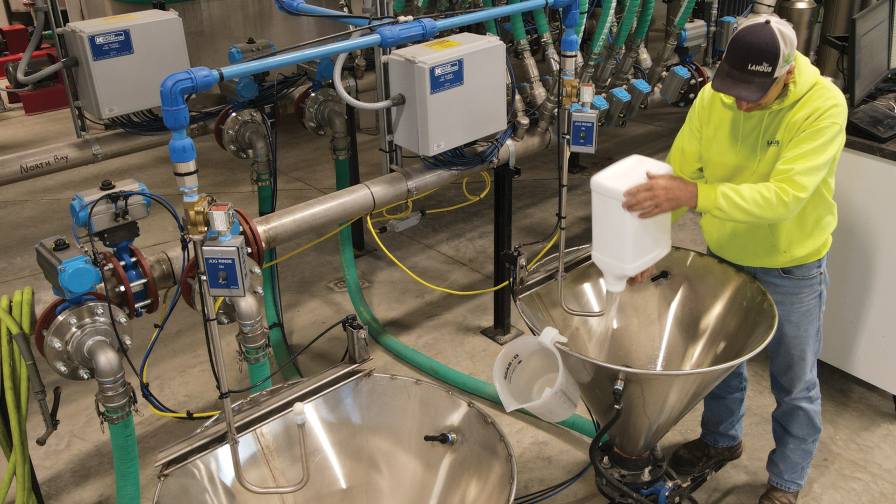
Kahler Automation’s in-plant solutions include Self-Serve 2 providing ag retailers with easy and secure on-site access for unstaffed loadout and dispensing.
Like many aspects of the ag community, technology has improved in-plant equipment and systems.
“The in-plant equipment and systems marketplace is evolving rapidly as ag retailers address challenges like rising labor costs, labor shortages, and operational inefficiencies,” says Jason Kaeb, Chief Operating Officer, KSi. “Automation has become essential for achieving ROI, reducing manhours, and enhancing accuracy and consistency across systems. Industry-wide, there’s a strong emphasis on improving accountability and integrating systems to maximize efficiency, reflecting a broader shift toward smarter, more connected operations.”
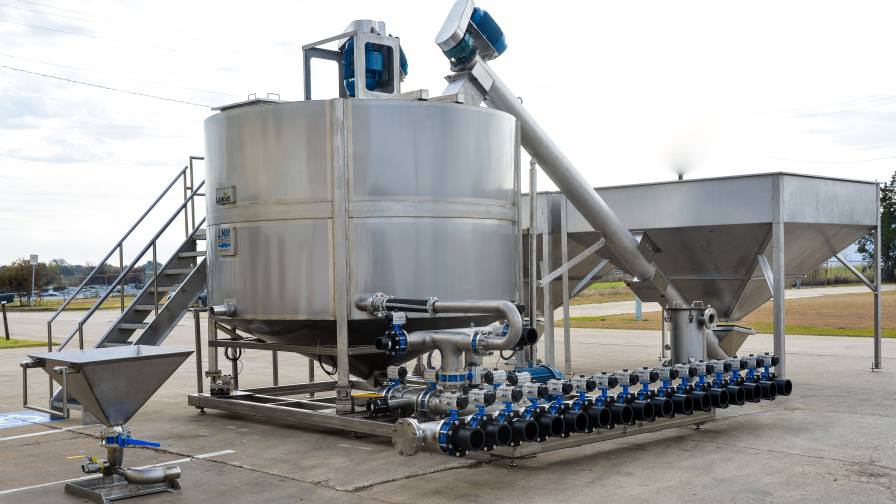
J May’s eductor, hoppers, augers, ingredient valves, agitators, access stairs/platforms for Landus Cooperative in Boone, IA.
Donnie Spradlin, Vice President Sales & Marketing, J.May Equipment Group, agrees these tools have improved.
“It is far better than it has been in the previous years,” Spradlin says. “Companies are making capital investments in equipment that they know are tools to increase profits and efficiencies.
“Designing and manufacturing the correct in-plant equipment to address the needs of the grower is extremely important,” Spradlin continues, “especially for specialty products or blends that include secondary and micronutrients. That offsets the commodity aspects of the NPK.”
The growth of the market for these systems is largely due to improvements.
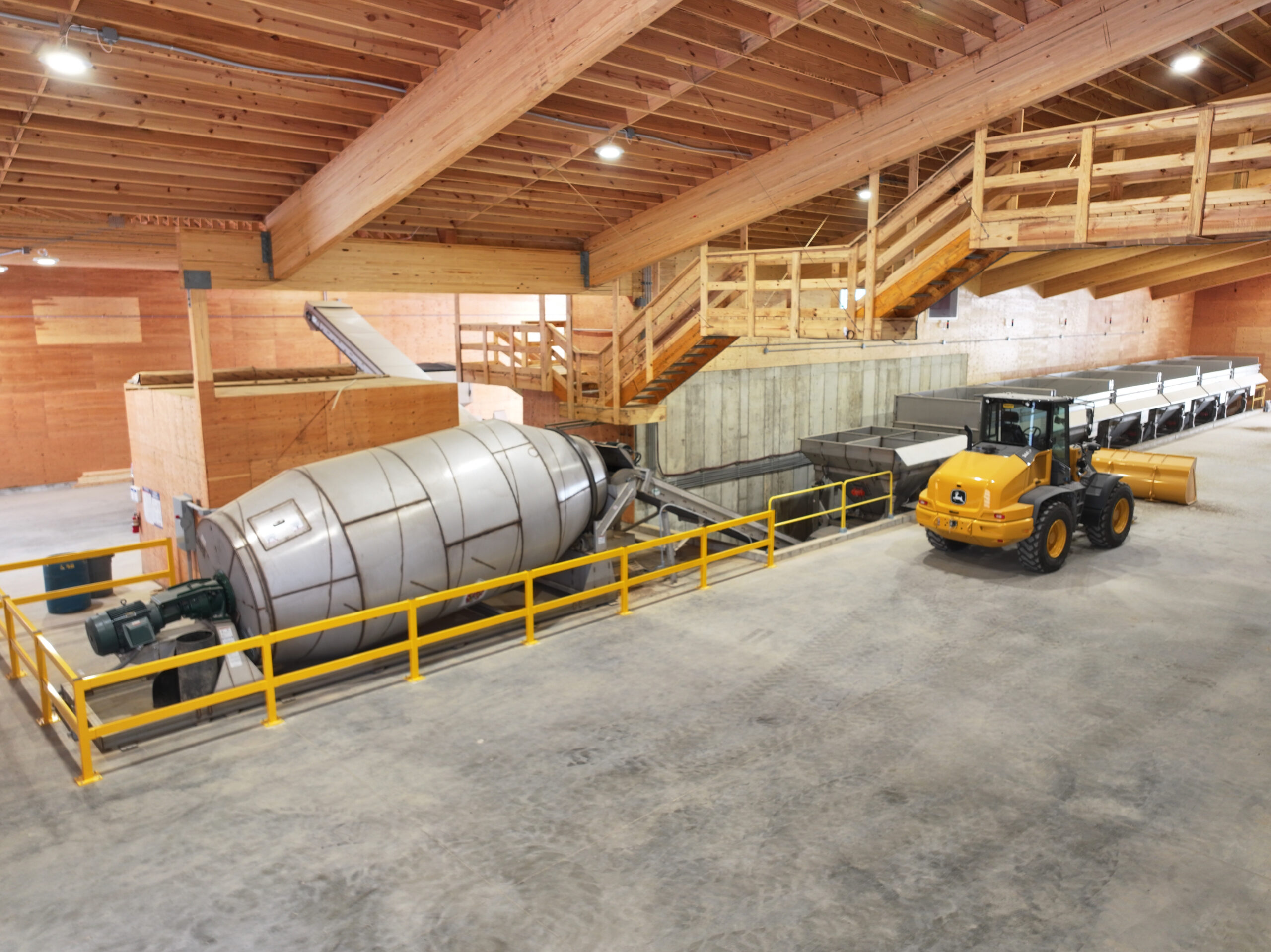
Doyle Equipment Manufacturing’s AUTOBATCH blend system.
“The in-plant equipment and systems marketplace is experiencing dynamic growth and innovation,” says Casch Doyle, Vice President of Marketing & Technology, Doyle Manufacturing. “With increasing demand for efficiency, automation, safety, and sustainability, companies are investing heavily in advanced technologies to streamline operations, reduce costs, and enhance productivity. In agriculture, where downtime is not an option, high-quality equipment that performs reliably is essential. The consolidation of smaller locations into larger, more efficient systems is also driving the need for cutting-edge solutions. This momentum reflects a competitive landscape where innovation sets new benchmarks for performance and adaptability.”
Technological advances have drawn many retailers to embrace these tools.
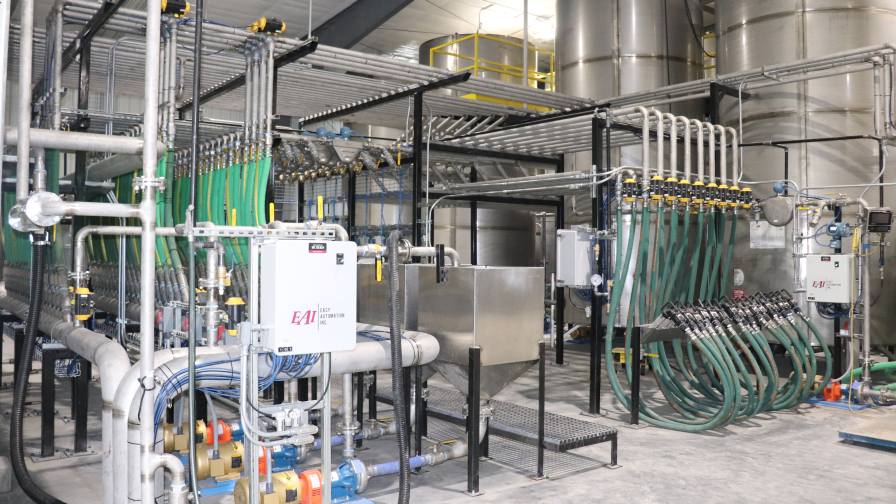
Easy Automation’s fully automated liquid agronomy system in North Loup, NE.
“To date, the agricultural retail market has largely embraced some level of technology,” says Sam Pendleton, Vice President of Sales at Easy Automation, Inc. “Only industry innovators and early adopters are investing in the latest in-plant equipment and systems, leaving the majority behind.”
RETAILER BENEFITS
“The demand for in-plant equipment and systems remains strong,” says Colt Silvers, Vice President of Business Development, Kahler Automation. “We will continue to see a trend of consolidation as many retailers look to service larger geographic areas with fewer facilities. Advancements in automation technology have incentivized this distribution hub model as retailers continue to benefit from the transformative gains in speed, accuracy, and throughput provided by modern systems.”
In-plant systems offer more than just the ability to serve more customers.
“The standard of performance for these systems has increased in the past several years,” says Easy Automation’s Pendelton. “In the beginning, the expectation of the system was to simply make the equipment run. As automation technology and equipment has become more reliable and accurate, the next step is looking at efficiency and overall speed of the system.”
According to Kahler’s Silvers, “Systems are becoming far more sophisticated as the market shifts to larger facilities offering a wider range of products and more complex blends. This shift has dramatically increased the demand for robust enterprise data management tools as part of an automation program with organizations servicing larger areas with more miles between plants.”
To deliver on those demands, manufacturers are constantly updating new solutions, says J.May’s Spradlin.
“Our J. May liquid mixing systems are in constant designing and re-designing for improved efficiency that addresses and meets the requirements of the buyers,” Spradlin says.
“Some of the other liquid system manufacturers have also made updates to performance, while some have stayed with the basic system for years. Those are less performance oriented and not state-of-the-art systems. NTEP (National Type Evaluation Program) is a must for these systems for certification. For dry, the loss-weight systems are the newest trend for high plant output. They can be set for straight through high volume or prescription blends. Some loss weight systems have difficulties becoming NTEP approved.”
In-plant equipment and systems are highly customizable, giving retailers the power to deliver on their needs and expectations.
“Today, each ag retailer can build their customized set of tools within their system that best fits the needs of their facility,” says Easy Automation’s Pendleton. “Instead of having to use one type of system to solve all their issues, there are many different types of ERPs and work order platforms to integrate into the automation technology system. We have adapted to this desire for customization by developing API’s and integrations for the end-users to be able to transfer information back and forth between their desired tools to assist in data transfer, accounting and inventory management.
“There are two main driving factors: real-time data and labor,” Pendelton continues. “In the heat of the busy season, the ability to review real-time data for their facility, including inventory, equipment efficiency, and billing and accounting, is a game-changer. It allows the ag retailer to anticipate and respond quickly with informed, data-driven decisions. Ag retailers are faced with numerous challenges surrounding labor including lack of availability and training.”
COLLABORATION
“While some systems can be proprietary, there is increasing flexibility in how equipment and systems interact,” KSi’s Kaeb says. “Collaboration between providers has become essential to delivering effective solutions. Ag retailers who work with providers capable of supporting both integration and serviceability gain a significant advantage. Building long-term relationships with a company that understands and meets your needs can enhance efficiency and system reliability without restricting future choices.”
Ensuring continued growth requires considering a long-term approach.
“At Kahler Automation, we consult with our customers to build systems that meet their unique needs,” Silvers says. “We encourage our clients to begin their projects with a plan for the desired functionality of the system, considering future growth. Starting with automation in mind allows customers to build a facility that will not limit the capabilities of their system while ensuring satisfaction with the project.”
CHANGING ROLES
As good as in-plant equipment and systems are, end users are exploring how these tools can evolve.
“Users must stay abreast of the growers’ demands,” J.May’s Spradlin says. “Most are seeking technical assistance and formulation assistance to produce proprietary blends. Unfortunately, education sessions in the industry for specialty blends have become few and far between. Growers are demanding the inputs for maximum yields.”
In-plant systems and equipment must, says Kahler’s Silvers, change with the times. “Technology continues to evolve along with retailers’ needs,” he says. “The struggle to find qualified employees, paired with the volume of products being moved through modern facilities, creates new challenges and opportunities for our customers. Our LOADPASS product is a prime example of innovation that increases product throughput while reducing the labor burden and improving overall safety on-site.
“Organizational growth and access to labor are major drivers,” Silvers continues. “Accuracy, efficiency, and safety are more important than ever as facilities continue to move larger volumes of product with fewer employees.”
According to KSi’s Kaeb: “Systems have grown from basic operational tools to sophisticated platforms that integrate seamlessly with business software. Automation and data systems now enable greater speed, accuracy, and reliability, while also improving the experience for everyone involved—from operators to managers. This progression reflects the industry’s commitment to innovation and adaptability in response to changing customer needs.”
When it comes to in-plant systems, KSi’s Kaeb says end-users have found new ways to implement their systems.
“Consolidation in the ag retail sector has led to fewer, larger facilities that require more efficient and scalable systems,” he says. “Operators now rely on automation to enhance speed, accuracy, and reliability, which has become critical given rising labor costs. KSi’s in-plant equipment and systems solutions enable operators to trust automation fully, freeing them to focus on other operational efficiencies, while ag retail management leverages these tools for seamless integration with business software, accurate inventory control, and robust reporting.
“Labor challenges, rising costs, and the demand for greater accountability are key drivers,” Kaeb continues.
“As the industry evolves, there’s an increasing focus on speed, efficiency, and accuracy to remain competitive. These factors make automation and system integrations not only attractive, but also necessary for optimizing resources and delivering consistent results.”
LOOKING AHEAD
According to Doyle, the industry continues to expect in-plant equipment and systems to improve in three critical areas.
“Speed, reliability, and efficiency will continue to define the segment,” he says. “As fertilizer blends become increasingly complex, customers require versatile and durable equipment capable of handling any mixture with precision and consistency. Doyle is committed to meeting these evolving needs with robust, innovative solutions.”
According to KSI’s Kaeb, these systems need to meet current and changing needs to ensure success.
“The future lies in continuous innovation, with advancements in automation and integration enabling ag retailers to scale operations and enhance service quality,” he says. “The segment will likely see growing adoption of technologies that streamline workflows, improve accuracy, and provide better data visibility for decision-makers.
Kahler works with customers to ensure systems meet the retailer’s needs.
“Organizations with a clearly defined technology vision will have a competitive advantage,” Silvers says. “Business integration and decision-support tools at the enterprise level will play a pivotal role as facilities become larger and more spread out.”
OPPORTUNITIES AND CHALLENGES
“Opportunities lie in the continued adoption of IoT-enabled devices, improved system integrations, and the expansion of automation into new regions,” KSi’s Kaeb says. “These advancements provide enhanced accountability, operational visibility, and serviceability. KSi is driving these innovations, helping customers modernize their equipment and achieve a competitive edge in their markets.
“One of the biggest challenges is balancing innovation with compatibility,” Kaeb continues. “Many facilities have legacy hardware that must be integrated with new automation solutions. KSi’s approach emphasizes strategic decision-making about when to upgrade and when to adapt parts of an existing system, ensuring a seamless transition for our customers.”
A lack of labor continues to push systems forward.
“We expect to see more retailers moving towards unattended systems,” Easy Automation’s Pendleton says. “Unattended means no labor, fully automated. Growers can pull into the loadout system, enter their order information and load themselves in a safe and efficient manner. We also expect to see continuous advancement in system capabilities as we adopt new technologies that are presented to the industry, such as AI.
KSi’s Kaeb agrees automation is key.
“KSi consistently develops new solutions that prioritize efficiency, accuracy, and user experience,” Kaeb says.
MARKET GROWTH
According to Doyle Manufacturing, there are a number of factors pushing forward more advanced in-plant systems.
“Several factors drive these innovations: ease of use, speed, efficiency, and safety,” Doyle says. “Additionally, with a changing workforce, facilities must operate effectively with fewer personnel. Doyle systems are designed to accommodate this shift, enabling a single operator to manage an entire facility or allowing two operators to handle tasks like filling hoppers and operating automation software, ensuring smooth, high-output operations.”
Subscribe Today For
