Fertilizer Blenders in 2026: Being More Precise

Farms are increasingly turning to prescription and customized fertilizer blends to wring as much productivity as possible out of the soil and seeds they are given to work with, powering growth for the manufacturers of the machinery as well as the retailers who are their largest customers.
“The global shift toward precision agriculture continues, and the bulk blending fertilizer market’s expected compounded annual growth rate (CAGR) being somewhere between 3% to 7% (depending on the source) over the next decade will translate into security for future opportunities with the fertilizer blending and handling market,” says Evan Halscheid, Director of Business Development for Sackett-Waconia.
One firm, Verified Market Reports, projects the fertilizer blender market will accumulate a CAGR of 7% from 2024 to 2033, growing its value from $2.5 billion to $4.5 billion, even as uncertainty over tariffs and other factors persists.
Mixers and blenders assist in the production of many types of specialized fertilizers, from polymer-coated controlled-release fertilizers to stabilized nitrogen fertilizers. In most cases, growers turn to retailers to obtain the precise nutrient composition and release formulas to maximize crop output.
“Ag retailers continue to be our primary market for our blend systems,” says Nate Wittmaack, President and COO at Ranco Fertiservice. “We have worked with some large growers throughout the years, but these sales are not particularly common. But we do enjoy the opportunity to work with growers directly for dry fertilizer blending needs.”
Ranco’s bestselling equipment for blending nutrients is its Declining Weigh system, Wittmaack says, which is in line with its continuous-blend specialty. These machines weigh the output of each component during the blending process and adjust output every few seconds to compensate for variability due to flowability or density changes.
“We do still offer volumetric versions, which can be a good option in certain circumstances,” he adds. Their advantages include the speed at which a truckload can be mixed and the quality of the blend even when adding small amounts of nutrients. The smaller DW Series II blenders are designed to fit the footprint of existing Ranco volumetric blenders if customers do choose to upgrade.
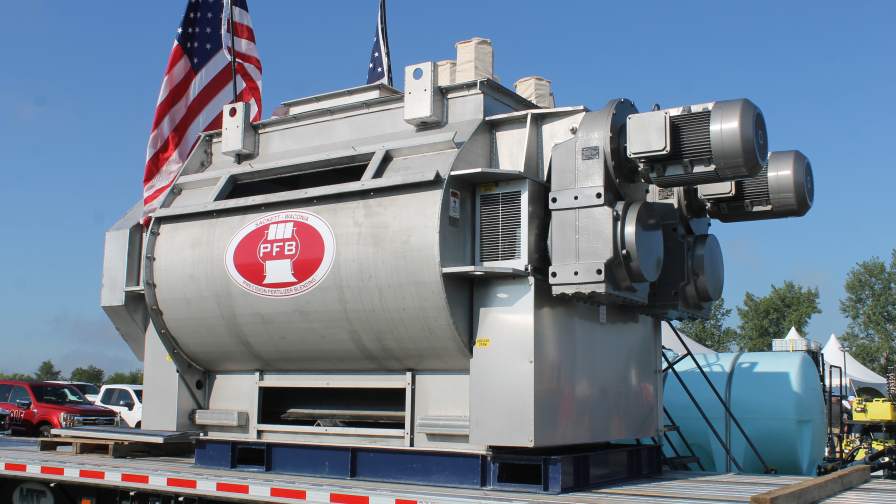
According to Sackett-Waconia, the HIM batch blender allows for static weight dosing of raw materials for a much more accurate dose.
Halscheid says Sackett-Waconia also has a clear sales winner. “Our HIM batch blender is by far the most popular,” he says. “Batch blending allows for static weight dosing of raw materials for a much more accurate dose. In addition, batch blending with the HIM provides the best blending and coating quality available in the industry. [It offers] precision mixing for precision agriculture.”
HIM 2.0 uses dual rotors within a unique shell design for gentle mixing which benefits polymer-coated particles and other innovative fertilizer components. The bomb-bay-style doors release the finished blend as quickly as possible to limit ingredient segregation.
Long-Term Commitment
Retail-scale fertilizer blending and mixing systems can be costly to put together, particularly given the technology needed for today’s emphasis on streamlining and monitoring operations. The good news is about the durability of most of the models, which indicates the upfront investment is likely to pay off for years or even decades.
Halscheid says longevity can be tied to many outside factors, such as climate, throughput, and the kinds of material handled. “With that said, we have found the typical life of our vertical blender shells to last 25-plus years and the vertical auger and drive system to last in the 10-to-15-year range,” he says. “Many of our first HIM blenders that were commissioned in the early 1990s are still in operation today, with several of the older units having processed over 1 million tons and counting.”
Ranco’s Wittmaack agrees exterior factors do have an impact on longevity, but says his company has its own workhorses it can point to. “We have DW Blend Systems in service in Florida that have been there since the early 2000s,” he says. “And we have volumetric blend systems still in service from the early 1980s.”
Looking Ahead
For the 2026 season, ag retailers and growers are expected to demand faster throughput and greater integration from their fertilizer blenders amid uncertain market conditions, both Wittmaack and Halscheid say.
“Ag retailers continue to look for ways to streamline their operations and processes. This effort to optimize will continue to lead to the adoption of integrations between the retailer’s business software and the blend execution systems,” Wittmaack says. “Also, ag retailers are looking for equipment and designs that allow for ease and accessibility of maintenance and continue to emphasize the importance of service-related activities. This means equipment suppliers like us need to be prepared to be responsive in terms of accessibility and availability of spare or repair parts, as well as resources to assist in maintenance.”
Sackett-Waconia’s Halscheid sees incoming hurdles stateside that could eventually squeeze retailers’ willingness to invest in costly blending machinery. “One of the largest challenges in the domestic market is the continuing policy shifts around tariffs, which have both added costs to materials and unpredictability on how these costs will trend,” he says. “Another challenge is shifting trade policies and global conflict driving volatility in natural gas markets. This directly affects the costs of fertilizers, and we are currently seeing fertilizer-to-crop price ratios at their highest levels in the past several years. These challenges can be precursors to a decrease in spending on new fertilizer blending facilities and reduced fertilizer use while cash remains tight.”
Both firms continue to innovate and plan to unveil new products this year, though Wittmaack says Ranco isn’t ready to dish about them yet. Halscheid of Sackett-Waconia says besides typical research and development, “We are also promoting a new expandable soluble fertilizer blending system for the soluble fertilizer market. Greenhouse growing and liquid fertilization are on the rise, and we can offer a system that can grow with our customer’s business.”
Subscribe Today For
