Smart Tech
Tracking the Smart Tech Age in Ag Retail
 December 10, 2025
In terms of market buzz, newer ag technologies (i.e., Smart Tech) have been the talk for much of the agricultural world these past few months. Indeed, since the first practical artificial intelligence (AI) systems were introduced to the world a few years ago, these technologies have exploded across numerous industry landscapes — including agriculture.
“Drones, vision spraying, and short stature corn — all these things will fundamentally change the way farming is done going forward,” said Paul Bonnett, Senior Director, Nutrien Agronomy, at one industry event during early 2025. “In my mind, I believe these will have as profound an impact on this industry as the introduction of genetically-modified crops did back in the mid-1990s.”
That’s why when CropLife® Magazine compiled the information from its 2024 CropLife 100 survey of the nation’s top ag retailers, the Smart Tech numbers were surprising. During 2024, ag retailers saw their revenues in Smart Tech systems and services decline 59%, from $815 million in 2023 to $338.1 million. Many respondents to the 2024 survey blamed the overall decline in grower-customers income between 2023 and 2024 for this drop. On a more positive note, many CropLife 100 ag retailers predicted that 2025 would be a better year for Smart Tech sales as market conditions “settled back down.”
A Stronger 2025
Luckily, these predictions proved to be accurate. According to data collected in the 2025 CropLife 100 survey, Smart Tech products and services sales did rebound, hitting $347.8 million. This represented an almost 3% revenue increase from 2024.
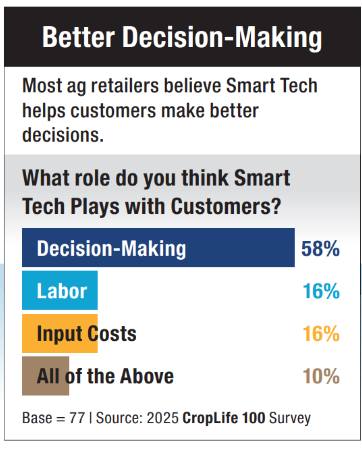 In terms of what advantages Smart Tech products and services offer to ag retailers and their grower-customers, the majority of respondents (58%) believed these systems were the most useful in helping to make better informed decisions when it came to farming practices and in-field operations. The rest of the survey respondents were split equally — 16% apiece — in thinking Smart Tech products and services were the most useful in addressing ongoing labor issues (such as maintaining an adequate workforce on the farm) or in helping grower-customers maximize their crop inputs prices/usage.
Besides looking at how Smart Tech systems are currently helping ag retailers and their grower-customers in today’s agricultural market, CropLife wanted to find out more about what Smart Tech systems the nation’s top ag retailers are planning to invest revenues in going into the 2026 growing season. For this question, respondents could choose multiple options — and many did just that!
Perhaps not surprisingly, far and away the most popular Smart Tech options among ag retailers for next year were software and apps. These products were chosen by 33% of respondents as their Smart Tech picks for 2026.
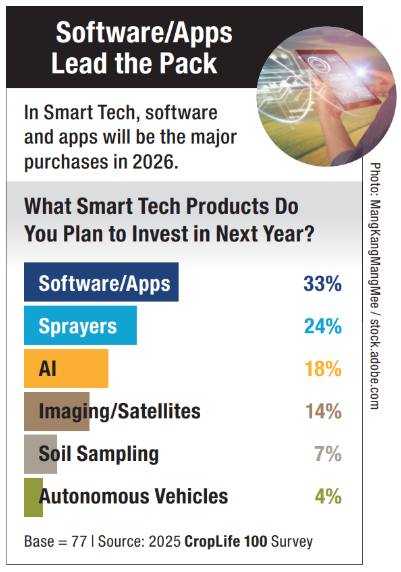 A close second was any kind of Smart Tech systems to help equip self-propelled sprayers for custom application work. According to the 2025 CropLife 100 survey, 24% of respondents plan to purchase these kinds of Smart Tech products for their 2026 growing season needs.
Rounding out the Top Three, 18% of respondents plan to invest in AI systems for 2026. This would include products for in-field work as well as office/facility management.
As far the rest of the options, 14% of 2025 CropLife 100 ag retailers are looking to purchase Smart Tech imagery/satellite systems in 2026. Seven percent plan to invest in soil sampling Smart Tech equipment.
Surprisingly, autonomous vehicles finished last among Smart Tech options for the nation’s top ag retailers. Only 4% of 2025 CropLife 100 survey respondents plan to buy these products next year.

For more Smart Tech topics, click here.
Subscribe Today For
