
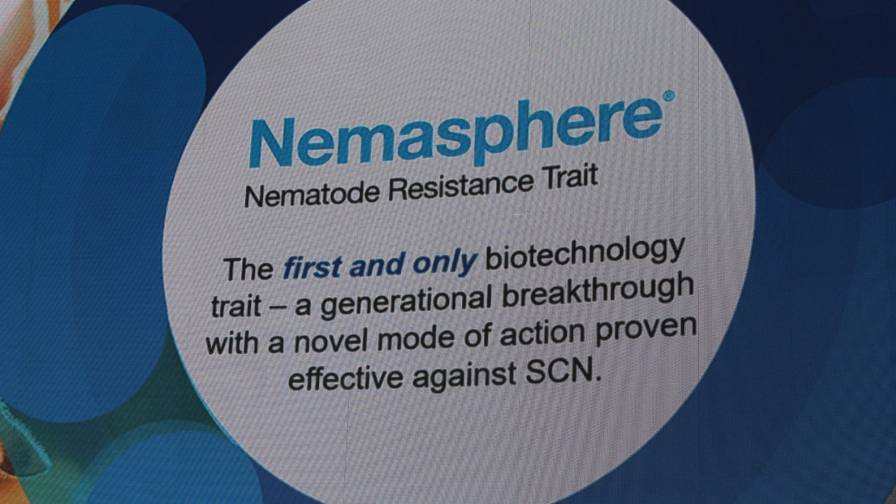
On June 10, BASF Agricultural Solutions announced plans to introduce a new trait to combat yield losses from soybean cyst nematodes (SCN). Called Nemasphere, the company claims this will be the first and only biotechnology trait for SCN in the U.S. BASF also announced that Nemasphere will be stacked with the Enlist E3 herbicide tolerance trait and available in a full range of soybean varieties.
At an in-person event in mid-May announcing the launch of Nemasphere, Bryan Perry, U.S. Head of Seeds and Traits, told attendees this latest product was BASF’s way of “giving back to the farmers” that have long struggled with yield losses from SCN. As Scott Kay, Vice President, Agricultural Solutions, pointed out, SCN is the nation’s No. 1 yield-robbing pest, costing growers an estimated $1.5 billion annually. “SCN affects more than 200,000 farms each year and, according to a survey BASF conducted of growers, has been detected in 91% of sampled fields,” said Kay. “In 2024, proper SCN management could make the difference between growers making money for the year or losing money. And now, BASF will have a solution to this problem.”
According to Julia Daum, Senior Program Leader for BASF, the company first started looking at the SCN issue back in 2005. Then, as now, there were two varieties of soybean that were used for SCN control – PI 88788 and Peking. However, said Daum, over the years, the effectiveness of these to manage SCN infestations has waned. Instead, the company began experimenting with certain Cry proteins for control of SCN – similar to how other Cry proteins have been used to control other crop pests such as in corn. “Many ag companies were trying to put Cry proteins into a plant for several years, but most of these efforts ended in failure,” she said. “Finally, BASF managed to succeed, using a protein called Cry14Ab. This was put into field trials to test back in 2017.”
In the Nemasphere plants, the Cry14 protein is ingested by nematodes, interfering with the nutrient uptake in the insect intestines. This eventually leads to the nematode’s death. Based upon field trials, which were conducted on more than 200 fields, Nemasphere soybean plants showed an average yield boost of 8%, said Dunn.
[poll id=”384″]
In terms of when Nemasphere will be available for the agricultural marketplace, BASF anticipates gaining regulatory approval for the brand by 2028. “It would then be available on a limited basis for that year’s growing season, probably around 50,000 acres,” said Perry. “We would then offer more widespread availability in time for the 2029 growing season.”