The Spring Fertilizer Outlook: Considering ‘Forks in the Road’ for Application Demand
 February 12, 2025
Ag retailers believe nitrogen demand will be up in 2025.
One of the legendary baseball figure Yogi Berras’s most famous quotes was “when you come to a fork in the road, take it.” For ag retailers and their grower-customers, this could aptly describe what might happen during the upcoming spring fertilizer application season, depending upon which fork in the road the industry ends up taking.
For starters, the first potential fork in the road for spring fertilizer application could be if the road leads to more fertilizer usage or less. Regarding this question, the ag retail marketplace seems split.
On one road, ag retailers such as Heartland Co-op, West Des Moines, IA, foresee good demand for fertilizer application this spring. “I’m positive,” says Chris Behrens, Executive Vice President of Sales and Marketing. “I believe more corn will be planted.”
 Historically speaking, Behrens is correct. Since corn usually requires more fertilizer than other major row crops to keep yields high, more acreage for this crop could translate into higher fertilizer demand for spring.
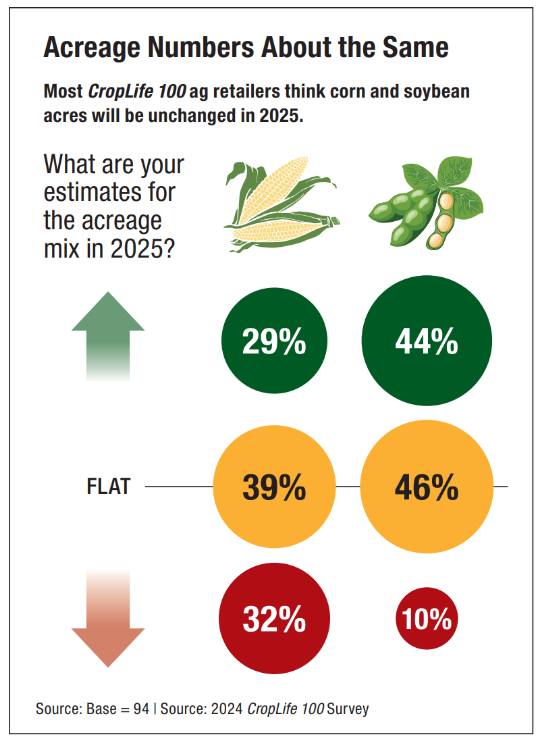
And government numbers back up this view. Right now, the latest USDA acreage projections for the 2025 growing season forecast corn plantings will increase by 1.3 million acres to 92 million acres vs. 2024. Many ag retailers agree with this view. According to data collected in the 2024 CropLife 100 survey, 29% of respondents believe corn acreage would be up for their grower-customers this year.
Going down another road, some ag retailers predict fertilizer demand could be challenged in 2025 due to commodity prices. “Negative to last year,” says Kreg Ruhl, Vice President, Crop Nutrients, GROWMARK, Bloomington, IL, of his 2025 fertilizer outlook. “Depressed farmgate economics are expected to surface as demand destruction.”
This fork in the road could be equally in play in 2025. As commodity prices have dropped throughout 2024 — and crop inputs prices remained high — several ag retailers are already reporting that grower-customers are cutting back on their fertilizer needs.
“Farm budgets look very tough for the 2025 crop,” says George Secor, President/CEO at Sunrise Cooperative, Fremont, OH. “We are already seeing folks skimp on P2O5 [phosphorus pentoxide] application and those tough farm budgets absolutely will be what challenges us to grow our volumes in 2025.”
Heartland Co-op’s Behrens agrees. “The biggest challenge is going to be in growers not applying full rates, cutting back to maintenance rates when they just pulled record yields,” he says.
Going down either road, GROWMARK’s Ruhl believes some grower-customers will wait until the last minute to decide upon their fertilizer application needs this spring – pressuring ag retailers to respond in kind.
“I expect farmers will defer or delay decisions longer as the unknowns pile up,” he says. “A grain rally or the issuance of ad hoc payments could alleviate some of this depending upon timing. I believe retailers will have to sell harder to place the specialty products that are considered less proven.”
Other Retail Responses
In addition to having to “sell harder” on some fertilizer products, ag retailers may be more cautious in how they stock up fertilizer warehouses for the spring season. “Some retailers may pre-buy less or cut back on fill tons,” predicts Heartland Co-op’s Behrens.
Sunrise’s Secor also foresees some caution on the part of ag retailers this year when it comes to fertilizer. “It sure feels like retailers are trading quite a bit hand-to-mouth right now,” he says. “When you consider poor farm economics, strong enough interest rates, and very high P2O5 values, why wouldn’t retailers be very cautious with what they own?
“What we coach our own folks on though is we have to find out what the farmer thinks need to be done differently not what we think needs to be done differently,” continues Secor. “We really need to make sure our own biases do not put too much pressure on farmers to do something differently than they really want to do. One thing we are doing differently is trying to work this simple question into our grower conversations: ‘Mr. Farmer what are you planning to do differently in 2025 compared to in years past?’”
Of course, this begs a simple question for spring fertilizer — which forks in the road will the macronutrients take in 2025? And the simple answer is it depends upon who you ask.
For some answers to this year, Secor takes a look backward at what happened in the market during fall 2024.
“As we wrapped up fall application season, it seemed like our potash application was right on track with 2023,” he says. “Phosphates looked to be off 20% to 25%. This was due to the current state of the farm economics as well as the fact that phosphates are very expensive relative to the value of grain.”
Looking to this year, Secor sees mixed paths for macronutrients in his part of the country. “I expect nitrogen sales will be very good here at Sunrise for the 2025 crop year, as we are expecting a very good corn acreage number, which will drag nitrogen sales up with those strong acres. Potash is very affordable at this point in time, and we are expecting strong applications — something quite frankly the 2024 fall season has already shown us. Finally, as we have reported several times over the past few years, we continue to see stronger sulfur applications.”
Heartland Co-op’s Behrens also predicts strong nitrogen sales for spring 2025. “Nitrogen will perform the best,” he says. “If the grower is going to spend money, it is going to be
on nitrogen.”
Taking a different fork in the road in spring 2025 could be phosphorus. “Phosphorus will do the worst” predicts GROWMARK’s Ruhl. “This will be due to the already fragile economics at the farmgate.
The risk of new tariffs might magnify this effect.”
Down the Tariffs Road?
When judging the impact various wildcards might have on fertilizer demand this spring, many ag retailers are looking at the proposed tariffs by the new administration as a definite negative path. “The unknown political landscape is a worry, particularly around tariffs (imports/exports/retaliation),” says Ruhl.
Sunrise’s Secor agrees that the moves the second Donald Trump Administration could make bear watching. “For me, it’s fairly straightforward — the new U.S. leadership most definitely could impact the marketplace in 2025,” he says.
In addition, Secor suggests ag industry watchers keep an eye on soybean market dynamics, particularly on the international stage. “It also sure seems like on the soybean front, we are starting to build some burdensome supplies from the world supply and demand,” he says. “We cannot ignore this fact either.”
And as always, GROWMARK’s Kuhl says that ag retailers should watch revenues — for themselves and those that directly impact grower-customers. “Continuation of low carbon efforts could spur more domestic supply and investment,” he says. “Low carbon premiums would be positive if growers started getting those opportunities. [However,] ad hoc payments could be lost to inflated land values and cash rent.”
Subscribe Today For
