New Tech Emerges, But Legacy Tools Still Lead Drift Reduction

In March, CropLife® Magazine presented the results from our 1st annual Pesticide Regulations and Drift Reduction Agents (DRAs) Survey. Conducted during the fall of 2025 with the assistance of the Council of Producers and Distributors of Agrotechnology (CPDA), this first article looked at some of the overall issues and agriculture market trends impacting the industry when it comes to the use of adjuvants and DRAs. This included responses from both ag retailers and their grower-customers.
 2026 ESA Technical Guide to Mitigation Options
Access the full report today and ensure your organization is ready for what’s next. Download the Report >>
In this article, we will discuss the one topic that wasn’t covered in that first feature — technology. Over the past several years, many new technologies have been introduced into the agricultural market. This includes artificial intelligence-driven systems and spray drones. Are any of these newer technologies making a big splash within the DRAs sector?
In a word, some. However, based upon the survey data, older, more established technologies still rule the marketplace, for now.
GPS A-OK
When respondents were asked which precision agriculture technologies they were currently using to mitigate drift, more than one-quarter (27%) indicated that GPS-guided self-propelled sprayers were their technology of choice. No other option topped the 20% mark in the survey.
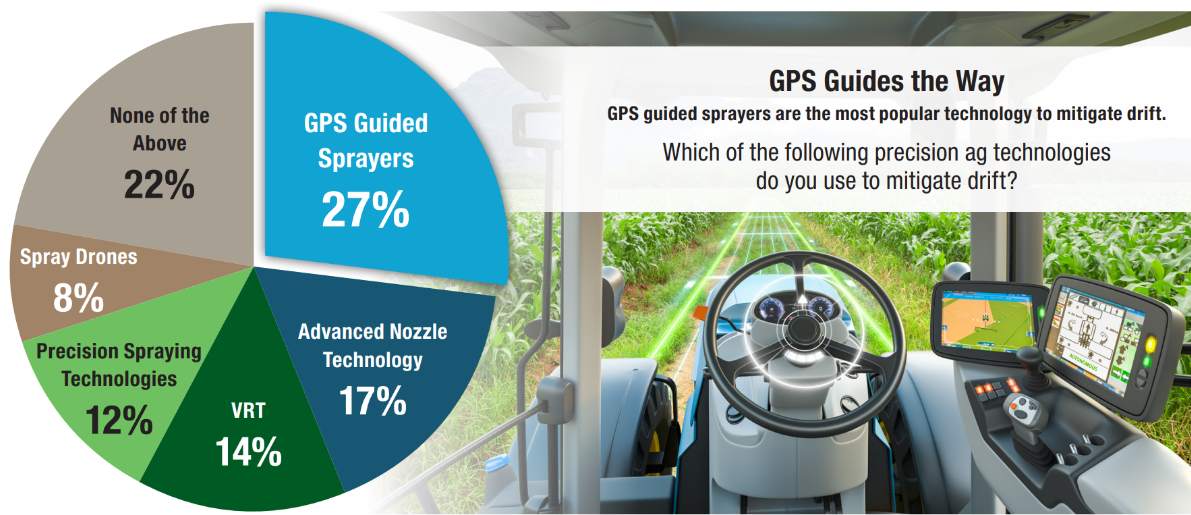
Base = 178 | Source: CropLife/CPDA 2025 Pesticide Regulations and Drift Reduction Agents (DRAs) Survey.
A distant second on the survey among precision ag technologies to mitigate drift was another older one — advanced nozzle technology such as pulse width modulation at 17%. First introduced during the 1990s, pulse width modulation technology is a spraying system where the flow rate is controlled by a pulsing solenoid at each nozzle.
In third place was another older technique, variable rate technology (VRT). According to the survey, 14% of respondents use this method to mitigate their drift issues.
Following these three established technologies, the Smart Tech-oriented ones finally appear. According to the survey, 12% of respondents are currently using precision spraying technologies such as John Deere’s See & Spray to manage drift in their crop fields. Another 8% say that they are using spray drones to manage drift.
The remaining 22% of respondents indicated that they are currently using no precision or smart technologies to manage drift on their farms.
Subscribe Today For
