Smart Tech
Precision Ag’s Changing Landscape: What’s Rising, What’s Falling in 2026
 July 8, 2026
Editor’s note: The CropLife/Purdue Precision Survey is the longest-running continuous study of precision ag adoption, conducted now for three decades — at least every other year since 1996. The 96 ag retailer input supplier respondents were mostly located in the Midwest and included cooperatives, independent retailers, and those part of a regional or national chain. The results reported are for dealers that identified as primarily working with field crops such as corn, soybeans, wheat, rice, cotton, milo, sugar beets, and forages. Dealers that work with specialty crops such as tree fruits and nuts, vegetables, berries, and grapes were analyzed separately.
 Be First to Hear the 2026 Precision Ag Dealership Survey Results
Join us at 2026 Tech Hub LIVE as Purdue’s Bruce Erickson unveils the latest Precision Agriculture Dealership Survey findings. Learn more >>
While newer smart technologies are gaining market traction, older ones seems to be falling out of favor with users. This was a major finding of the 2026 CropLife® Magazine/Purdue University Precision Ag Adoption Survey.
Dealers report that most acres in their areas use guidance, a combine yield monitor, section controllers, and planter controllers, as has been the case for the last few years and most have been steady (see Figure 1 below). Added to those at half or more for the first time is cloud storage of farm data, which has nearly doubled since 2020.
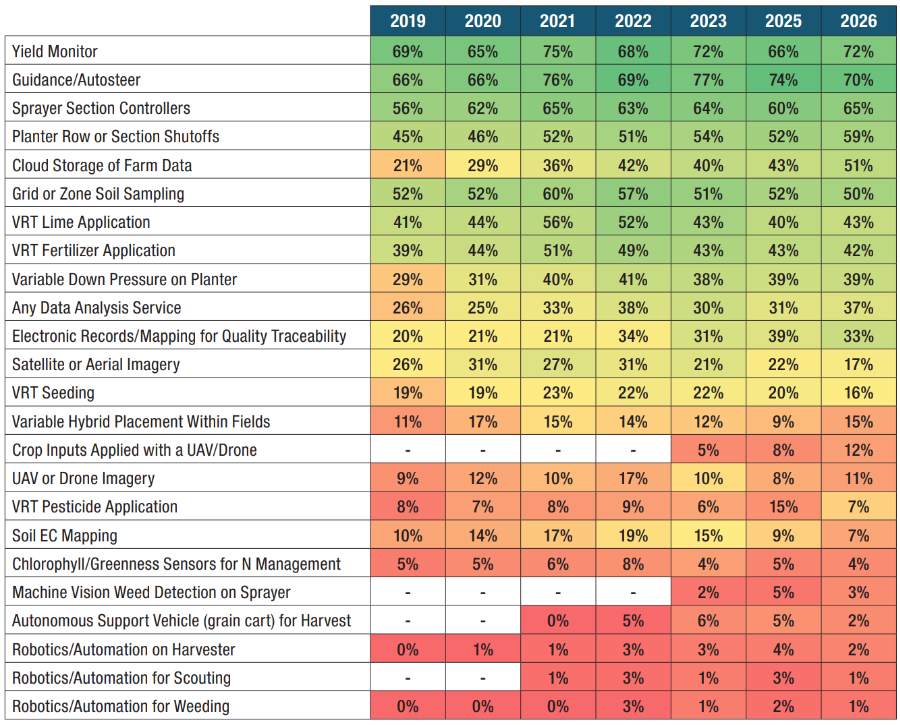
Figure 1. Grower use of precision technologies, local market area estimated by retailers, ranked for 2026. This question was skipped in 2024.
Crop inputs applied with a UAV/drone have increased rapidly, but other newer technologies such as machine vision weed detection on a sprayer, which enables variable rate technology (VRT) herbicides, and autonomous grain carts are still mostly in the single digits of adoption. Note that variations of a few percentage points may not signal a trend, as there are different responders every year.
But dealers are reporting a decline in grower use of some precision ag practices introduced in the 1990s. Slowly declining to half is precision soil testing, and below half of acres now for the last few years are VRT fertilizer applications. It makes sense that adoption of precision soil testing would mirror adoption of VRT applications, as one informs the other.
Dealers also report fewer acres using variable rate seeding. And despite being available for two decades or more, dealers report most farms are not using imagery as a standalone service (whether that is satellite, aerial, or drone), but imagery could be bundled as part of a scouting or data analysis service.
A Shifting of Emphasis with Dealer Offerings
Going along with declines in growers using precision nutrient management, fewer dealers are reporting that they offer VRT fertilizer application custom services (see Figure 2 below). The percentage of dealers offering VRT fertilizer was around half in 2010 and peaked in 2020 at 89%, and has been declining since, now at 78%. Since 2024 this calculation has only been for dealers who are providing custom fertilizer applications, not all dealers.
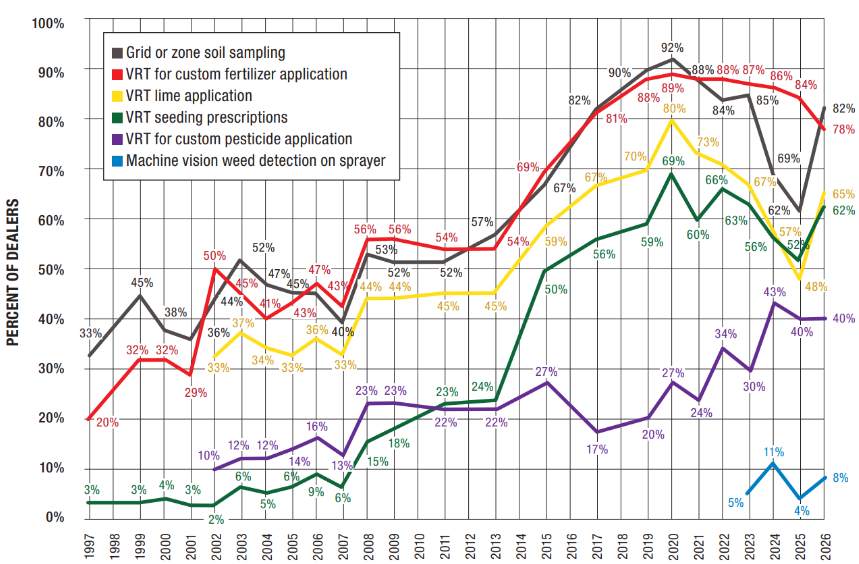
Figure 2. Dealer offerings of precision services over time, precision soil sampling, and variable rate technologies. Starting in 2024, VRT fertilizer is only for dealers who indicate they custom apply fertilizers, and starting in 2024 VRT pesticides are only for dealers who indicate they custom apply pesticides. Prior to that they were for all dealers responding.
A similar trend can be seen for dealers offering variable rate seeding prescriptions, with around a quarter of dealers offering in 2010, peaking at 69% in 2020, and now at 62%. Up in recent years are dealers offering VRT pesticide applications and crop inputs applied with a UAV/drone.
A full report detailing all of the 2026 results will be posted on CropLife.com later this year. The full report from the 2025 survey, and also previous years, can be accessed here.

For more Smart Tech topics, click here.
Subscribe Today For
