
Turning Nitrogen Gaps Into Opportunity
 Nitrogen management has rarely been this difficult to navigate. Prices have climbed, timing windows are tight, and many growers have already reduced their upfront applications. For ag retailers, that combination creates both risk and relevance. The retailers who step in with clear guidance and practical tools can help growers protect yield while managing cost exposure.

Galynn Beer
The current environment is defined by uncertainty. As Galynn Beer, vice-president of global sales at Tidal Grow AgriScience, puts it, “There’s just a lot of uncertainty surrounding the markets right now. What’s the nitrogen availability? We all know the price has really gone up on us.” That pressure is forcing decisions before conditions are fully known.
Growers are responding in predictable ways. Many have cut nitrogen rates, will delay sidedress applications, or have shifted acres out of corn. Those choices made sense at the time. They also create in-season risk that retailers are now positioned to address.
Reduced Rates, Rising Risk
Nitrogen reduction is often the first lever growers pull when margins tighten. In moderation, that decision may have a limited downside. Once reductions reach meaningful levels, the risk profile changes.

Dr. Trey Cutts
Dr. Trey Cutts, vice-president of commercial ag science at Tidal Grow, explains it directly. “If you’re deficient in nitrogen at V4 to V6, you’ve already left yield on the table because it’s a critical stage for kernel formation.” By the time visual symptoms appear, yield potential has already been impacted.
That reality is often underestimated. Early deficiency shows up as pale, slow-growing plants. Later, it causes leaf firing and reduced ear development. By V8 to V10, the consequences are unavoidable.
Retailers can play a critical role here by pushing earlier field evaluation. That means getting growers to look beyond canopy color and assess lower leaves and plant structure. Catching deficiencies early creates options. Waiting limits them.
Economics Still Favor Yield Protection
High nitrogen prices are top of mind, but cost reduction is only part of the equation. Beer emphasizes the importance of balancing variable and fixed costs. “If we cut that nitrogen back too far and that yield starts declining, we’re saving money on a variable cost. But if yield comes down, our fixed cost per bushel goes up.”
That message matters in grower conversations. Pulling back on nitrogen can feel like a controlled decision. The impact on yield, and therefore total cost structure, is less obvious until it is too late.
Retailers who can frame decisions in terms of total return, not just input savings, will bring more value to the relationship.
Timing Pressure Is Real
The window for in-season correction is narrow. As corn approaches rapid vegetative growth, demand increases sharply. “We’re going to quickly be to that V4 stage where that demand curve kind of stands on end,” Beer notes. “Decisions are going to be required.”
Weather, logistics, and uncertainty have pushed some growers past the point where traditional methods are practical. Once the crop is too large, mechanical application risks damage or becomes unfeasible.
At that stage, foliar approaches move from optional to necessary.
Where alignN® Fits
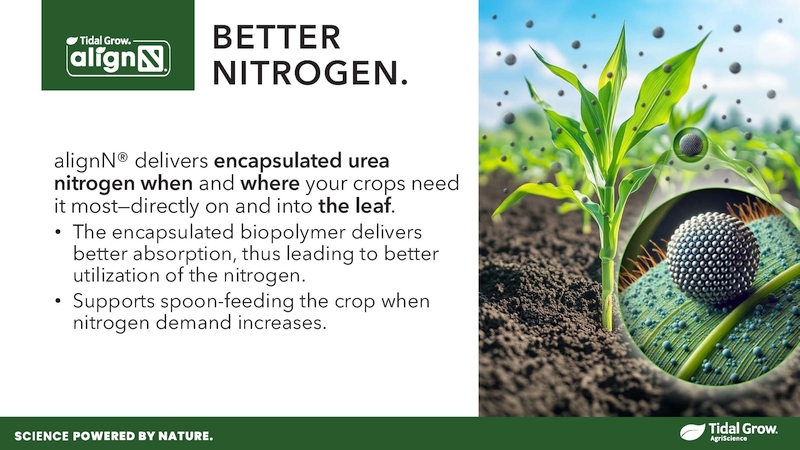
Late-season nitrogen strategies are evolving, and alignN, Tidal Grow’s intelligent delivery urea system designed for foliar delivery, fits squarely into this gap. It provides a practical option when sidedress is no longer viable or when growers need to adjust rates based on in-season conditions.
Rather than requiring a separate pass, alignN can be applied with herbicides or fungicides, helping retailers integrate nitrogen management into existing applications. That flexibility matters in a compressed season.
Cutts frames the value clearly. “Anytime you can feed that crop when it’s actively growing, your nitrogen use efficiency and your return on investment are going to go up.” With alignN, that feeding happens directly through the leaf, using a delivery system designed to improve uptake and utilization.
The intelligent delivery approach is central to its performance. “It’s all about better intake into the plant versus trying to deal with the different loss mechanisms from other nitrogen sources,” Cutts says. By improving absorption and reducing loss pathways, the product is designed to make each unit of nitrogen count.
Field data reinforces that positioning. Across more than 10,000 trial acres, alignN demonstrated a 27 percent improvement in nitrogen use efficiency along with consistent positive returns, including in programs where growers had already reduced base rates.
New Scenarios Require Targeted Responses
This season has introduced unconventional scenarios, many of which are already playing out in retail conversations.
For growers who miss sidedress entirely, the priority is recovery. As Beer notes, “There’s nothing worse than regret to create urgency on the part of the grower.” In these situations, foliar nitrogen solutions like alignN provide a way to respond quickly without damaging the crop or requiring additional equipment.
For those who reduced nitrogen rates early, alignN offers a way to layer in additional nitrogen if conditions justify it. That gives growers more control over risk while preserving upside potential.
Even acreage shifts to soybeans have introduced new considerations. High-yield soybeans can outpace nitrogen supplied through nodulation alone, particularly on acres originally planned for corn. In those cases, late-season foliar nitrogen becomes part of the yield conversation, and alignN provides a tool to support that strategy.
Retailers as Decision Partners
The throughline across all scenarios is guidance. Growers are managing uncertainty, cost pressure, and time constraints simultaneously. Retailers who can simplify decisions and present targeted solutions are essential.
That starts with early field assessment, continues with clear economic framing, and extends to recommending tools that fit how growers actually operate. alignN gives retailers a flexible, in-season option to address those needs, especially when timing or logistics limit traditional nitrogen strategies.
The goal is not just to sell a product. It’s to help growers finish the crop they have already invested in.

If you missed the live broadcast of this webinar, ‘Late-Season Nitrogen: What Retailers Need to Know When Growers Have Already Cut Back’ you can view the archived version online here or visit CropLife.com/webinars and check it out today.