Getting nitrogen applications right is one of the most critical factors in maximizing crop performance. But for growers, deciding when and how much nitrogen to apply is rarely straightforward. Weather, crop stage, soil variability, and mounting product choices all add layers of complexity to sidedress decisions.
Biome Makers believes soil biology holds the missing piece to smarter nitrogen management. Their BeCrop® Farm platform is helping growers move beyond guesswork by integrating biological indicators into sidedress timing and nutrient strategies.
The Challenge: More Variables, More Pressure
“Growers face a long list of questions when it comes to sidedressing,” says Mark Kinsey, Sales Director at Biome Makers. “How much nitrogen did they apply upfront? Have they had excess rain or a dry spring? Are they using models to guide rates, or are they relying on flat applications? And on top of that, there’s constant marketing pressure around add-on products and technologies.”
It’s a balancing act between agronomic needs, efficiency, and what’s logistically possible, especially for large operations managing thousands of acres. “There’s always a tradeoff,” adds Biome Makers Agronomist Gus Plamann. “Pre-plant and at-plant applications are often easier from a labor and equipment standpoint. But if you can work sidedress or Y-drop applications into your plan, the benefits are clear. You’re applying nitrogen when the crop actually needs it.”
The data backs that up. Research from the University of Illinois has shown that sidedress nitrogen applications consistently deliver the highest uptake efficiency compared to fall, pre-plant, or at-plant applications.
Soil Biology: The Missing Link in Nitrogen Decisions
While agronomic models and weather tracking help guide nitrogen management, most growers have had limited visibility into the biological processes happening beneath their crops. That’s changing.
“Biological soil data adds an entirely new layer to nitrogen decisions,” says Plamann. “Our BeCrop Farm platform measures microbial activity that directly impacts nitrogen availability. That includes indexes like nitrogen release, which reflects how effectively soil microbes are converting organic nitrogen, urea, and ammonia into plant-available nitrates.”
Understanding these microbial processes can help growers fine-tune nitrogen rates and application timing with much greater confidence. For example, if BeCrop Farm shows high nitrogen release driven by active microbial communities, a grower may be able to reduce sidedress rates without sacrificing crop performance. Conversely, low biological activity may signal a need to increase nitrogen or deploy biostimulants to jumpstart microbial cycling.
There’s also a risk management angle. As Plamann explains, “If you’ve got really high nitrogen release and sandy soils, you could be at risk for nitrate leaching. On heavier soils, denitrification becomes the concern. That’s where tools like urease inhibitors or stabilizers come in to slow down excessive microbial cycling and protect that nitrogen investment.”
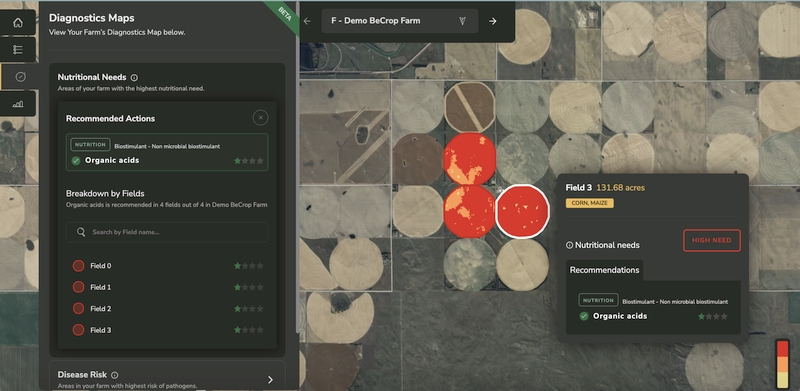
BeCrop Farm: Turning Biological Signals into Actionable Insights
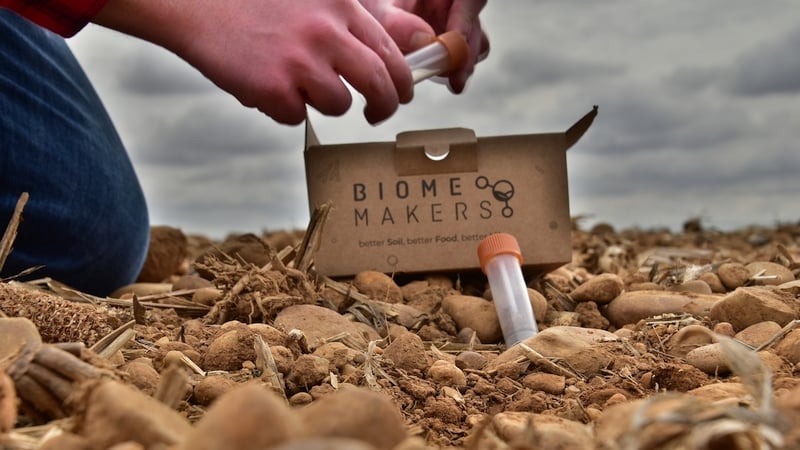
BeCrop Farm takes complex soil biology and translates it into clear, field-specific recommendations. That includes subfield-level insights to guide variable rate nitrogen applications.
“Instead of treating the whole field the same, BeCrop Farm shows how biological activity varies across acres,” says Kinsey. “You can layer that on top of organic matter maps, mineralization rates, and other data to really dial in your nitrogen strategy.”
For growers already leveraging precision agriculture, biological data adds another decision layer that has been missing. “Precision ag advanced dramatically over the last decade, but biology was largely treated as a black box,” says Plamann. “BeCrop Farm brings precision to soil biology, letting growers make smarter, acre-by-acre nitrogen decisions.”
The platform also integrates with traditional soil chemical testing, including the Haney soil health test, giving growers a more complete picture of soil function and fertility.
What Sets BeCrop Farm Apart
Beyond precision, the strength of BeCrop Farm lies in its global database and AI-powered analysis.
“We’ve built this on more than 200 crops, 56 countries, and an enormous volume of soil data,” Kinsey explains. “Particularly for row crops like corn and soybeans, our dataset is incredibly robust. That gives context to individual field results and helps growers understand what’s optimal or suboptimal based on real-world comparisons.”
The platform also addresses one of the biggest frustrations in the biological product space: inconsistency. As Plamann puts it, “You see biological products showing great ROI in some fields, but not in others. It makes sense when you look at the biology. If a soil already has high nitrogen mineralization, adding more biologicals may not move the needle. But where biology is lacking, the same product can drive significant yield and efficiency gains.”
BeCrop Farm helps demystify those scenarios by measuring the biological baseline first, so growers apply the right solution in the right place.
Biological Insights Driving ROI
Looking ahead, biological data is poised to reshape nutrient management strategies across the industry.
“For years, we’ve had good models for nitrogen efficiency based on chemistry and physics,” says Kinsey. “But biology was largely unmeasured. Now, we’re filling that gap. It’s not just about applying more fertilizer. It’s about understanding where the biology is working for you, where it’s working against you, and how to adjust accordingly.”
This approach has clear ROI implications, not only through optimized nitrogen use but also through improved yield stability, soil health, and long-term field performance.
“Ultimately, sustainability isn’t a buzzword,” Kinsey adds. “It means being able to farm that acre profitably year after year. That takes smart, science-based decisions. BeCrop Farm gives growers the tools to make those decisions with confidence.”
Want to sidedress smarter? Learn how BeCrop Farm can help you integrate biological data into your nitrogen strategy. Contact Biome Makers to get started.