
Phosphorus management remains one of the most persistent challenges in crop production. Fields can test adequately for phosphorus, fertilizer can be applied at recommended rates, and crops can still experience nutrient stress. The reason is simple: nutrients in the soil are not always available to the plant.
According to Mike Howell, vice president of agronomy at Ostara, the industry’s focus should extend beyond fertilizer rates and toward nutrient availability.
“The challenge is not simply applying more fertilizer,” Howell says. “It’s keeping the nutrients available throughout the growing season.”
For retailers, that distinction is becoming increasingly important as growers look for greater returns on fertilizer investments and seek strategies that improve nutrient use efficiency.
The Phosphorus Availability Problem
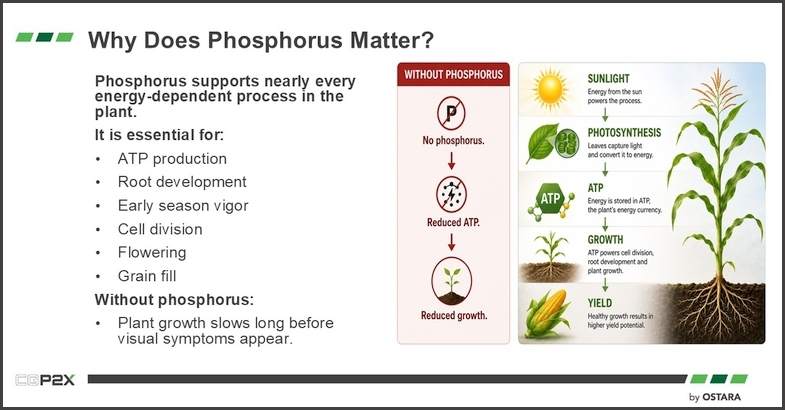
Phosphorus plays a central role in crop development. It supports energy transfer, root growth, cell division, flowering, and grain fill. Yet despite its importance, phosphorus presents unique challenges in the soil.
“Phosphorus is one of our most important nutrients for crop growth,” Howell notes. “It’s also one of the least mobile nutrients in the soil.”
Unlike nitrate nitrogen, phosphorus moves only short distances after application. Placement becomes critical because roots must physically reach the nutrient before it can be absorbed. Even then, a large portion of applied phosphorus may become unavailable.
In acidic soils, phosphorus can bind with aluminum and iron. In alkaline soils, it can react with calcium. These reactions convert phosphorus into forms that crops cannot readily access.
This helps explain why growers sometimes see phosphorus deficiency symptoms despite soil test results showing adequate nutrient levels.
Healthy Roots Drive Nutrient Uptake
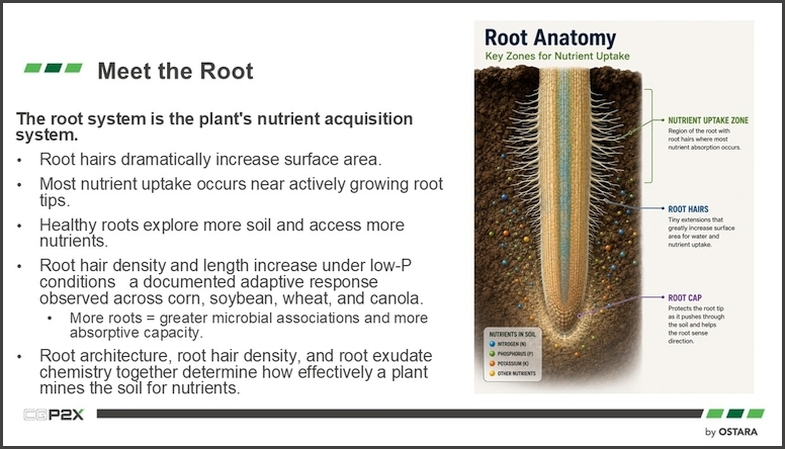
A plant’s root system serves as its nutrient acquisition network. Root architecture, root hairs, and root exudates all influence how effectively a crop can access nutrients.
Plants acquire nutrients through several pathways, including mass flow, diffusion, root interception, and biological activity. While mass flow and diffusion are well understood, biological processes are often overlooked in fertility discussions.
Root hairs dramatically expand the root’s surface area and help crops explore more soil volume. Under low-phosphorus conditions, many crops respond by increasing root hair density and length, allowing them to capture nutrients more efficiently.
Healthy roots also create favorable conditions in the rhizosphere, the biologically active zone where roots, soil chemistry, and microorganisms interact.
Root systems do more than absorb nutrients. They actively shape the environment around them, influencing pH, microbial activity, and nutrient availability.
The Microbiome’s Hidden Contribution
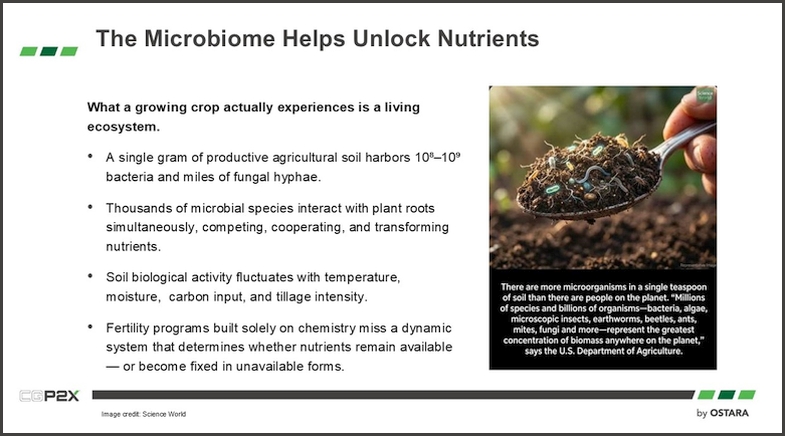
While fertilizer programs typically focus on chemistry, crops grow in a living ecosystem.

Dr. Shawn Semones, technology advisor at Ostara, says the soil microbiome plays a fundamental role in nutrient availability.
“The microbiome is critically important,” Semones explains. “It’s this biologically active zone that exists around the roots. This is where the actual roots, the microbes, the nutrients, and the soil chemistry all interact and ultimately allow nutrients to be available to the plant.”
That microbial community includes bacteria, fungi, and other organisms that continuously transform nutrients in the soil. Their activity helps mineralize organic matter, release nutrients, and improve nutrient cycling.
Many microbes also produce organic acids that influence nutrient solubility and availability near plant roots. Within the rhizosphere, these biological processes support the continuous exchange of nutrients required for crop growth.
“Soil biology is not separate from fertility,” Semones notes. “When you have a healthy microbiome, a healthy soil biota in combination with the right nutrient program, you end up with a better performing plant.”
For retailers, this highlights the importance of considering soil biological activity alongside traditional fertility metrics.
Why Mycorrhizal Fungi Matter
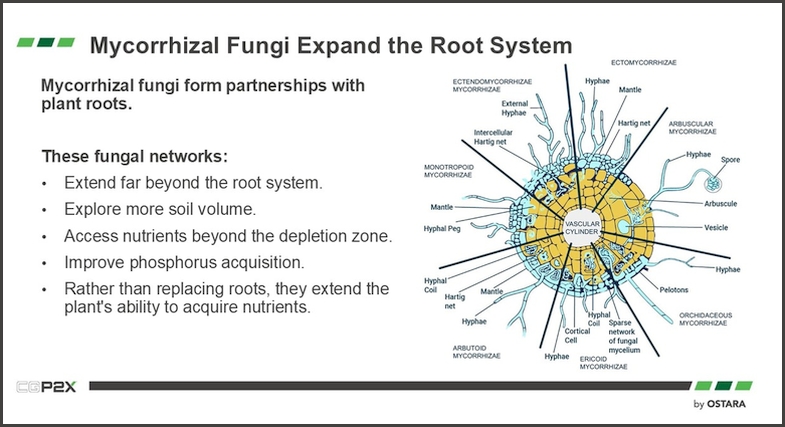
Among the most important members of the soil microbiome are mycorrhizal fungi.
These fungi form symbiotic relationships with plant roots and extend microscopic hyphae far beyond the reach of the root system itself. Those networks effectively increase the plant’s ability to explore soil and acquire nutrients.
“The fungi actually connect to the plant, reach far out into the soil, grab onto nutrients that the plant can’t get to either by its roots, fine roots or root hairs, transfer those back to the plant for easy access,” Semones says.
This relationship is particularly valuable for phosphorus acquisition. Because phosphorus is relatively immobile, depletion zones often form around roots as nutrients are absorbed. Mycorrhizal fungi allow plants to access phosphorus reserves beyond those depletion zones.
The result is a larger effective root system and greater nutrient acquisition capacity.
According to Semones, roughly 95 percent of land plants form some type of mycorrhizal association, making these relationships a critical component of nutrient use efficiency.
A Different Approach to Phosphorus Delivery
The interaction between roots, soil biology, and nutrient availability is the foundation behind Ostara’s CG P2X ™ Fertilizer.
CG P2X is a 9-42-0 fertilizer that combines nitrogen, phosphorus, and nine percent magnesium in a single granule. It was designed to address many of the limitations associated with conventional phosphate fertilizers, including nutrient tie-up, nutrient loss, seed safety concerns, and uneven nutrient availability.
Rather than rapidly dissolving after application, CG P2X relies on interactions among plant roots, soil chemistry, and microbial activity to release nutrients over time. Semones describes this process as being driven by crop demand and biological activity in the rhizosphere.
“We say on demand, but that demand is created not only by the plant, but the soil and the biology in the soil,” he says.
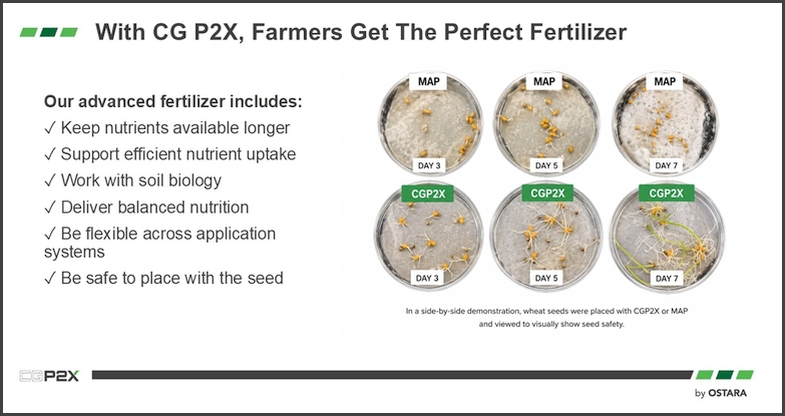
Because the product has a low salt index, it can be placed closer to seed than many conventional phosphorus sources. Ostara also reports that more than 95 percent of the nutrients in CG P2X remain available to the crop during the first year after application.
Research highlighted by the company shows the granules remain physically intact in the soil significantly longer than conventional phosphate fertilizers. In one study, CG P2X maintained its original weight after three months in the field, while traditional phosphorus sources experienced substantial losses.
According to Howell, the product’s efficiency allows growers to achieve comparable crop performance with less total phosphorus applied.
“If you were applying 100 pounds of MAP, we recommend that you apply 60 pounds of P2X,” Howell says.
Measuring Success by Nutrient Efficiency
As fertilizer costs continue to influence crop economics, nutrient efficiency has become a key performance metric.
Applying more fertilizer does not necessarily translate into greater crop uptake. The more important question is how much of the applied nutrient ultimately reaches the plant.
“Nutrient efficiency matters more than application rate,” Howell says. “The value of your fertilizer and your nutrition package should be measured by how much of that actually gets into the crop and produces yield in the end.”
That shift in thinking has led to growing interest in advanced fertilizers designed to maintain nutrient availability while supporting healthy root systems and soil biology.
For retailers, this means evaluating fertility programs through a broader lens. Nutrient chemistry, root development, microbial activity, placement, and soil conditions all influence fertilizer performance.
The most successful programs recognize that fertility is not simply a matter of supplying nutrients. It is about creating conditions that allow crops to access those nutrients efficiently throughout the season.
“When you put all of that together, you get the best nutrient availability and the best nutrient use efficiency,” Semones notes.
The interaction between roots, soil biology, and nutrient management ultimately determines how effectively crops convert fertilizer investments into yield. For retailers helping growers maximize performance, understanding those connections has become increasingly important.

If you missed the live broadcast of this webinar, “How Do Crops and Soil Biology Work Together to Secure Critical Nutrients” you can view the archived version online here or visit CropLife.com/webinars and check it out today.