
When Fertility Isn’t the Problem: Using DNA to Diagnose Soil Issues
When two fields look the same above ground but yield very different results, the cause often lies where you can’t see it—in the biology of the soil. Biome Makers’ in-season DNA soil testing gives growers the power to uncover hidden factors that limit performance. By identifying both the microbial species present and the functions they perform, soil biology is turned into clear, actionable insights for stronger crops.
“DNA testing lets you measure something you can’t see,” explains Scott McElveen, Technical Sales Representative for Biome Makers. “You can have two areas of the field that look identical but behave very differently. The difference can be an invisible, biological root cause.”
Biome Makers uses its BeCrop® testing platform to analyze soil microbial DNA, pairing species identification with functional profiling. Instead of just listing which microbes are present, the platform maps what those organisms can actually do—from nutrient cycling to disease suppression to stress mitigation. The result is a clear, actionable picture of the soil’s biological capacity.
Why In-Season Testing Matters
The best time to run DNA testing is when you notice performance differences during the growing season. That’s when comparisons between a strong area and a weak one can be most revealing.
“Always work with at least two samples,” recommends Mark Kinsey, US Sales Director for Biome Makers. “A single test can only tell you what’s in that one spot. Two tests let you see what’s different between good and poor performance.”
For example, if the weaker area has higher disease pressure and lower biocontrol capacity, the crop may divert energy into defense instead of growth. If both areas have similar nutrient availability but very different stress adaptation scores, the issue might be abiotic stress tolerance rather than fertility.
Pathogens Without Infection Still Cost Yield
One of the most important insights from DNA analysis is that pathogens can reduce yield potential even without causing visible disease. Plants sense pathogen-associated molecular patterns and activate their immune systems in response. This “pattern-triggered immunity” diverts resources away from growth.
“If a young plant is allocating energy to defense, it’s not putting that energy into yield,” Kinsey notes. “You don’t have to see full-blown disease for pathogens to be costing you.”
BeCrop® reports account for both pathogen abundance and the soil’s natural biocontrol potential. The worst-case scenario is high pathogen presence with low biocontrol capacity—a vulnerable soil that leaves plants to fight alone. The best case is low pathogen levels and strong biocontrol agents already in place.
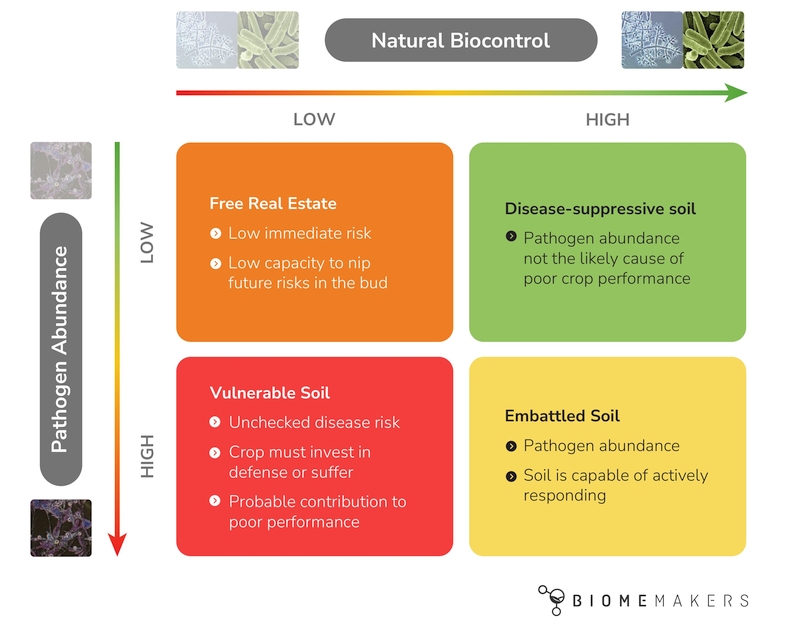
Biocontrol requires planning. “You can’t apply Trichoderma after a plant is already infected and expect it to work,” McElveen says. “The biocontrol agents have to get there first.” That means matching products to target pathogens, applying them under conditions where they can perform, and delivering them early enough to establish before disease pressure hits.
Stress Adaptation: The Microbial Safety Net
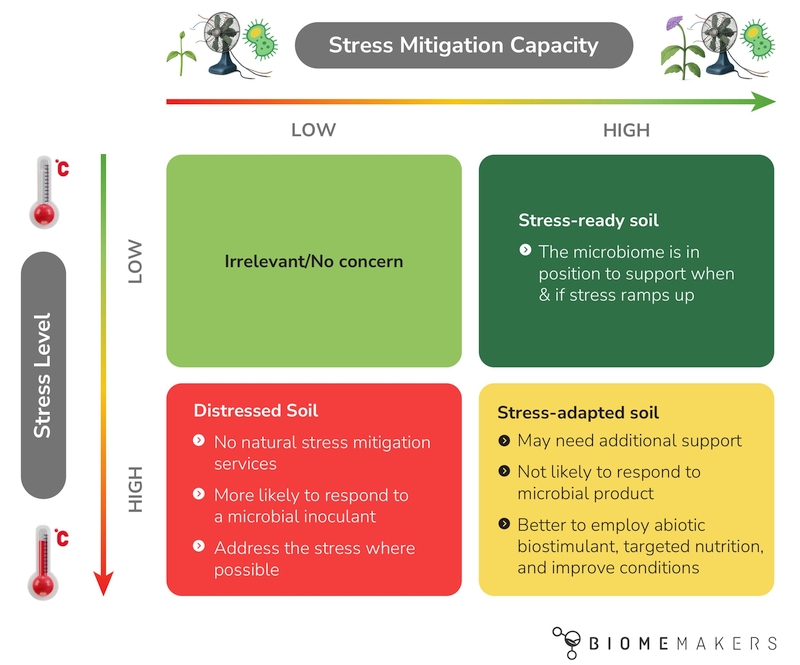
Abiotic stress—drought, heat, salinity, and heavy metal toxicity—can limit yield as much as disease. BeCrop® testing measures the abundance of microbial functions that help crops adapt, including exopolysaccharide production (which improves water retention), salt tolerance, heavy metal resistance, and production of plant stress hormones like salicylic and abscisic acid.
McElveen describes exopolysaccharides as “the glue that holds soil aggregates together,” creating a more stable, water-holding environment around roots. Higher scores indicate the soil microbiome is ready to help plants manage moisture swings and nutrient availability.
As with pathogens, the degree of stress, taken together with the capacity of the microbiome to mitigate the impact of that stress on the crop, informs what interventions are best placed to protect yield. A soil facing high stress with low adaptation capacity is the one most likely to benefit from inoculation with stress-mitigating microbes.
Plant Growth Hormones: The Growth Engine
The final functional area is plant growth promotion, driven by microbial production of hormones such as auxins, cytokinins, and gibberellins. These guide root architecture, nutrient foraging, and overall vigor.
“Organisms that produce plant growth hormones are often the same ones that deliver multiple other benefits,” McElveen says. “I look at hormone production as a proxy for whether you have growth-promoting microbes in general.”
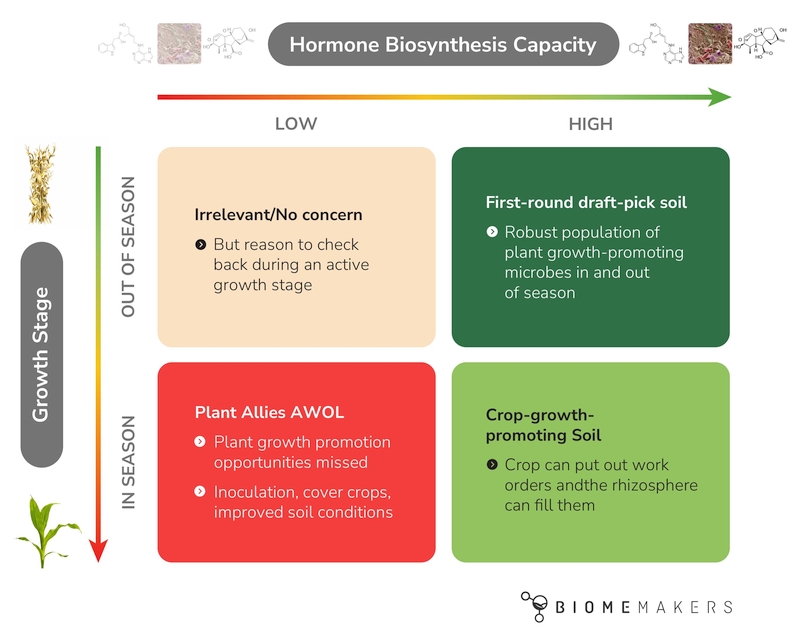
Timing matters. High growth hormone capacity during the active growing season is a strong advantage. Low capacity in-season means the crop is missing out on potential vigor, making microbial inoculation or changes to soil conditions worth considering.
Case Study: Diagnosing Chronic Underperformance
One grower had been trying to improve a consistently underperforming section of irrigated land for four years. Soil chemistry tests showed increased nutrient availability, and DNA analyses indicated better nutrient cycling potential in the weak zone compared to the strong zone. However, DNA analysis also revealed high disease pressure, low biocontrol scores, and reduced stress mitigation capacity on the underperforming ground, which desperately needed stress mitigation.
“They’d been greasing the squeaky wheel with the wrong grease,” McElveen says. “The problem wasn’t nutrient deficiency at all. It was biology.”
The comparison showed, for instance, that the strong area had more exopolysaccharide-producing microbes, helping it cope with moisture variability. That insight opened the door to targeted interventions rather than blanket inputs.
From Data to Decisions
Soil DNA testing isn’t about collecting data for its own sake. It’s about matching management actions to actual biological conditions. Comparative sampling helps isolate causes, separate nutrient issues from biological ones, and decide where to invest resources.
Kinsey sums it up this way: “Understanding what’s happening biologically in the soil lets you know when, where, and how to act—and just as importantly, where not to waste effort.”
How to Get Started
Growers can begin with the BeCrop® Test, which delivers functional soil biology profiles through a web portal. For higher-resolution mapping, BeCrop® Farm uses AI to integrate over a thousand data layers and pinpoint sampling zones across the field.
If you’re already scouting with imagery or NDVI, you can use those tools to define sampling areas for the BeCrop® Test. For a precision approach, BeCrop® Farm generates functional maps that can guide variable-rate applications, prioritize fields under stress, and fine-tune timing.
To get actionable insights from your own soils:
- Identify a performance contrast—strong and weak areas, or high and low yield zones.
- Pull comparative samples during the growing season for maximum decision-making value.
- Review the functional report to pinpoint whether pathogens, stress, or growth-promotion capacity are limiting performance.
- Act early when deploying biocontrol or stress-mitigating products, so they are in place before threats peak.
Chronic underperformance doesn’t have to stay a mystery. Soil DNA testing gives you the functional map of what your fields can and can’t do, turning invisible biology into clear next steps for better yields.
Learn more here: https://info.biomemakers.com/what-youre-not-measuring-might-be-costing-you-yield