PlantBeat: Your Plants’ Pulse In The Palm Of Your Hand
 September 10, 2014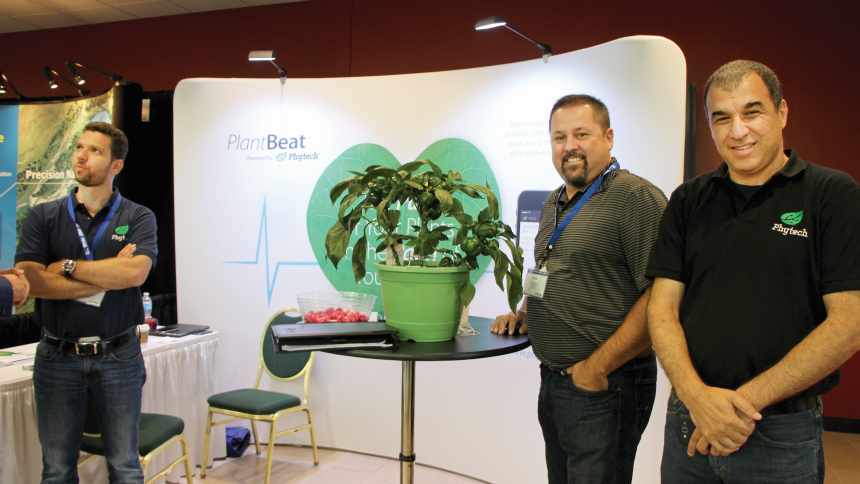
Phytech introduced its PlantBeat technology at InfoAg 2014.
The struggle between Israeli and Hamas forces in the Middle East has ramped up considerably in recent months. Thankfully that state of affairs didn’t dissuade Israeli agriculture tech firm Phytech from making the trek to InfoAg in July, where the Kibbutz Yad Mordecai-based outfit debuted its intriguing PlantBeat technology to the domestic precision ag crowd.
Already in place across thousands of acres in its native Israel, as well as with Paramount Farms, California’s largest grower of almonds and pistachios, as part of a joint R&D program with University of California-Davis researchers, PlantBeat is primed for a full U.S. launch this year in several specialty crop markets (cotton, tomatoes, apples, nuts, citrus, grapes, etc.) before making a planned jump to corn and soybeans by 2016, according to the company.
The system itself features unobtrusive sensor hardware that attaches at the stalk (or fruit for fruit crops) to approximately two or three plants per thousand acres, where it continuously monitors miniscule plant growth contractions (i.e., the plant’s “heartbeat”), translating the growth data into what Phytech calls “actionable real-time alerts and recommendations” that are beamed via cloud directly to a grower or agronomist’s smartphone or tablet.
“The raw data looks similar to a graph of an EKG if you were to monitor our hearts,” says Sarig Duek, CEO, during an interview at InfoAg 2014. “Every day, every plant in the 24-hour cycle, it shrinks and it swells. How much does it shrink, and when is the plant OK, and when is it stressed? This is a grower-focused, in-season decision support tool that is based on plant monitoring, because the plants themselves tell the story of the crop.”
What PlantBeat is aiming for, according to Duek, is enhanced insight into the always-evolving, real-time condition of the plant.
“Once the crop is planted, now you obviously have the growing season to manage,” he says. “In irrigated plots, the first question a grower or agronomist will ask themselves every single day is, ‘When do I need to irrigate again, and how much do I put on?’”
“So we try to help with what we as a company call ‘the loneliness of decision making’, because the grower can call the agronomist, but now the agronomist needs to make a trip out to the field,” Duek adds. “And if the plants are indeed stressed, it will usually not show up to the naked eye until about five days later, so the agronomist likely can’t see it right away either. But if you are continuously monitoring with these sensors you see the stress as it develops, and you act on it immediately, saving potential yield loss.”
Field Proven
Working alongside ag researchers from the University of California-Davis on the R&D end of things, PlantBeat is already making its mark in one of America’s most unforgiving growing climates: California.
“As everyone knows, California is in the midst of a big drought, so basically all of the best practices established over the years cannot take place anymore (with water restrictions) or they have changed,” says Duek. “With UC-Davis researchers we have combined data from PlantBeat with data from their deficit irrigation trial. So now we can look and say, ‘Hey guys, when you manage water and optimize your irrigation to a certain point, we know that stress levels will not pass a certain level, and you can achieve such-and-such yields.’”
Another significant aspect of PlantBeat is that the product is offered purely as a service; users don’t purchase the sensors that Phytech deploys in their fields, giving them the ability to trial the system without much of an investment commitment.
“Last season our growers in Israel, they achieved around 11% greater yields than the country average by acting on data from PlantBeat,” says Duek. “The service itself costs around $20 per acre, but these growers averaged around $300 profit per acre from that extra yield bump. And that’s not even counting the optimization of irrigation, which also saves a lot of money.”
Subscribe Today For
