AI in Agriculture Advancing Rapidly
 March 19, 2025
 In late January, a Chinese company introduced the world to its newest artificial intelligence (AI) product. Called DeepSeek, this program was reportedly as advanced as existing AI programs but had been developed at a fraction of the cost. Almost immediately, the stocks for U.S. technology companies with AI systems plunged in market value, temporarily sending financial shockwaves throughout the nation’s economy.
This incident helped aptly illustrate a point made by Brian Lutz, Vice President, Agricultural Solutions at Corteva Agriscience, at the 2025 Illinois Fertilizer & Chemical Association (IFCA) annual meeting a few weeks earlier in January.
“I’m sure you are all hearing quite a bit of buzz about AI and how it will impact various parts of our lives and industries,” said Lutz. “You don’t have to look far at all to see AI in action. Really, AI is all around us.”
Of course, the evidence suggests that AI in agriculture is still somewhat underperforming. In CropLife® magazine’s ag technology survey, conducted in the fall of 2024, the percentage of ag retailers planning to purchase AI-based systems for their operations in 2025 stood at only 28%. This trailed such ag tech segments as drones and software systems in terms of planned purchase percentages (30% and 29%, respectively).
A more recent survey showed similar percentages for AI systems. According to data collected in the 11th annual CropLife Ag Retailer Buying Intentions Survey, 30% of respondents expect to spend increased amounts on AI systems this year (between 1% and more than 11% vs. their 2024 spending). Twenty-two percent expect to spend less on AI products in 2025. The remaining 48% plan to spend the same amount on new AI systems as they did during the 2024 growing season.
A Long History
According to Lutz, the concept of AI goes back more than 60 years. The term was first coined in 1956. Throughout the 1980s and 1990s, this quickly became a staple of science fiction television shows and movies — everything from positive portrayals such as “Star Trek: The Next Generation” (the android Commander Data) to extremely negative ones (the mankind killing Skynet computer in “The Terminator” movies). In the meantime, AI advancements extended into real life from there, including the IBM Deep Blue computer beating the reigning chess champion in 1997 to the release of ChatGPT in 2022.
At its heart, said Lutz, AI can be defined in this way. “AI is the mechanism to incorporate human intelligence into machines through a set of rules or algorithms,” he said.
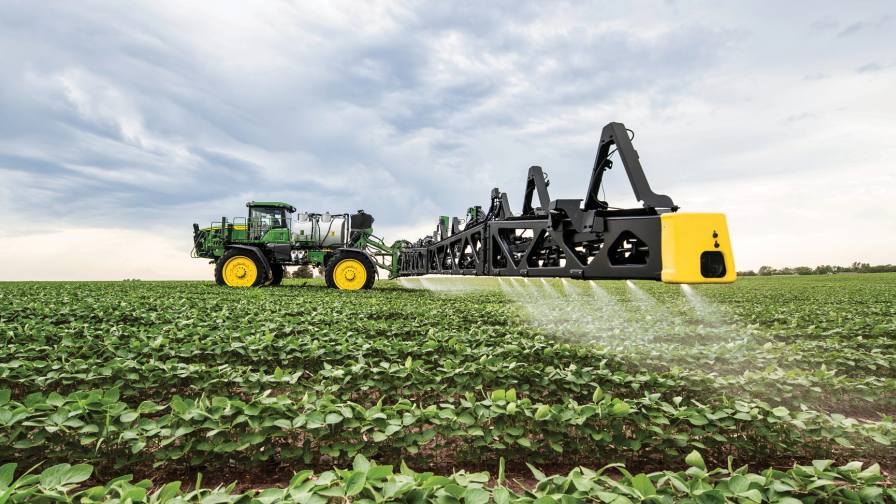
John Deere’s See & Spray is an example of Machine Learning AI.
In agriculture, AI first presented itself as part of John Deere’s See & Spray system, introduced in 2017. This product, designed to be used on the company’s self-propelled sprayers, incorporated AI learning to help the units quickly identify weeds vs. crops and spot apply herbicide applications accordingly.
According to Lutz, See & Spray is an example of one type of AI system called Machine Learning. A term first introduced to describe AI systems back in 1959, Machine Learning is defined as an application of AI that provides systems the ability to automatically learn, predict, and improve from experience without being explicitly programmed.
Besides Machine Learning, there are two other types of AI systems approaches in the mix, said Lutz. The first is Deep Learning. “Deep Learning is a subset of Machine Learning that uses neural networks — similar to the neurons working in the human brain — to mimic human behavior,” he said.
The last type of AI is one Lutz expects to see lots of activity in during 2025 and beyond for agriculture. It’s called Generative AI (GenAI for short). “GenAI refers to a branch of Deep Learning that focuses on creating new content or data that resembles a given training set,” he said. “And these systems are advancing rapidly. Today’s GenAI models are 10 billion times larger than the Deep Learning models a decade ago.”
The New AI Systems
Already in 2025, there have been numerous AI-oriented systems launched catering to the agricultural marketplace. For example, in January, CNH Industrial N.V. — the parent company of Case IH and Raven Industries — introduced a chatbot powered by AI system called CNH AI Tech Assistant. The systems works by simulating conversations to provide a diagnosis and repair plan for CNH brands’ machines. This tool enables dealer technicians to save time on repairs by providing fast and accurate answers to technical questions.
A first-of-its-kind tool was developed with dealer feedback, CNH AI Tech Assistant tool is already at work at over 300 authorized agriculture and construction dealer groups in North America, Australia, and New Zealand, with global expansion underway.
“The AI Tech Assistant is trans-formative and sets a course in future tool development that is instinctive to resolving dealer needs,” said Rosella Risso, Head of Agriculture Parts & Service at CNH, in a press release announcing the launch. “Our goal within the Global Parts & Service team is to simplify repair processes, improve uptime and customer satisfaction with their machine.”
At Syngenta, CEO Jeff Rowe had this to say about using AI in its operations. “AI and digital tools are revolutionizing farming and sustainable practices,” said Rowe in a recent panel discussion on the topic. “Advanced monitoring systems integrate satellite imagery, drones, and soil maps to enable precise crop management. Predictive analytics, powered by AI and machine learning, provide farmers with actionable insights, transforming reactive practices into proactive strategies.”
He added that the company is working on the next generation of biologicals products for agricultural use in conjunction with a company called TraitSeq and its proprietary AI methods to identify highly specific indicators of a plant’s cellular state called biomarkers. Using TraitSeq’s proprietary platform, scientists from both companies are hoping to leverage AI to analyze complex biological big data, to uncover the intricate molecular interactions that impact a crop’s ability to utilize available nutrients in the soil.
“At Syngenta, we are accelerating the pace at which we innovate, to deliver solutions farmers urgently need,” said Camilla Corsi, Head of Crop Protection Research, in a press release on the partnership. “Technologies such as TraitSeq’s AI-driven platform enable us to revolutionize our research, attain important data-driven insights, so that we can develop the next-generation of sustainable solutions.”
At Corteva, said Lutz, the company is also using AI systems to aid in its crop protection products and seed developments. “Corteva generates more sequence data in less than one day than what the world had prior to 2009,” he said. “The first genome sequence was achieved at a cost of $300 million and took years. Today, we can sequence a genome in days at a cost of a few hundred dollars.”
And GenAI modeling will continue to grow in importance throughout 2025, he predicted. “Recent advances have enabled a step-change in our ability to model proteins and molecules,” said Lutz. “These models promise to accelerate the speed of innovation in key ag inputs.”
Subscribe Today For
