In-Plant Equipment and Systems: Real-Time Data, Labor Challenges Among Leading Adoption Drivers for Latest Automation Technology
 April 16, 2025
Murray Equipment’s ICS in-plant systems increase speed, safety, accuracy, and efficiency at the plant(s) all the way through to the back office.
As the understanding of a crop’s needs grows the importance of delivering the right mix of products becomes more critical. Combine that with worker shortages and rising costs means getting it wrong could lead to disaster.
“Between industry consolidation, higher inventory costs, and labor shortages, in-plant systems have become a necessity for ag retailers and wholesalers who are looking to stay competitive,” says Todd Scobie, Director of Sales and Marketing, Murray Equipment Inc. (MEI). “The speed, accuracy, and efficiency advantages of in-plant systems are so clear that ag retailers and wholesalers recognize that their longevity is tied to in-plant equipment and systems.”
From variable rate technology to artificial intelligence the technological sophistication at the retail level and among their grower-customers varies greatly.
“To date, the agricultural retail market has largely embraced some level of technology,” says Sam Pendleton, Vice President of Sales at Easy Automation, Inc. (EAI) “However, the extent of adoption varies widely, with many facilities still relying on outdated systems despite advances in automation. While automated systems have been around since the 1970s, only industry innovators and early adopters are investing in the latest in-plant equipment and systems, leaving the majority behind. We see skilled-labor accessibility, inventory management, and blend accuracy as primary drivers in the decision making behind an investment in automation technology.”
Drivers
The gap between those left behind and those adopting the latest technology is widening.
“There are two main driving factors,” Pendleton says. “First, real-time data. In the heat of the busy season, the ability to review real-time data for their facility, including inventory, equipment efficiency, and billing and accounting, is a game-changer. It allows the ag retailer to be able to anticipate and respond quickly with informed, data-driven decisions. The second is labor. Ag retailers are faced with numerous challenges surrounding labor including lack of availability and training.
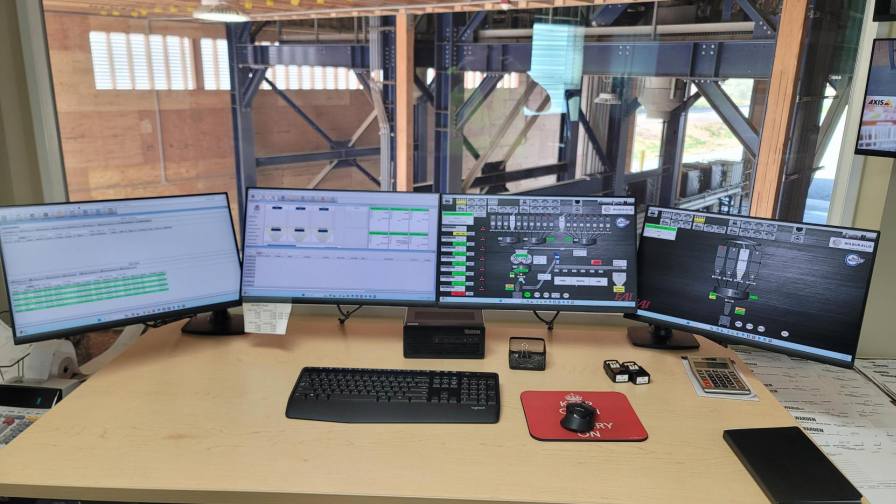
Modernized, streamlined office utilizing computer-based software and HMI for facility control. These HMIs are customized for this specific dry agronomy facility averaging 45,000 tons per year. Photo: Easy Automation
“While there is a desire to reduce labor, this need is rooted in the desire to simplify or eliminate the mundane and tedious tasks employees are having to deal with throughout the day,” Pendleton continues. “If automation technology can handle those repetitive tasks, employees can utilize their talents and skills to improve the facility in other ways.”
According to MEI’s Scobie: “Turn-over and labor shortages have been a pain point for ag retailers in recent years. At MEI, we’ve focused on making our in-plant systems intuitive, accurate, and safe. We offer several HMIs (human machine interface) so users can access the systems from tablets, control boxes, and computers. This allows users to effectively be in multiple places at the same time. We’ve also seen an uptick in unattended solutions. This allows inventory to be moved around the clock and ease the burden on plant staff requiring less overtime and increasing throughput during the day.”
Unless someone has been living “off the grid” for the past year, it would be hard for anyone to not understand the way artificial intelligence has been integrated into many aspects of daily life. In-plant systems and equipment are no different.
“Machine learning has been an element to our automation systems for some time now,” EAI’s Pendleton says. “While adoption of this technology is continuously increasing, machine learning and AI is run on data provided by the facility. Collecting data at a facility starts with investments such as installing modern, accurate sensors and ensuring all equipment is connected and controlled by an automation system. These are the first steps in preparing your facility for the ability to integrate more sophisticated machine learning and AI into your facility.”
MEI’s Scobie shares other factors driving the need for versatile and efficient equipment. “Consolidation and increasing competition, rising inventory costs, and labor challenges is driving ag retailers to update their facilities with the latest in-plant technology.
“As facilities age, we will see more and more retailers updating their in-plant systems,” Scobie continues. “We are also involved in a lot of new facilities as retailers are looking to expand into new markets, take control of their inventory company-wide, and simplify procedures for less experienced employees.”
Expectations
“The standard of performance for these systems has increased in the past several years,” EAI’s Pendleton says. “In the beginning, the expectation of the system was to simply make the equipment run. As automation technology and equipment has become more reliable and accurate, the next step is efficiency and overall speed of the system. Programs have become faster, have more integrations, and more technology implemented directly into the equipment.”
According to Scobie, retailers are finding additional advantages to employing the latest in-plant equipment.
“With inventory and commodity prices, retailers, and wholesalers are finding value in shared inventories across regions,” Scobie says. “ControlPro Central HUB, allows all company locations and the home office to work in unison. One of the benefits to MEI’s ICS Controls is that we continually push out updates. Our products tend to evolve with new features being added throughout the year as we partner with customers to help them be more productive.”
Among the latest advances is ensuring connectivity to existing tools.
“We all have small computers in our pockets with our smart phones,” EAI’s Pendleton says. “The power of these phones and their role in increasing efficiency of systems is just starting to surface. As we have created more integrations and APIs we have found ways to leverage phone apps and QR codes in driver interactions. For example, truck flow through a facility can now be streamlined as drivers can use their phone to scan or provide load information and be routed to the correct loading area to deliver or receive product. Essentially, they can flow through a facility without ever having to leave their sprayer or truck. This helps keep wheels turning and planters planting. All with the tools that are already in our pockets, our smart phones.”
Evolving
As the understanding of agriculture needs above and below the ground continues to advance retailers must work to understand how in-plant equipment and systems adapt to meet that growing knowledge.
“Today, each ag retailer can build their customized set of tools within their system that best fits the needs of their facility,” EAI’s Pendleton says. “Instead of having to use one type of system to solve all of their issues, there are many different types of ERPs and work order platforms to integrate into the automation technology system. We have adapted to this desire for customization by developing APIs (application programming interface) and integrations for the end-users to be able to transfer information back and forth between their desired tools to assist in data transfer, accounting and inventory management.
“We expect to see more retailers moving toward unattended systems,” Pendleton says. “Unattended meaning no labor, fully automated. Growers can pull into the load-out system, enter their order information and load themselves in a safe and efficient manner. We also expect to see continuous advancement in system capabilities as we adopt new technologies that are presented to the industry, such as AI.
“Automation isn’t just controlling the equipment at the plant; automation brings the whole operations together and allows the facility to reach its peak efficiency and capacity by bringing complex systems to the surface through our programs,” Pendleton adds. “From work order, ERPs and inventory management to the HMI that is actually turning on and off equipment, automation technology provides connectivity between it all. If you’re looking for a way to not only level up your facility in terms of speed and efficiency, but also leverage real-time data to make strategic decisions, automation is the place to invest.”
Subscribe Today For
