Weathering Liquid Storage Challenges
 October 10, 2015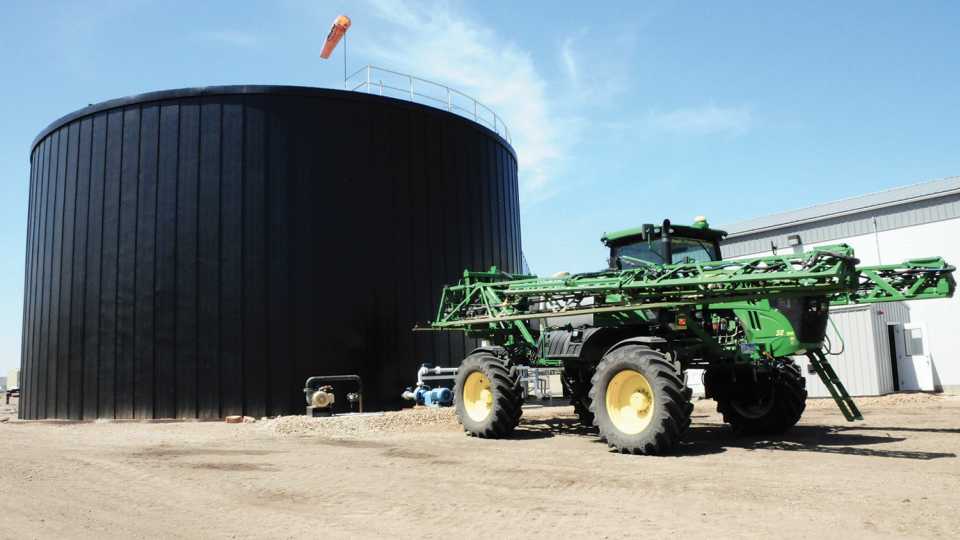
Heartland Tank Companies will be completing more heated, insulated storage in 2016, like this heated tank at a Helena Chemical facility in Madison, SD.
As reported in CropLife’s® second annual Facilities Report in July, large-scale plant builds and upgrades continue strong. But dealers and growers are very interested in smaller scale projects as well, purchasing varied sizes of tanks and their accompanying containment.
Unfortunately, the weather hasn’t exactly been the most job-friendly. For instance, with the harshness of the past two winters, Heartland Tank Services has experienced a short off season to get all its tank construction and inspections done, says Chris Brooks, president. “We have to wait for the ground to warm so tank foundations can be put in place, and then the owner needs the tanks completed in the early fall for fill,” he explains. Having enough qualified labor to meet the deadlines for these builds has become a challenge as well.
The cold winters have also created many salt issues with dealers trying to store 32% nitrogen in tanks that are too small — and in some cases filling them with 32% nitrogen in the dead of winter, says Brooks. “Many owners who stored 32% in the past without problems have been surprised with the salt issues come spring. This in turn has caused many problems with internal PVC liners and has placed a heavier demand on our crews for repairs,” he explains.
Heartland Tank Companies is planning and will be completing more heated, insulated storage with containment systems in 2016. These systems are designed for products that cannot freeze or that have a higher salt out temperature.
“We’re finding that many customers do not have the personnel or manpower to manage new construction installations and are having to use multiple vendors to complete them,” says Brooks. Many need a general contractor that has experience in fluid and dry fertilizer facility construction. Heartland will be offering and producing complete turnkey liquid solutions for customers who want them, which will include engineering, site plans, plumbing design, load-in and out facilities, storage tanks with containment systems and installation of all plumbing with automation — along with construction and management and start-up.
The wet summer in some regions also impacted the business. “It’s presented some scheduling challenges for construction,” notes Christina Schmidt with J.C. Ramsdell Enviro Services.
Ken Hunter, president of Hunter Agri Sales, says that with all the rainfall in the Midwest in 2015, having containment under a roof was a big plus. Hunter’s Plia-Tank unit has been a best seller for the company, and one benefit of the system is that it allows buyers to build primary and secondary containment under one roof. “They don’t have to deal with rainwater,” he says.
Hunter has seen plenty of wicked weather in his career, especially considering 2016 will mark the 40th year his company has been selling products to fertilizer dealers and ag suppliers.
More Liquid Storage Needed
Tank companies CropLife contacted agreed that liquid fertilizer use is on the rise among growers. “We’ve seen continued growth of liquid fertilizer and liquid starters in the upper Midwest, and that has helped our sales over the last 12 months,” reports Brent Friesen, sales manager at stainless tank manufacturer Novid Inc. He credits the higher demand to more acreage in the region being planted to crops such as canola and corn.
In fact, more stainless steel storage is being built for dry products as well as liquid, Friesen says.
Another trend is more on-farm liquid storage by growers. Hunter says lower grain prices are spurring them to try to get fertilizer at lower costs in the off season. In addition, farming operations continue to get larger, also increasing the need for more storage. Plus, Friesen points out that on-site resources allow growers to speed up planting in the spring — they don’t have to wait on product delivery at crunch times.
Lower commodity prices have caused some large-scale liquid construction to slow. Butch Kirk, president of International Tank Service (ITS), says large builds of new liquid UAN fertilizer tanks are down. “We’re still building new tanks this year, but not as many as in the past,” he notes.
Whether at farms or dealerships, J.C. Ramsdell’s Schmidt has seen an increase in smaller tanks being installed for liquid fertilizer. “Here we recommend our wooden containment dike that unlike concrete, will not crack. We have had these systems installed and in use for more than 20 years,” she points out.
At presstime, J.C. Ramsdell had designed and installed over 500 wooden systems, constructed of No. 1 lumber that is custom-treated for ground contact and potential decay. Schmidt notes that wooden containment is ideal for liquid fertilizer, which can be corrosive to steel and concrete.
New Developments
Tank manufacturers continue to expand and tweak their lines to meet customer demands. For instance, this year, in a move to expand and diversify in the ag tank marketplace, Precision Tank acquired A&B Welding.

David Hemming, Precision Tank & Equipment President/CEO
David Hemming, CEO & president, explains that combined, the two firms will be able to offer a full range of tanks, from smaller stainless, fiberglass and mild steel tanks all the way up to tanks with three million gallon capacity.” Both companies serve different areas in the agricultural tank market — so together they will be able to offer additional products, resources and services to agriculture retailers throughout the Cornbelt.
Novid recently started manufacturing stainless steel cone bottom tanks for chemical storage. The company continues to expand the sizes it offers in flat-bottom tanks, to accommodate customers’ changing needs, says Friesen.
Enviropac launched its sharp new user-friendly Website this year, which includes the firm’s new logo and tagline, “Products for a better environment.” Dennis Neal, president, made the case for choosing fiberglass tank options, noting they are maintenance-free and never rust. “Highly corrosive liquids seem to have an appetite for mild steel,” he says. And he touts the affordability of large capacity fiberglass tanks.
J.C. Ramsdell recently introduced its Rail-Guard containment system in response to an accident where a customer experienced a complete product release from a railcar. The facility’s owners wanted a solution if such an problem ever happened again.
The build provides containment of a spill at facilities where products are loaded or unloaded by rail, says Schmidt. “Typical drip pans that are placed at facilities catch just that, drips or small gradual spills,” she says. “If a large spill occurs, the facilities face massive clean-up costs, possible lawsuits, and a loss of valuable products into the ground. Rail-Guard captures a complete railcar failure.”
ITS’ Kirk describes a recent change in tank construction technology. Previously, customers had put a HDPE liner inside a tank for corrosion protection and secondary containment. “But now they’re leaving the liner out and putting it within the dike wall and also underneath the storage site,” he describes. Kirk says this is a move back to more traditional containment style, where the liner is outside the tank, under the tank and not in it.
States are not only adding and changing tank and containment regulations, their requirements can differ from federal measures. “If you’re selling to farmers, you must be aware of these changes,” says Hunter. He offered some good news, though. Several states are offering cost-share assistance on containment builds through Natural Resource Conservation Service programs.
“Customers ask if their tanks need to be set in a containment system and that always comes down to local state laws. Stainless steel doesn’t crack and split so the chance of needing containment is almost nil,” says Novid’s Friesen says. He touts the benefits of stainless tanks, saying they offer significantly reduced maintenance costs and ultimately increased productivity — something customers are always looking for.
Subscribe Today For
