The Work-A-Round: Addressing Tanks and Containment Challenges Within Tight Budgets
 October 12, 2026
 Ag retailers are shoring up their existing tanks and systems for future dependability while retrofitting them with technology to track every drop of costly inputs.
“As the pricing for liquid fertilizer products continues to increase, our clients are becoming more vigilant in tracking every gallon they move through their systems, and improved measurement systems will continue to become more common,” says Paul Butler, Eastern Sales Manager for Heartland Tank.
Tank and containment suppliers reported a downturn in new construction throughout 2026 attributed to macroeconomic trends. Butler says, on top of rising fuel and fertilizer costs, steel prices for building tanks is skyrocketing due to demand from data center builders.
These market challenges, as well as industry labor shortages, are increasing prices, according to Dale Pedersen, Business Development Manager for Agra Liners.
Given these circumstances, retailers are bypassing larger prices by investing in fortifying established systems. Ag retailers are also looking at efficiency and tracking every ounce of product.
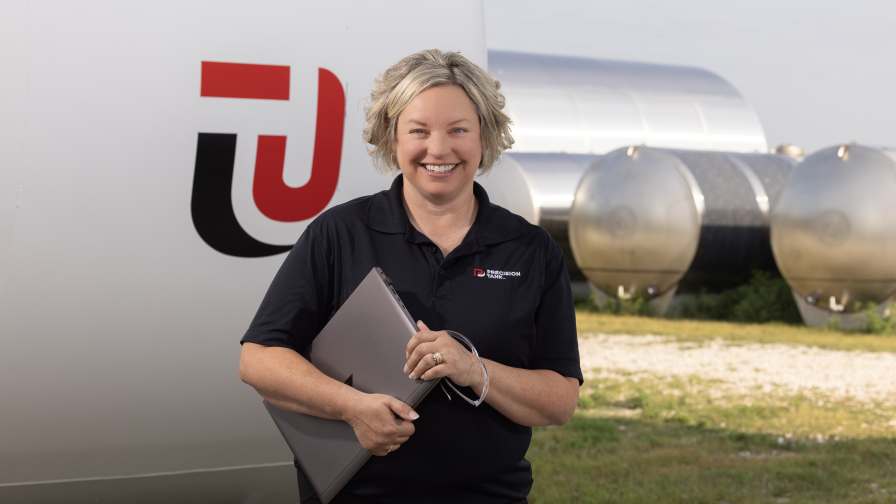
Genna Brockhouse, Precision Tank.
“Level sensors, metering, automated valves, overfill alarms, leak-detection systems, and remote monitoring and controls can provide operators with more timely information about inventory and operating conditions as well as provide for automated control over mixing/hot-load operations,” says Genna Brockhouse, Vice President of Operations for Precision Tank.
Safety First
Tank inspections also boomed in 2026. At the end of the growing season, emptied tanks better show structural and other noticeable issues.
“Tanks built within containment berms that either lack an internal PVC liner or have a poor industrial coating are exhibiting the most significant corrosion,” Heartland Tank’s Butler says.
Anthony Tucker, Sales Manager for DAKK Liners, says: “Our safety message is that the liner is only one part of the system. The material must be compatible with the product, the tank must be properly prepared, and the liner and containment must be inspected and maintained.”
Replacement Strategies
Ag retailers who need to replace or refurbish tanks or containment systems can do some of the footwork ahead of submitting an order to help speed up the process, several suppliers said. Here are four considerations.
1. Finalizing Amount of Storage. The overall number of tanks a single storage system calls for can be in flux due to shifts in growers’ practices — from using ag tech that may reduce chemical usage to changing products used for regenerative ag practices.
“While large tanks are good for single product storage, smaller individual tanks provide the flexibility needed at dealership locations,” says Dennis Neal, Owner of Enviropac. “Dealers should consider tanks with internal sloped floors or cone bottoms to provide more complete drainage to be able to switch products for multiple tank usage.”
Monitoring the growers in your region, and their use of Smart Tech, can help decision-making when it comes to storage.
“As the industry becomes more educated on what is available technology-wise, there will be more demand to only apply what is exactly needed for the crops being planted,” says Agra Liners’ Pedersen. “In some parts of the country, we could see more of a demand for additional liquid storage and in other parts the amount of storage might be reduced.”
2. Building Out a Timeline. Besides shrinking capital budgets, DAKK Liners’ Tucker says retailers and suppliers must work within limited windows of time for emptying tanks as well as weather or site-driven delays when it’s time to do an installation.
Beginning the planning process early by getting all corporate approvals and formulating a design is helpful for obtaining all construction permits, which also speeds up the construction process, Heartland Tank’s Butler says.
“Once the client is ready to proceed with a project, Heartland Tank always emphasizes completing the foundation for the new storage asset before winter sets in, since spring can be unforgiving and lead to construction delays,” he adds.
One other point to consider is having your land evaluated for building.
3. Identifying Best Storage for Products. Retailers should also nail down exactly what will be stored in each tank and how it must be contained, Pedersen says.
Here are some questions that should be asked and answered when planning:
- Can the product be stored safely in the kind of tank that will be used?
- Will you need additional vents or a liner for the roof?
- What is the tank’s working capacity vs. its total capacity?
- Will it accommodate your future needs?
4. The Budget. Tanks and containment suppliers are cognizant of the brutal economic conditions retailers are trying to work with and do whatever they can to make the process of spending money more bearable.
“Clients and asset owners are very conservative in how they plan to spend their budgets,” Heartland Tank’s Butler says. “We continue to work with our industrial partners on future projects and to advise them on our costs to help them budget and move forward at a pace they feel comfortable with.”
Looking at the budget for this year, and for the upcoming years, is also a strong strategy for thriving in tough financial times.
“The lowest initial price is not necessarily the lowest total cost over the life of the tank or system,” says Wil Lunt, President of Precision Tank. “We work with our customers to find the best option for their operations to fit within their budgets, even if they have to stage it for future expansion.”
Subscribe Today For
