In-Plant Automation Helps Ag Retailers Do More with Less Labor

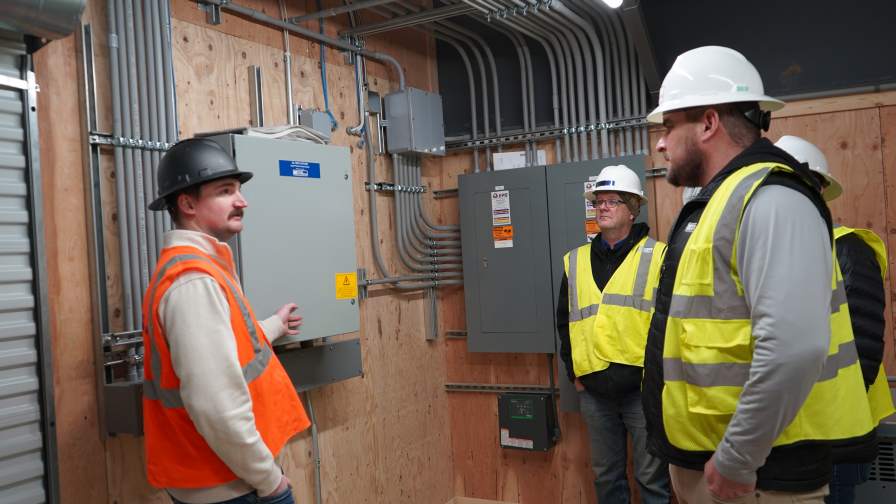
The next generation of control panel sizing that controls three loadout bays, 41 liquid products, repackaging, and 132 valves. Photo courtesy of Kahler Automation
Automated in-plant systems that measure and dispense materials such as fertilizer blends could be part of the answer for spread-thin retailing operations, according to Todd Scobie, Murray Equipment, Inc. (MEI) Sales and Marketing Manager.
“Retailers recognize that automation reduces both the physical and mental load on employees — freeing them to focus on customers, reducing seasonal labor needs, and unlocking new business opportunities,” Scobie says.
Manufacturers have been upgrading the automation potential of their systems throughout the 2020s, after the pandemic ratcheted up the pressure on two of agriculture’s longtime pain points: Labor and logistics. Finding the personnel to process orders and distribute products became even more difficult, and it still hasn’t been able to recover. This, in turn, holds up truckers under pressure to deliver high-importance goods to the fields.
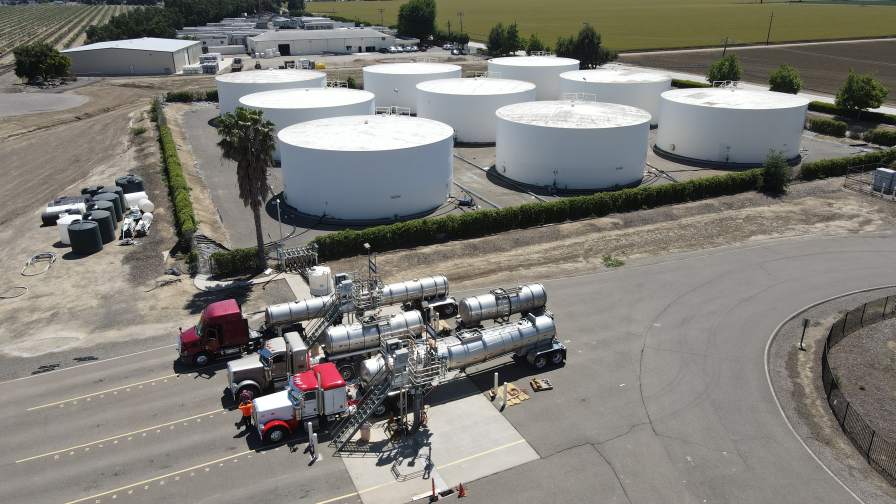
An aerial view of tanker trucks being loaded at a retail facility. Photo courtesy of Kahler Automation
Aaron Burmeister, Product Manager at Kahler Automation, says in many cases, truck drivers no longer have to wait for a retailer’s employee to come out to the bay and dispense the load.
“Many locations now run loadout processes that don’t even wait for an employee to show up,” Burmeister says. “The equipment handles requests, meters product, and sends drivers on their way around the clock with almost no human involvement.”
Unattended Loading, Human Operators
Scobie says MEI’s ICS Controls system can handle a single-product preset and everything up to unattended bulk fertilizer loadout on-demand 24/7 but recommends human oversight of the process for time-sensitive orders.
“MEI’s ICS Controls are flexible by design: Businesses may determine the amount of leeway they want their employees to have when creating batches,” Scobie says. “The software allows for in-plant adjustments and to send the information back to the home office for update.”
As in-plant systems grow in complexity and capabilities, their costs tend to rise as well, potentially leaving some retailers scrambling to finance upgrades or replacements for their machinery. Kahler’s Burmeister and MEI’s Scobie agree the price will be right over the long term.
MEI’s ICS Controls are designed to be modular and scalable, Scobie notes, making them easy to phase in as funding becomes available for different components of the whole.
“Additionally, MEI’s plant software, ICS ControlPro, operates on a subscription model,” Scobie says. “Continuous updates ensure plants receive the latest technology on an ongoing basis.”
He adds that MEI does not force obsolescence onto its products, continuing support and retrofitting infrastructure as long as it’s feasible.
Kahler’s Burmeister says the upfront investment in updated systems will pay off over time as the benefits pile up.
“Automation improves precision that helps facilities move more product and execute more complex blends with minimal operator input,” he says. “National Type Evaluation Program measurement devices paired with legal-for-trade software reduce inventory loss and prevent costly mistakes.”
Automation builds up the bottom line for retailers and the growers they serve for many of the same reasons, reducing waste and accelerating sales and deliveries. It also reduces employee burnout, increases safety, and offers greater transparency through abundant data.
“For growers, that means shorter wait times, consistent blends, and a clear, defensible paper trail. For retailers, it means dependable throughput and fewer disputes,” Burmeister says. “Because technology provides traceable, unbiased measurements, enhancing fairness, and operational precision in agriculture, it effectively balances the scales and reinforces the relationship for all parties involved.”
Scobie adds the faster service enabled by automation also draws in larger growers who otherwise might produce their own mixes on-site, driving new business to the retailers. “There is never a bad time to automate,” he says.
The retail industry’s move toward unsupervised pickup of some merchandise will shift labor demand but not eliminate it, both Scobie and Kahler’s Burmeister say, but the ease of using in-plant systems limits the amount of retraining necessary to get workers up to speed.
“Operators increasingly focus on oversight, safety, and data-driven decision-making, supported by simplified human-machine interfaces and powerful loadout software,” Burmeister says. “At Kahler, we also provide a wide variety of training and support resources, including a free knowledge base and 24-hour phone support.”
MEI’s Scobie concurs that employee intervention in sales will become less constant but will still be critical at certain points. “Murray Equipment and ICS are intentionally intuitive,” he says. “However, training is still important, particularly for handling exceptions and non-routine situations. How the system is implemented varies by company, so training employees to follow standardized processes is critical for consistency and safety.”
Innovations Coming
Innovation is already running rampant over the ag landscape, and wider industry trends are expected to steer automation and industry concentration in the upcoming year or two. “I expect continued growth in mobile driver workflows, unattended processes, multi-site data integration, and expandable, hub-style plant designs as consolidation accelerates,” Kahler’s Burmeister says.
MEI’s Scobie says retail leaders and workers continue to bring more screens and high-tech gateways into daily operations. “We are seeing adoption of more HMIs. Companies are opting to move toward more digital and mobile control interfaces,” he says. “While MEI and ICS have possessed this technology for some time, adoption has accelerated as retailers grow more comfortable with digital vs. manual control interfaces.”
Tech fixes for these systems are largely delivered through software updates, but both Kahler and MEI provide hands-on support for their clients.
Kahler’s Burmeister says: “Most issues can now be diagnosed and resolved remotely thanks to advances in ethernet-connected devices, remote access tools, and built-in software update capabilities. Retailers can often install updates themselves. Many software or communication-related problems are handled through remote diagnostics and support.
“Certain situations, however, such as physical hardware/instrumentation and commissioning, still require on-site field technicians. Kahler maintains a top-notch field service team capable of on-site electrical and PLC troubleshooting when physical intervention is necessary.”
MEI’s Scobie notes that besides pushing updates out to clients, MEI offers in-person and virtual training, online and after-hours support, and a substantial online knowledge base. “However, if customers need us on-site for either equipment or software needs, we make it a priority,” he says.
Artificial intelligence and automation have injected the ag community with fresh technology and approaches to consumer needs. Most observers expect these game-changers to continue reshaping how it conducts its commerce.
Kahler’s Burmeister says these tools have become fundamental to retailers and the ecosystems they support. “In-plant automation has become essential because it helps ag retailers stay productive when labor is limited and weather windows are tight,” he says. “It increases throughput without expanding facilities, improves accuracy by reducing operational errors, and keeps trucks moving during the short bursts of demand that happen between storms or temperature swings.”
MEI’s Scobie adds the support system around a given in-plant system will be just as crucial to a retailer’s success as the nuts, bolts, and semiconductors that comprise the equipment. “When selecting an automation platform, scope and functionality are only part of the equation. Retailers are also choosing a long-term business partner,” he says.
Subscribe Today For
