Smart Tech: Thinking Outside the Box

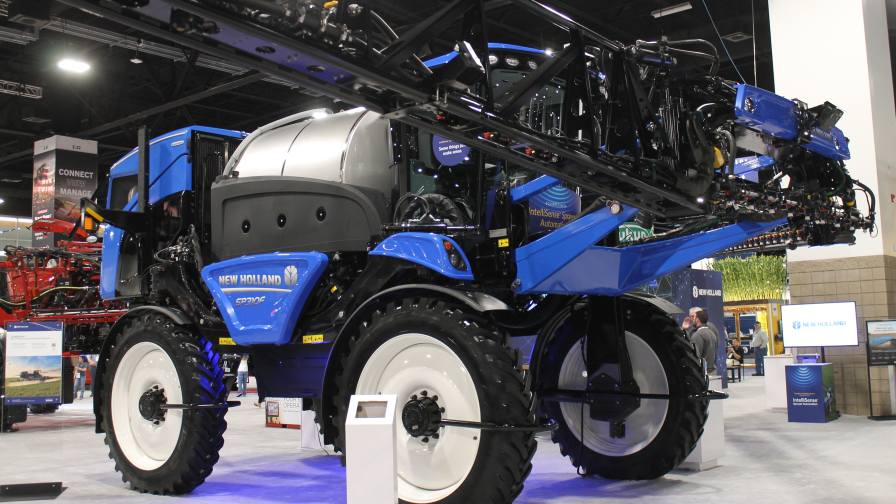
New Holland’s IntelliSense Sprayer Automation uses a single cab-mounted, factory-fit SenseApply Camera unit to continuously scan up to 50 feet out in front of the sprayer.
 Nutrien Ag Solutions held a formal ribbon-cutting ceremony in March at its newest Innovation Farm located just south of Champaign, IL. Besides providing education and testing products for the fertilizer/seed/biologicals company, this 282-acre farm will also examine a newer sector — equipment.
“Equipment has a much larger role in agriculture today,” said Jeff Tarsi, President, Global Retail for Nutrien, at the event. “When you are talking about ag equipment today, you are talking about much more than tillage. You are talking about data collection, data simulation, how you can compile data, those kinds of things. You are trying to take up to 20 different data points, all with a vision of precisely delivering a solution to a grower that will give him or her the best chance to win.”
Paul Bonnett, Senior Director, Nutrien Agronomy, agreed that testing out ag tech equipment will be important at the Innovation Farm.
“Drones, vision spraying, and short stature corn — all these things will fundamentally change the way farming is done going forward,” said Bonnett. “In my mind, I believe these will have as profound an impact on this industry as the introduction of genetically-modified crops did back in the mid-1990s.”
In particular, artificial intelligence (AI)-powered vision spraying (such as John Deere’s See & Spray), sensors, drones, and satellite imagery are becoming increasingly popular tools for ag retailers and their grower-customers. For example, according to various sources, the revenues globally for AI in agriculture in 2024 topped $1.8 billion. This year, revenues for this sector are expected to reach $2.4 billion, growing to $3 billion by 2026. Of all the segments that utilize AI in agriculture, market data suggests software commands the largest overall share, representing 45.2%. Market watchers say this is because AI software solutions are helping to transform traditional agricultural practices.
“I’ve seen lots of new products for agriculture over the years, but AI systems are the most exciting development I’ve ever seen,” says Glen Franzluebbers, Director of Professional Ag Services at Central Valley Ag Cooperative, York, NE. “It helps save so much time from what we’ve been doing manually for many years.”
Offering Solutions Through Software
Over the past few years, several AI software systems have been introduced into the agricultural marketplace. One of these is Ag Assistant from Taranis. Powered by a generative AI model, Ag Assistant integrates data sources from various modalities — including images, text, and audio — to provide “a profound understanding of agronomy.”
“Taranis has pioneered an AI agent in agriculture that enables and equips the agronomists serving producers,” says Jason Minton, the company’s Chief Commercial Officer. “Ag Assistant enhances the service retail organizations provide to their growers. Having an instantaneous understanding of the issues and the optimal solution creates efficiencies and opportunities the industry has never seen before.”
In operation, Ag Assistant can analyze the leaf-level data captured by Taranis and contextualize it with relevant industry research and current seasonal trends to generate comprehensive and actionable reports. “As an example, consider a scenario in which Ag Assistant identifies a widespread specific weed threat, indicating that the prescribed weed management program did not work,” says Minton. “Rather than an agronomist spending hours and days during the growing season manually walking and scouting fields, reviewing seed hybrid information, weather history and forecast, herbicide label information, identified weed control, etc., Ag Assistant will immediately generate a detailed, expert-level agronomy report to the agronomist that analyzes those factors and more to provide a targeted control recommendation for the specific field and farm in question.”
Speaking of weeds and crop pests, other major agricultural suppliers are also experimenting with AI-powered systems to manage these yield robbers. For example, Syngenta Crop Protection is collaborating with AI-informed crop health company Enko to discover novel weed control molecules, advancing efforts to bring much-needed innovation in herbicide technology to growers. The collaboration targets a new mode of action, using Enko’s ENKOMPASS platform.
“As an innovation leader, Syngenta is pursuing some of the most cutting-edge research in the field of agricultural technology,” says Camilla Corsi, Head of Research at Syngenta Crop Protection. “This novel solution will be an important breakthrough in the field of weed control and will represent a critical tool for resistance management.”
Another collaboration involving AI is Agmatix and BASF. These companies are collaborating to develop a cutting-edge digital solution for detecting — and predicting — the presence of soybean cyst nematode (SCN).
At the heart of this initiative is Axiom, an advanced AI technology engine developed by Agmatix, which transforms vast amounts of raw agronomic data into highly standardized and enriched datasets.
“This data process enables the development of a machine-learning model capable of detecting and predicting SCN infestations with unprecedented accuracy and scalability,” says Ron Baruchi, President and CEO at Agmatix.
Advances in Targeted Application
Targeted application is another area of Smart Tech that is expected to see significant growth over the next few years. Here, the motivation comes from providing cost-savings to users.
According to the Foreign Agriculture Service, total production costs for row crop farms increased in the U.S. by 26.6% from 2017 to 2022, and crop protection products averaged 7.7% of the total cost.
“With continually increasing crop production costs, it’s vital for producers to find technologies that can both reduce their costs and improve profitability,” says Tristen Avent, University of Arkansas, Senior Graduate Assistant in the Crop, Soil, and Environmental Sciences Department. “Targeted applications programs could reduce the herbicides applied while providing comparable weed control to traditional broadcast applications. More specifically, our research showed that, on average, this technology’s targeted sprays saved a range of 28.4% to 62.4% on postemergence herbicides compared to traditional broadcast applications.”
Many of the new developments in targeted application were on display at the 2025 Commodity Classic trade show, held in early March. For instance, John Deere highlighted improvements to its See & Spray Select system. Historically, this system has been used to control weeds in fallow fields. But now, See & Spray Select comes with new variable rate capabilities.
“Users can now vary the rate of application in real-time based on the biomass detected by each camera throughout their fields,” says Josh Ladd, Go-to-Market Manager for Application at John Deere. “Additionally, growers can adjust how much product they wish to apply on an individual nozzle level based on the green biomass detected, giving them the ability to apply the right amount of product on every acre of their field.”
Other examples of targeted application are in the works from New Holland and Case IH. At Commodity Classic, both companies announced plans to incorporate Raven Industries’ Sense & Act technology into their sprayers for the 2026 models. For New Holland, the system is called IntelliSense. For Case IH, it’s called SenseApply.
“Unlike other smart apply technology familiar to North American applicators and farmers, which employ multiple boom-mounted cameras, IntelliSense Sprayer Automation uses a single cab-mounted, factory-fit SenseApply Camera unit,” says Paul Welbig, Director of Precision Technology at New Holland. “The SenseApply camera unit is a forward-looking, multi-spectral vision system that enables IntelliSense Sprayer Automation to continuously scan upcoming field conditions — 50 feet out in front of the sprayer — across the full width of the boom from a high vantage point atop the cab.
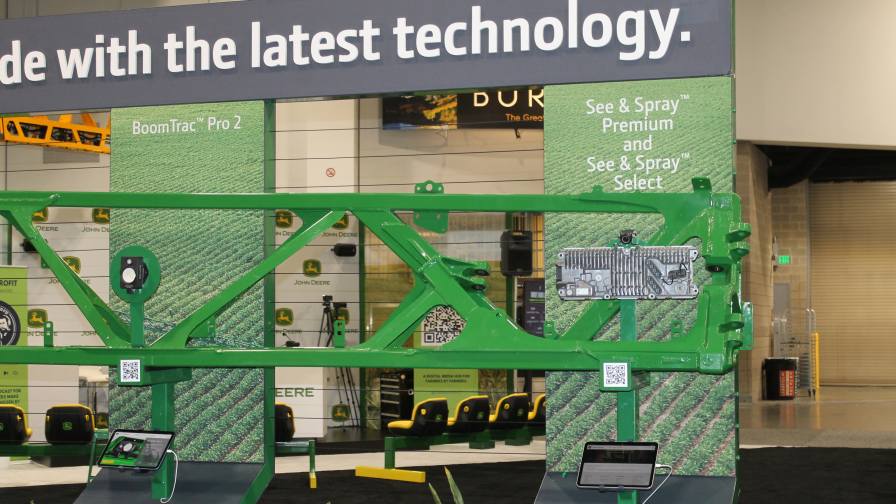
John Deere’s See & Spray Select is now being offered to customers with new variable rate capabilities.
“The result is an expanded vision of the field that generates quicker and longer leading assessments,” he continues. “This allows the operator to drive and apply accurately at a faster speed than any other sense and act technology on the market today.”
Looking forward, Steve Sporrer, Senior Strategic Accounts Manager at John Deere, believes advances in AI and other products could help move the adoption needle forward.
“There are many factors that will help adoption rate continue to grow,” says Sporrer. “Ease-of-use and a familiar experience across machines helps users feel comfortable using the technology. Machine integration allows for users to see the individual field outcomes through the data collected.”
Subscribe Today For
