The Message from Industry Reps at MACA 2025: Collaborate for Success
 September 18, 2025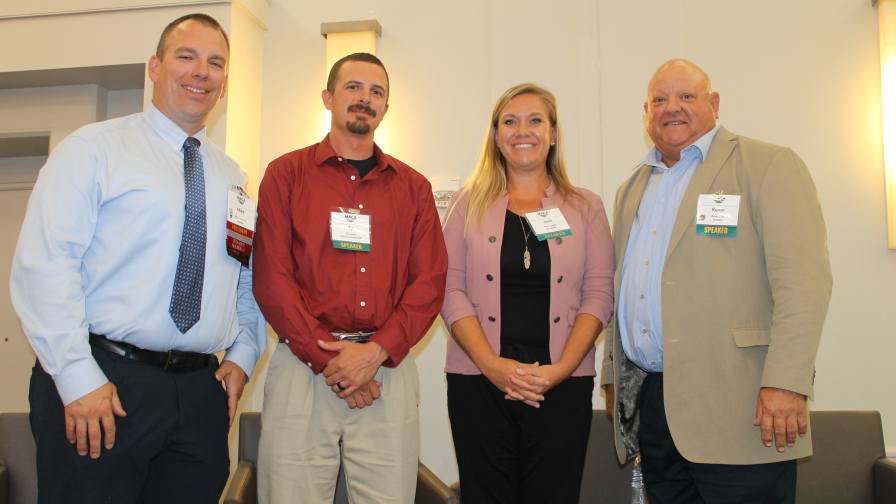
MACA panel included AMVAC’s Michael Lehman, MFA’s Ty Coats, Syngenta’s Jami Loecker, and TST Farms’ Kevin Cox.
There’s little denying the state of agriculture in 2025. This was emphasized during the recent Mid America CropLife Association (MACA) annual meeting in early September.
“Right now, farming stinks,” said Indiana Grower Kevin Cox, Owner of TST Farms, told attendees. “We are selling grain today at the same levels of 1974. We came out of 10 years of about the best ever economic conditions. Our farm spent more than $1 million on new grain bins and equipment during these years. Now, we are trying to figure out how to just pay the fertilizer bill.”
According to Jami Loecker, Agronomy Service Manager for Syngenta Crop Protection, this tougher-than-usual agricultural environment is why the entire industry needs to work together to maintain success.
“We are here to talk about collaboration,” said Loecker. “That’s one of the only ways we can be sure we as an industry are being sustainable, advocating for business, and doing the right thing by the agricultural industry – from the manufacturers to the ag retailers to the growers to the equipment side of the business to working in crop protection products like me. The partnership piece is really about not just working with our own segment; you have to work with everybody.”
Ty Coats, Agri Services Manager at MFA, an ag retailer based in Columbia, MO, agreed with this view.
“For ag retailers, we are also collaborating on both sides of the business – being in the middle between suppliers and growers,” said Coats. “Recently, that’s meant working much harder at using things like technology to help growers meet their needs.”
For today’s grower-customers, he added, this has meant ag retailers such as MFA are using whatever technological and logistics tools available to them to fulfill these requests.
“We are working with technology to deliver applications in a timely manner since farmers are getting their products into the ground faster than ever before,” said Coats. “Besides technology, we are bringing in extra equipment from our other facilities to help do this.”
Syngenta’s Loecker said her company is also employing more technology today than in the past to keep pace with agricultural industry needs.
“Innovation is really important to us, with artificial intelligence (AI) and how we will work that concept into our own business,” she said. “In regard to AI, we can use it for due diligence, to help research new active ingredients that the market will need to keep addressing problem pests. AI programs can help us do that research quicker than we’ve been able to ever do it before.”
TST Farms’ Cox also said his farm is beginning to employ newer technologies on his acres. However, these aren’t AI-based systems just yet.
“We are more into site-specific applications these days vs. the shotgun approach we used to use,” he said. “So, we are using drones in some of our fields to help apply fungicides and insecticides only where we need them to be.”
In summation, Cox recommended to MACA attendees that their companies continue to work not only collaborating with the entire agricultural supply chain but also place an emphasis on reaching out to potential newer customers as well.
“Chances are your customers of 10 years ago aren’t your customers of today,” he said. “And your customers of 10 years from now probably aren’t your customers of today. You’ve got to build relationships with the newer generation of growers coming in, because guys like me won’t be around forever. If you don’t do that, those potential customers will go somewhere else for what they need and they will be gone forever.”
Subscribe Today For
