25 Years of Change: How Ag Retailers Have Adapted, Consolidated, and Innovated
 November 25, 2025
  Editor’s Note: As we mark the first 25 years of the 21st century, CropLife reflects on the innovations, challenges, and transformations that have shaped ag retail — honoring our past while looking ahead to agriculture’s promising future. In this article, we spotlight the key moments, industry shifts, and resilient people who have defined ag retail’s evolution — and set the stage for what’s next.
For ag retailers, the past 25 years have seen numerous changes to the way the industry operates. Yet, through all this, the underlying mission of ag retailers — to be the trusted advisor to the nation’s grower-customers — remains intact.
“A retail agronomy location is a community business and that has not changed,” says Tim McArdle, Industry Ambassador for ResponsibleAg and a former executive at BRANDT. “Our radius of service has increased due to technology and efficiency, but we still serve a community of growers. Often, we are adjacent or surrounded by the community and most of our employees live in that community.”
In 2000, ag retailers were still adapt-ing their business models when it came to crop input offerings. The emergence of biotech crops, in particular Roundup Ready through the end of the 1990s, were shifting revenue away from other crop protection products. In the 2000 CropLife 100, crop protection products sales among the nation’s largest ag retailers still totaled, by then, $5 billion. However, fertilizer sales were not far behind at $4.5 billion (and would become the leading crop inputs category in revenues for CropLife 100 ag retailers within a few short years).
Today, according to the 2024 CropLife 100 data, the fertilizer category has grown its advantage vs. the crop protection products category to a 10% difference, with sales of $19.9 billion (46% of all crop inputs/services sales) compared with $15.3 billion (36%) for crop protection products.
The Coming of Online Retailers
Besides the start of a shift from crop protection product dominance among ag retailers to crop nutrition, the other emerging trend in 2000 was the establishment of online retailers. At this point, the internet was quickly becoming a new thing for everyone — from up-to-date information to a shopping venue, with virtual stores replacing physical ones. This led to a flood of web-based tools and commerce sites promising access to products and services, including agriculture.
Anxious to take advantage of this then-growing trend, many traditional ag retailers put up a shingle in cyberspace. However, for many of these start-ups, bad rural internet access limited their reach and utility. In addition, dedicated websites were expensive to construct and maintain, and many rapidly became obsolete.
One internet model that did work particularly well was a product auction site called XSAg. This site allowed virtually anyone, from a grower to a broker to a retailer, to put a farm input up for bid. The site prices were often substantially lower than farmers were able to buy from local retailers and cooperatives. This led to many growers printing off price sheets from XSAg price lists and then asking their retailer to match the price.
Ultimately, it became evident that the advice and services ag retailers offered grower-customers was an essential part of most product purchases, so XSAg never became the threat to retail “disintermediation” that was some market watchers originally feared. But XSAg still exists today (now doing as FarmTrade.com) and its success opened the door for another online retailer to appear in 2014 — Farmers Business Network.
Fertilizer Pain 2008-09
Through the early 2000s, ag retailers implemented plans for increasing and centralizing fertilizer storage. This was done in recognition that crop nutrition was becoming a bigger category in terms of overall crop input revenues and to better manage supply issues that could arise from importing fertilizer supplies from overseas sources.
For ag retailers of fertilizer, the message from suppliers during the early 2000s was simple — purchase early in the growing season to ensure your supply. “Fill your bins or you might find yourself short come the spring” was a common refrain.
And based upon the evidence, many ag retailers did just that through the 2008 growing season, filling bins to the brim in an effort to keep their “customer handshake deals/just-in-time” business models in order. But during this time, in part because of a boom in ethanol demand for corn growers, fertilizer prices kept increasing throughout the early part of the year.

In 2008-09, a lot of fertilizer was left unsold, hurting ag retailers financially.
By fall 2008, the market price for all fertilizer prices had bottomed out. Quickly, companies found themselves “underwater” in the crop nutrition supply/demand equation, with many grower-customers refusing to honor their “handshake agreements” to purchase fertilizer from their ag retailers. This led to a wave of ag retailers being forced to take losses on their unsold fertilizer stocks, some going out of business completely, and a call for the implementation of more formal, legally binding business contracts with grower-customers for fertilizer purchases going forward.
“Sure, you can view your grower-customer as friends and good old buddies, until there’s a $100 per ton difference in the fertilizer price,” said J Stephen Lucas, President of Jayhawker Consulting, at the 2009 ARA annual meeting. “Then, without a formal contract in place, you may find out that grower-customer isn’t such a good old guy after all.”
West Fertilizer
During the early evening hours of April 17, 2013, a fire was reported at the West Fertilizer facility located in West, TX. Firefighters were called to the scene and were attempting to control it. Then, at 7:50 p.m., a massive explosion took place (which the U.S. Geological Survey recorded as a 2.1-magnitude tremor). The blast and shockwaves from this event killed 15 people, injured 160 more, and destroyed or severely damaged numerous homes and buildings situated around the plant, including three schools.

The West Fertilizer plant explosion in 2013 was so powerful, it registered as a 2.1-magnitude tremor with the U.S. Geological Survey.
At the plant itself, the power of the blast was quite obvious. At the time of the accident, there was a railcar containing 100 tons of fertilizer on the tracks next to the facility waiting to be unloaded. It was blown several hundred feet away. The blast also left a nine-foot-deep crater 93 feet across at the location of the bin where the explosion originated.
Ultimately, investigators determined that there were two explosions, seconds apart. The first explosion caused a shockwave that ignited the stored ammonium nitrate (AN) in the building. The second was the AN exploding.
Not surprisingly, reaction to the West Fertilizer disaster was swift. The popular press blamed the plant’s owner for “trying to hide something” by not filing reports with the proper agencies and being allowed to operate “so close to populated areas.” Others pointed out that the plant carried only $1 million in liability insurance — an amount insufficient to cover all the damages inflicted upon the surrounding area.
The West Fertilizer disaster led directly to ag retailers across the country embracing efforts to police their own facilities with initiatives such as ResponsibleAg. This involved having independent parties inspecting facilities that store fertilizer, ultimately awarding them a score on their level of preparedness and helping them to fill in any gaps in their emergency plans.
“As I see it, retailers have two options,” said Allen Summers, then head of The Asmark Institute, in a 2015 CropLife® Magazine interview. “They can be proactive in ensuring their operations are compliant with the existing rules and regulations, some of which date back to the early 1970s, or the industry can sit still and wait for the government agencies to conclude their reviews of what happened in West, TX, and then enact what they believe will prevent another tragedy from occurring. ResponsibleAg looks to be the initiative that will effectively help industry improve its compliance effort.”
Consolidated Efforts
Even as ag retailers in the 21st century have expanded their products/services portfolios, the number of them doing business continues to go down. At the start of the 2000s, industry estimates placed the number of ag retail locations in the U.S. at somewhere north of 10,000. Today, it is estimated that this figure has dropped to fewer than 6,000. In many cases, these facilities have disappeared due to the consolidation of their parent companies with neighboring (or national) ag retailers.
And this trend has been particularly evident among two categories of ag retailers — cooperatives and national chains. Since 2000, some examples of this in action would include the following:
- In 2016, two very large, individually successful Ohio-based cooperatives — Sunrise and Trupointe — decided to merge their companies.
- When asked why by CropLife, Sunrise President/CEO George Secor cited this as the reason: “We were both coming off really strong financial years. At the same time, I kept telling our board that with what was going on across the agricultural space, the decks could easily get re-shuffled, and we could suffer as a company. In fact, I reminded them that 10 years ago, Sunrise and Trupointe each would have easily ranked in the Top 10 cooperatives in the country based upon our sales volume. However, by 2015, neither of us ranked in the Top 20 among cooperatives anymore, despite doing financially fabulous.”
- In 2017, Valley Agronomics, Nampa, ID, merged operations with Wilco-Winfield of Mt. Angel, OR.
- In 2019, Indiana-based cooperatives Co-Alliance, LLP, and Harvest Land Cooperative, Inc. merged. At the time, Co-Alliance had 24 outlets spread out across three states (Indiana, Ohio, and Michigan) while Harvest Land had 31 outlets located in Indiana, Ohio, and Illinois.
- In 2020, The J.R. Simplot Co., Boise, ID, finalized acquisition of Pinnacle Agriculture. This gave Simplot more than 240 crop input locations throughout the U.S. and Canada at the time with more than 4,400 employees and 500 crop advisors.
- In 2024, Indiana-based agriculture and energy co-op Keystone Cooperative began business. This company was the result of a merger between two farmer-owned cooperatives, Co-Alliance and Ceres Solutions. Combined, the company serves more than 20,000 farmer-owners across Indiana, Michigan, Illinois, and Ohio.
Another ag retailer that has significantly increased its marketplace footprint through consolidation since the 21st century began is Nutrien Ag Solutions. Back in 2000, the ag retailers originally owned by parent company Agrium did business under two separate names — Crop Production Services (CPS) and Western Farm Services. These ultimately united under the CPS name a few years later.
Today, Nutrien Ag Solutions is the largest ag retailer in the country, with more than 1,500 locations and more than $1 billion in sales. This ranks it as the No.1 ag retailer on the current CropLife 100.
Then, Agrium went on a buying spree. In 2006, the company acquired Royster-Clark, adding 254 Royster-Clark retail operations to its corporate mix. In 2007, Agrium expanded its retail operations into the Southern U.S. Plains through the acquisition of 32 retail outlets from Archer Midland Daniels (ADM). In 2008, the company purchased United Agri Products to create the largest agricultural retailer in North America. In 2009, Agrium bought 24 outlets from Agriliance in Texas and New Mexico. In 2010, the company acquired Miles Farm Supply in Kentucky. In 2012, it purchased Ritter Crop Services in Arkansas.
Today, Nutrien Ag Solutions is the largest ag retailer in the country, with more than 1,500 locations and more than $1 billion in sales. This ranks it as the No.1 ag retailer on the current CropLife 100.
And this consolidation trend is likely to continue. Already in 2025, several CropLife 100 ranked Midwestern-based cooperatives are discussing mergers. This includes Sunrise Cooperative, Mercer-Landmark, and Centerra Cooperative in Ohio and Premier Companies and Superior Ag in Indiana.
“Cooperatives will continue to look at consolidation opportunities as margin/earnings pressure and the urgency to continue to improve efficiencies continue at the forefront,” Shelly Kruse, then Executive Director, Strategic Relationships for GROWMARK, told CropLife in a 2023 interview. “Technology improvements, including increased digital connectivity and business use cases, and securing top talent provide the size and scope required to execute within these areas.”
Smart Tech Moving Forward
As ag retailers have put the past 25 years behind them, what milestones do the next 25 potentially hold? According to many observers, Smart Tech is likely to be one of the key market drivers.
Today, with the infiltration of consumer technology and the infusion of smartphones and tablets into virtually everyone’s hands, there are multiple new channels for communicating with grower-customers and suppliers. With access to the internet virtually anywhere, the ability for ag retailers to find information, contact customers, and record data have become commonplace.
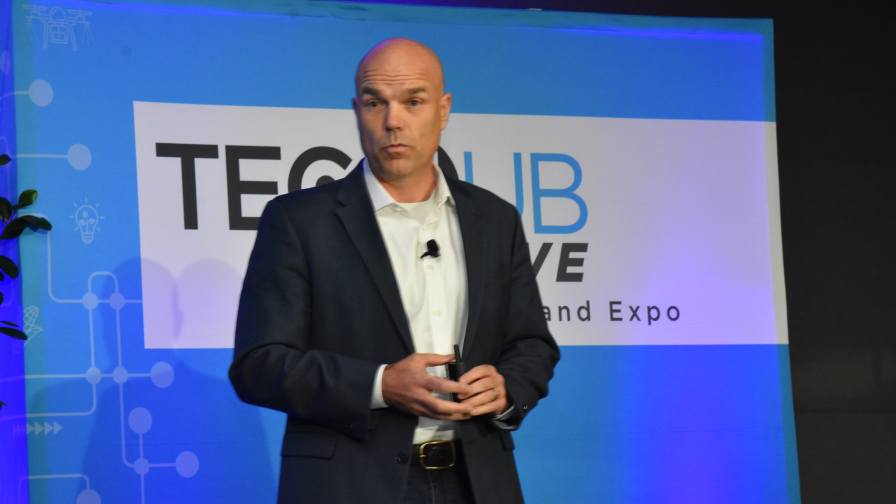
At the Tech Hub LIVE keynote, Greenpoint Ag CEO Jeff Blair explored how advancements in automation, AI-powered decision tools, and precision application systems are already reshaping ag retail.
At CropLife’s 2025 Tech Hub LIVE Conference, Jeff Blair, President/CEO for GreenPoint Ag, focused on how the ag tech industry can adapt and advance beyond the headwinds of today’s current tough conditions. One of his points was to utilize data better.
“Information is intelligence — the intelligence gathered from multiple sources of information,” said Blair. “You’ve got to connect those multiple sources of information in order to have [AI] work properly.”
And that’s where the people part of the AI equation will come into play. Blair predicted that people will ultimately be tasked with entering the data that AI systems source to create their predictive modeling and recommendations.
“This is still a people business; that’s not going to change,” he concluded. “And I predict that AI won’t replace people in our industry. But people who aren’t using AI WILL be replaced.”
Subscribe Today For
