Smart Tech
SIU Researchers Build Robot, AI to Detect Soybean Diseases Before Symptoms Appear
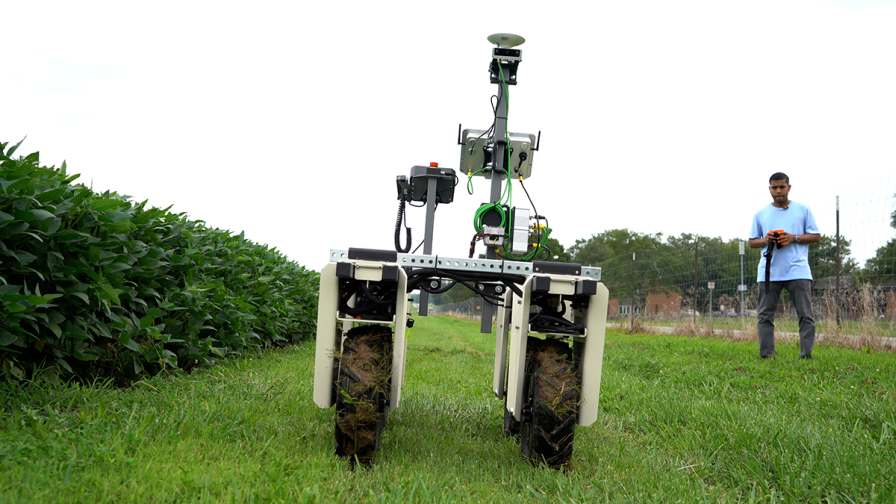
Samuel Singh, a doctoral student in the agricultural sciences program, showcases a robot equipped with multiple cameras that can capture plant diseases on soybean crops. Under the guidance of Billy Ram, assistant professor of precision agriculture, the goal is to collect enough data to predict the diseases before symptoms appear on the leaves and stems. Photo credit: Todd Duermyer

Harvest season is underway for soybean farmers across Illinois. Each plant among their crops is valuable, contributing to their yield and overall profit. A big issue that can eat into that small profit margin is plant diseases — so researchers at Southern Illinois University Carbondale are working toward a solution.
Billy Ram, an assistant professor of precision agriculture, and his doctoral student Samuel Singh, are working to design a robot and program its artificial intelligence (AI) models to detect soybean diseases before symptoms appear. The goal is for agricultural machinery companies to use that predictive technology to produce tractor or spray attachments for farmers that are efficient, affordable and easy to use.
Soybeans reign supreme in Illinois
Illinois is the number one soybean-producing state in the country. Across the state, 43,000 soybean farmers rely on making a profit from their crops to feed and support their families as well as invest in the equipment and products needed to sustain their farms.
Soybean prices are set based on a combination of global markets, local supply and demand, and futures trading. Over the past 20 years, soybean prices have increased — but so have the expenses that farmers pay to maintain their business.
“From the 2000-2004 average of $6.15 per bushel to the 2020-2024 average at $12.71 per bushel, farmers see the financial benefit of growing soybeans,” according to the Illinois Soybean Association. “However, non-land costs have also increased, with one farmer mentioning a 400% spike in productivity and pricing in this timeframe. With increased soybean prices come increased expenses.”
Increased expenses are just one factor that can cut into profit margins. Several other factors impact the growth of soybeans and their yield including the weather, pests, weeds and diseases.
Diseases cut into profit
Many diseases that attack soybean crops are caused by fungi in the soil and spread when it rains, Ram said. By the time symptoms appear on the stems or leaves, the plant is too damaged to produce a good yield.
“If a disease overpowers your field, late-stage fungicide application is not very efficient,” Ram said. “Once the disease attacks the farmer’s crops, the yield can be reduced to 60 to 70%. It has a real economic impact.”
On top of this, diseases can be difficult to eradicate. Often, these soil borne fungi will stay in the soil for long periods of time, attacking crops over consecutive growing seasons — which is why prevention is key.
Robots and AI are the cure?
Ram and Singh are conducting research on a soybean field at University Farms that has frogeye leaf spot, an invasive disease that causes lesions on the leaf and can spread to the plant’s stem and pods. Initially, the duo used a drone to create hyperspectral and multispectral maps of the field.
These maps utilize wavelengths not seen by the human eye helping researchers analyze the crop’s health from above. However, despite flying the drone close to the crops, they could not collect sufficient data to detect the frogeye leaf spot.
That’s because the drone’s camera had a difficult time capturing the lesions on the underside of the leaves and lower down toward the stem.
“At the end of the day, we’re only working with cameras,” Ram said about the research which received funding through the Illinois Soybean Center. “We’re solving an engineering problem more than an agronomic problem. The challenge is how efficiently can you collect a large source of data while the equipment is traveling the field.”
This is when the team decided to build and design a robot that could reach those hard-to-see spots. The robot is battery-powered, has four wheels, GPS and multiple cameras mounted to its frame to view the underside and tops of the soybean plants. The robot also has an autonomous setting where a user can upload a map of the field, and the robot can follow the rows on its own.
“The robot should be able to drive down the field, keep track of each plant, identify if the plant has a disease and which type, and then share what percentage of the crop is diseased,” Ram said.
Mapping the future
Now that the robot’s designed, Ram and Singh will work on developing the AI models that it needs to detect frogeye leaf spot. Once finished, the robot will detect the disease with precision.
“I want to design maps that help farmers detect hot spots, so farmers can see the hot spots and know what site-specific areas to apply fungicides instead of spraying all over the field,” said Singh, who is working toward a doctoral degree in agricultural sciences. “Soybean diseases are a problem all over Illinois. This project is challenging, but it’s exciting because I think we can develop these maps.”
Singh has spoken to local farmers during SIU agriculture events and has listened to the challenges they face. He wants to work toward developing tools and systems that support their practices.
“As an engineer, we love working on solutions that actually help people, not just something that sounds good on paper,” said Singh, who also has a bachelor’s in agricultural engineering and master’s in remote sensing. “The future means humans using robots to make life easier and more efficient.”
R1 status
The doctoral student selected SIU specifically to work on this research project and applied to the university’s program due to its recent Research 1 designation by the Carnegie Foundation for the Advancement of Higher Education.
“SIU is a R1 research facility so there’s a lot of quality research coming out of this university,” Singh said. “As a student, you get the exposure that you need. You get the expertise and guidance.”
This prestigious distinction ranks SIU among the top 5% of research universities in the country. Ram added that there are many benefits to this designation for SIU professors and students, such as the technology available to them.
“The R1 status means we’re doing cutting-edge research at the university, including in agriculture,” he said. “We’re using robotics, AI, and we have large facilities close to campus. We’re really focused on doing not just the day-to-day research but research that will be fruitful in the next 10 years.”

For more Smart Tech topics, click here.
Subscribe Today For
