Environmental Dynamics Spur Fungicide Growth

Fungicide demand for row crops has been stronger in recent years due in part to environmental conditions that have helped plant diseases proliferate.
The question from retailers and growers is what’s in store for 2025?
Gail Stratman, Regional Technical Service Manager at FMC, says southern rust flared up in corn in 2024, which was notable because it hadn’t been present in the Corn Belt in the past six years or so.
Southern rust was especially prominent in the western parts of the Midwest, which experienced ample moisture along with southerly winds early in the season, says Stratman.
Furthermore, Hurricane Beryl, which passed through the Caribbean and Mexico’s Yucatán peninsula in late June and early July of 2024, likely contributed to spreading disease spores north across a sizable region.
The environment is the wild card in the so-called disease triangle, whose two other components include a susceptible crop and the presence of a pathogen.
Sometime disease susceptibility falls off the radar a bit compared to yield potential and other issues when a disease hasn’t been present in five or six years, notes Stratman.
Nonetheless, growers need to remain vigilant.
“Growers need to keep an eye on the hybrids they’re selecting and varieties they’re putting in the fields when it comes to disease tolerance because we’re introducing so many new hybrids every year,” he says.
Tar spot is another disease that is top of mind for many growers.
“It was kind of localized again last year,” says Stratman. “However, it was severe enough in certain areas that many growers are watching it closely because they know that the pathogen is present in a lot of geographies and all it takes is the right conditions during a period of the growing season to really get tar spot to ramp up.”
Another disease that flared up last year was crown rot, says Stratman.
“I had more retailers and growers talk to me about crown rot last year than I had in the last five years.”
He explains: “The pathogens associated with most of our crown rot disease are present in most areas of the Corn Belt. They’re present in most fields.”
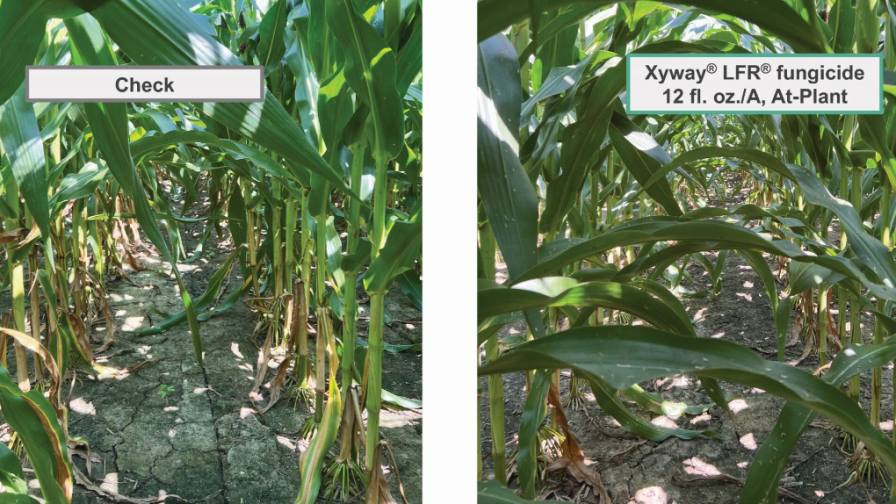
On Farm Demonstration — Utica, KY. Planting Date: April 15, 2023. Photographed: July 28, 2023. Photo: FMC
Given that scenario, growers need to determine how susceptible their hybrid is and what options they have to mitigate risk.
“Xyway is our fungicide that we apply during corn planting, and it’s shown some very good levels of suppression of some of the crown rot pathogens,” says Stratman. “We’re getting a lot of questions about utilizing Xyway to help manage that disease because we’ve seen such an uptick in the last two to three years, specifically in 2024, it was really prevalent in a lot of areas. Crown rot really caught growers’ attention and they’re struggling to manage it and keep their corn crop growing healthy all the way through maturing and keep it standing until harvest.”
Compounding the challenge for growers is that “as we continue to push the yield envelope, we’re pushing populations. We’re trying to manage this crop to maximize the yield potential for that top end revenue. However, depending on the conditions, crown rot is becoming a bigger issue for growers who are concerned about standability and keeping that crop stand late throughout the growing season.”
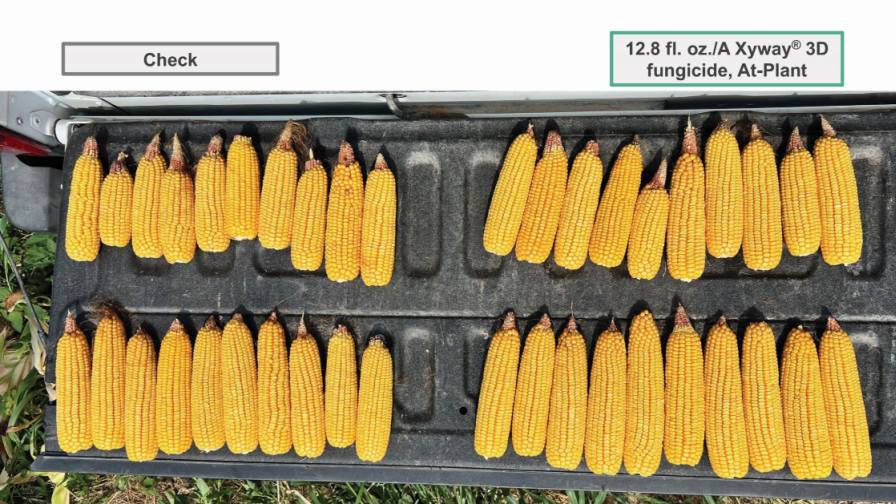
On-Farm Demonstration — Elizabethtown, KY. Photographed: August 24, 2023. Photo: FMC
In the meantime, the unpredictability of the environment cannot be ignored.
Abnormal weather events are likely to occur someplace, somewhere in any given year.
“Because of that, growers today need to be prepared for something they weren’t necessarily expecting. They need to ask themselves if this is something they can manage and mitigate, or is something completely out of their control?”
When it comes to plant disease, “In a lot of cases, we don’t need to try and eliminate it completely from the start. Rather, we need to recognize that the potential is always there for something to pop up and growers need to be ready to react,” says Stratman.
The Biological Solution
Biological-based products are increasingly part of suppliers’ crop protection portfolios.
FMC has introduced several biological solutions in the last few years.
“FMC is mostly focused on the biofungicide area. We have four products that are biologically based. We use them to enhance or build upon what our synthetic products can do, versus trying to entirely replace synthetic products with a biological,” says Stratman.
For example, FMC’s Ethos Elite biofungicide is an at-plant product that combines an insecticide for seedling insect control with a fungicide that’s biological based for seedling disease control.
“They basically work in the same area at the same time of the year, but they have slightly different targets,” Stratman says.
“One is for insect control and to help with stand establishment and stand protection. Then the disease piece comes along with it to protect against seedling diseases. So, they work hand in hand with each other.”
Furthermore, FMC has some biological foliar fungicides in the pipeline that look very promising, which are expected to be introduced very shortly, according to Stratman, and will “offer something a little bit different from a rotation and resistance management standpoint.”
At the same time, it’s important to manage growers’ expectations regarding biologicals when it comes to performance.
“We are continually learning [about biologicals] all the time and trying to help educate the customer on what to expect and what biologicals can do, and the value and return on investment they can achieve,” says Stratman.
The biologicals sector has grown so quickly in recent years that it’s sometimes difficult to keep up with all the products — and promises.
Stratman says: “There have been a slew of biological products that have come out and sometimes it becomes a little bit of a challenge to determine what exactly a product is intended to do, and how to evaluate all the claims.”
Indeed, the biologicals market has seen more than one company come and go.
“People became dissatisfied with the performance and some of these companies’ claims. These claims didn’t have a lot of concrete to them. They were just built on sand.”
For that reason, FMC has been very meticulous and methodical in bringing biological products to market.
“Our products need to do what we claim they can do. We need to offer certainty and predictability for the grower,” and provide guidance as to when, how, and where the products are going to work, he says, “because we’re asking the grower to put his money on the line and purchase that biological product, so we need to be able to tell him exactly what he can expect.”
Stratman say the lack of regulatory oversight of biological products may have contributed to some of the negative experiences growers
have encountered.
However, FMC’s biofungicides are registered with the EPA.
Ideally, biological products should be registered with the EPA and have efficacy data that describes its performance on the label, he says.
A Prudent and Pragmatic 2025
Stratman expects growers will be watching their input costs very closely in 2025.
“They’re going to have to do their homework on the products that they are considering and make sure they understand what the return on investment has been in previous trial work and talk to multiple sources about the performance of those products. Ultimately, the challenge for growers this year is to spend their dollars wisely and not overspend.”
Growers need to remain flexible and willing to adjust their plans, Stratman adds.
For example, some growers’ trade their tractors every three years or trade their combines every two years.
“This may be the year where you need to stretch that another year or two,” he suggests.
Stratman recalls growing up on his family farm in the 1980s and remembering his father saying that making money in farming was a luxury. It was really about making just enough to get to the next year and not go backwards.
In some ways, “We’ve kind of gotten spoiled over the last decade or so,” says Stratman.
“People have become accustomed to making some really handsome profits, but that’s probably not going to happen this year. We’re going to have to figure out how to adjust operations until the good years return and not go backwards into a hole. It may be harder for some folks, especially those who are heavily leveraged and need some good returns to make it from year to year. Others may be sitting on a little more cash.”
Either way, focusing on the “prudent and pragmatic” ways of farming are good advice in the current economic environment.
Subscribe Today For
