Why a ‘Just-in-Case’ Inventory Strategy Is the New Normal for Ag Retailers
 July 8, 2024
 Talk with anyone who regularly follows agriculture, and they are likely to point out that fundamental shifts in the way business is conducted tends not to change all that radically from year to year. For the most part, ag retailers and their grower-customers take their time, slowly implementing these kinds of changes.
Except now, that is. Visiting and talking with agricultural companies recently, I see a definite market alteration in the works, from just-in-time to just-in-case.
Of course, everyone that does business in our industry is familiar with just-in-time — the idea that products are purchased/delivered “as they are needed, without spending an inordinate amount of time sitting in a warehouse or storage facility.” For as long as I’ve covered this marketplace, the majority of companies have conducted their operations in this manner.
Now, however, things are changing. Numerous times with my recent visits with ag retailers across the country, location managers have mentioned that their companies now order/store many of their crop inputs well in advance of when they might find their way into a crop field. “We are keeping these products on hand, just-in-case,” is what I’ve often been told by these individuals.
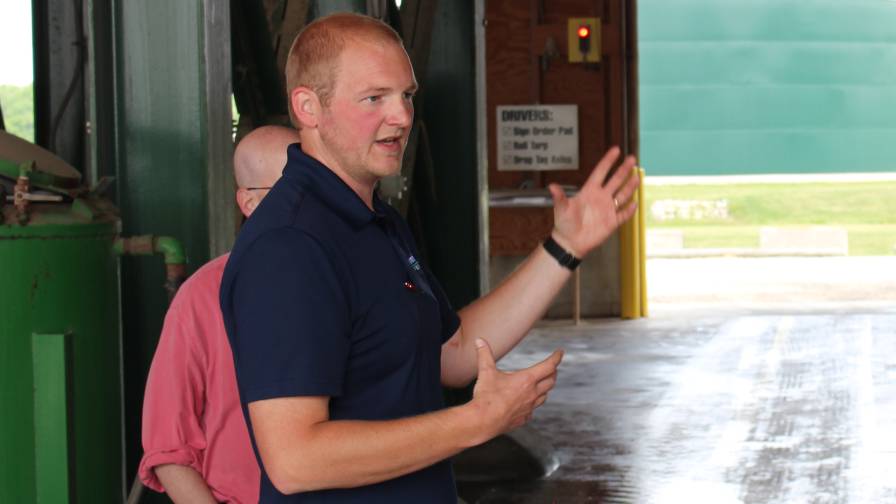
Zack Irons, Operations Manager at Sunrise Cooperative.
For example, I recently had the chance to visit an ag retailer in my home state of Ohio — Sunrise Cooperative. At the company’s Norwalk facility, I spoke with Operations Manager Zack Irons.
We talked about many aspects of today’s ag retail business, and I asked about Sunrise’s plans for purchasing application equipment for the fall 2024 season.
“Oh, we did that already,” said Irons. “And we’ve already bought eight new machines for the 2025 growing season.”
As to why just-in-time has given way to just-in-case, most folks I’ve talked with say it ties back to one of the watershed moments that has impacted the world since the start of the 2020s — the COVID pandemic. With the market disruptions this caused around the globe, companies in all industries often found it difficult to get products from suppliers on a reliable just-in-time basis. Instead, companies were forced to “plan ahead better,” meaning that keeping some products in their inventories became more accepted than in the past for reliability’s sake.
Actually, this reminds me of a conversation I had with Murray Equipment Inc. (MEI) a few years ago. Back in 2022, President/Owner Dan Murray told me how difficult it was for the company to obtain materials during the COVID years. To address this dilemma, MEI became “extremely proactive” in working with its suppliers and customers. “Starting in 2021, we worked with all of our suppliers to arrange for the purchase of the products we would need to keep our business going for at least the next two years,” said Murray. “I’m sure many other progressive companies are taking the same approach, because in this kind of supply environment, it’s critical to plan at least that far out if you want to stay in business.”
In other words, agriculture has gotten much better at planning ahead. Just in case.
Subscribe Today For
