Blending Smarter: Why Fertilizer Automation Is Becoming Foundational for Ag Retail
 March 30, 2026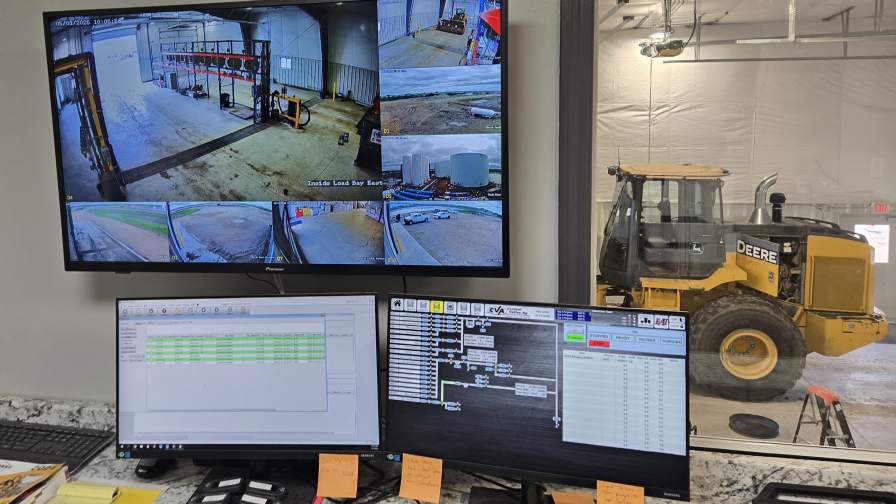
This liquid agronomy set-up from Easy Automation features the company’s NexGen Controller.
As demand grows for fertilizer that is tailored to the conditions it will be used under, labor shortages and other factors are creating the need for retailers to automate the process of blending the ingredients that go into these carefully calibrated recipes for growth. This requires manufacturers of fertilizer mixing machines and software developers to make products that mesh seamlessly to bring these combinations to life.
“As retailers manage higher volumes and more complex product mixes, the focus is shifting toward smarter automation, better diagnostics, and systems that are easier to standardize and scale across multiple locations,” says Colt Silvers, Vice President of Business Development at Kahler Automation.
Every blending software/equipment pairing works a little bit differently, but all rely on constant communication between the components of the system.
Sam Pendleton, Vice President of Sales for Easy Automation Inc., told CropLife® Magazine: “Facility automation software, including blending software, uses a multi-layered approach that includes an order management component, in our case, NexGen Controller, which sends data to a programmable logic controller that controls the operation of sensors, measuring devices, equipment, and hazard monitoring equipment within the facility. The two systems transfer data back and forth and talk to each other.”
Nate Wittmaack, President and COO at Ranco Fertiservice, says the firmware on the company’s MeshDCS functions as the blending software, since the systems come with built-in blending logic, through a distributed control system.
“This means each of our blending bins or metering systems is equipped with its own node control panel,” says Wittmaack. “This node panel has the logic and firmware designed to execute its prescribed task (i.e., how much material to dispense over a given time). The node relies on input information from the blender bin including scale input data and motor speed data. We constantly monitor amp draw of each metering unit, and each individual bin (or node) will make necessary adjustments to execute the requirements for that bin.”
A gateway controller coordinates all the bins, Wittmaack adds, and since the computer attached to the gateway doesn’t actually supply the brains for the process, it can be swapped out if issues arise.
While tech has been fine-tuned across the decades, there is still room for innovation in 2026, especially as new aspects of blending machines move into cloud-based solutions. “We are looking forward to implementing preventive maintenance improvements powered by AI and cloud-based data storage for our customers,” Easy Automation’s Pendleton says.
Austin Benes, Vice President of Sales at Kahler, agrees. “Our blending solutions operate within our on-premises control platform, Terminal Manager, which interfaces directly with facility equipment through I/O panels and application programming interface (API) connections,” Benes says. “With the launch of Constellation, we’ve extended that control to the cloud — giving customers greater visibility, consistency, and operational control across multiple facilities.”
Dealing with Limits
However, there are some limits to what the blending software can do. For instance, these systems cannot recommend to growers which ingredients should be incorporated into their customized fertilizer. This function usually comes from soil scientists or precision agriculture tools.
“Kahler Automation is intentionally designed to interface with leading agronomic platforms, allowing each system to focus on its area of expertise and deliver greater value to retailers and farmers,” Benes says.
Blending software makers concentrate on ease of integration with other programs used by retailers to simplify business processes.
“While the blending software integrates with other retailer functions in a software package, they aren’t necessarily always within the same program,” Easy Automation’s Pendleton says. “Integrations through API connection allow data to be easily transferred between an order management system and the blending software, and back. The power of integrating these programs lies in the ability to make real-time business decisions based on current, available data, such as inventory levels.”
Kahler’s Benes adds: “Our focus is on retail facility operations and the processes that enable ag retailers to efficiently deliver inputs to farmers. Kahler systems are purpose built to manage the operational activities inside the facility — from blending to logistics — ensuring speed, accuracy, and reliability.”
Dealing with Complications
Nutrients going into fertilizer blends are responsive to the input from software, but reactivity can complicate some processes.
“There’s no real limit to the types of commodities that can benefit from automated blending, but some products do require additional safeguards due to sensitivity or compatibility concerns,” Benes says. “As we see more micronutrient blends and biological products produced locally, system configurability becomes essential. At Kahler, our platforms are designed to prevent incompatible mixing, automate purging and cleanout processes, and eliminate human error — ensuring both safety and product integrity.”
As retailers focus on efficiently processing customized fertilizer orders from growers, adoption of automation software has become widespread, but industry figures still see room for expansion in this market.
“As ag retail operations continue to scale and diversify, automation is shifting from a competitive advantage to a foundational requirement,” says Kahler’s Silvers. “The next phase of growth will come from retailers modernizing legacy systems, connecting operational data across their facilities, and using automation to maintain speed and accuracy as complexity increases.”
Ranco’s Wittmaack sums it up a bit more simply. “The uptake of these technologies has increased significantly in the last 10 years and will continue to be a common conversation when we propose blend system equipment to customers,” he says. “It will not slow down.”
Subscribe Today For
