

Solving your nutrient deficiencies with an efficient product could pay off in yield potential.
When it comes to micronutrients, their importance in crop fertility is anything but “micro.” Like macronutrients, micronutrients are essential to crop growth and production, with plants requiring different nutrients at different growth stages. Creating a comprehensive nutrition plan that targets the right nutrient at the right time is vital to growing strong, healthy plants.
In today’s ag economy, you might already be considering cutting back on inputs like micronutrients. But applying effective products may prove to be a relatively small expense that pays dividends come harvest. Including inputs like MAX-IN Ultra ZMB® Plus micronutrient in your fertility plan, which has been shown to improve corn yield potential by up to 6.9 bu/A,1 can help address deficiencies and boost return on investment (ROI) potential across acres.
Are Micronutrients Worth the Cost?
Micronutrients are a critical part of an effective fertility plan, helping to solve nutrition deficiencies and provide plants the resources they need to produce strong yields. Crop Protection Product Manager Jon Zuk from WinField® United says with rising input costs, he sees some growers curbing their use of products such as micronutrients but warns that doing so may cost them in the long run.
“Even though micronutrients are used in a more nuanced way than macronutrients, they still play a significant role in plant development, which can help boost yields, and, therefore, ROI potential, in your corn and soybeans,” he clarifies.
Zuk explains the key to solving deficiencies (without spending more than you have to) is by targeting plants with the right nutrient at the right time. For example, the most optimal time to apply foliar potassium (K) is during reproductive growth stages.
“Tissue test results from WinField United showed K deficiencies in 79.2% of R1-R5 soybean samples and 51.1% of R1-R4 corn samples,”2 Zuk details. “Typically, this means applying potassium at fungicide timing to meet nutrition demands, which improves later-season grain fill and nutrient uptake.”
Is There Proof Micronutrients Improve Yield Potential?
For most growers, solving the most common nutrient gaps, while optimizing cost and operational efficiency, is the most feasible approach to nutrition management. According to WinField United tissue sampling reports, zinc, manganese and boron are the most common micronutrient deficiencies in corn and soybeans.3 When growers need to address all three deficiencies and are looking for a productive option, Zuk recommends MAX-IN Ultra ZMB Plus micronutrient.
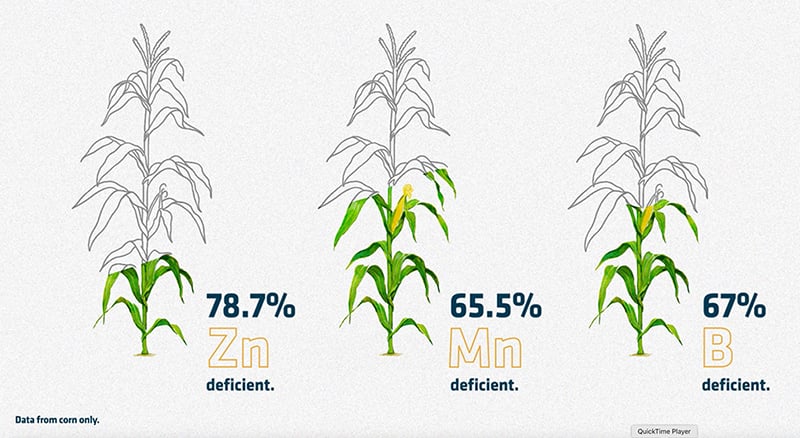
“A deficiency in even just one key micronutrient can impact yield potential. With one efficient application of MAX-IN Ultra ZMB Plus micronutrient, you can meet a majority of in-season crop demands to help maximize crop performance potential,” Zuk advises. “MAX-IN Ultra ZMB Plus micronutrient can help improve corn yield potential by up to 6.9 bu/A.1”
When Should I Apply a Micronutrient?
To hit the optimal timing in corn growth, Zuk recommends applying MAX-IN Ultra ZMB Plus micronutrient during early vegetative stages (V5-V10).
“Years of tissue testing data prove this is the best chance for seeing a yield response to the zinc application found in MAX-IN Ultra ZMB Plus micronutrient. However, the manganese and boron allow it to flex into responding to those nutrient gaps and other application timings, as well, such as V18-R2. The combo of zinc, manganese and boron allows plants to move more nutrients into growing points, maximize photosynthetic capacity and transport sugars exactly where and when they are needed most,” Zuk shares.
What Steps Should I Take This Spring?
Zuk suggests if you took any in-season tissue sampling or end-of-year soil sampling, your first step should be to review the results with your agronomic advisor.
“Tissue samples can help you find the right micronutrient products to correct any deficiencies on your priority acres and when to tackle them. If you don’t have tissue samples from your farm, talk with your local retailer about accessing a tissue sample data set from your area to find out what micronutrient deficiencies might be evident in your geography.”
1Based on 8 trials across Answer Plot locations, 2024.
2Data from internal WinField United research.
3Average based on 221,050 tissue samples from the WinField United Tissue Sample Treasury across V4-R2 growth stages from 2012-2022.