
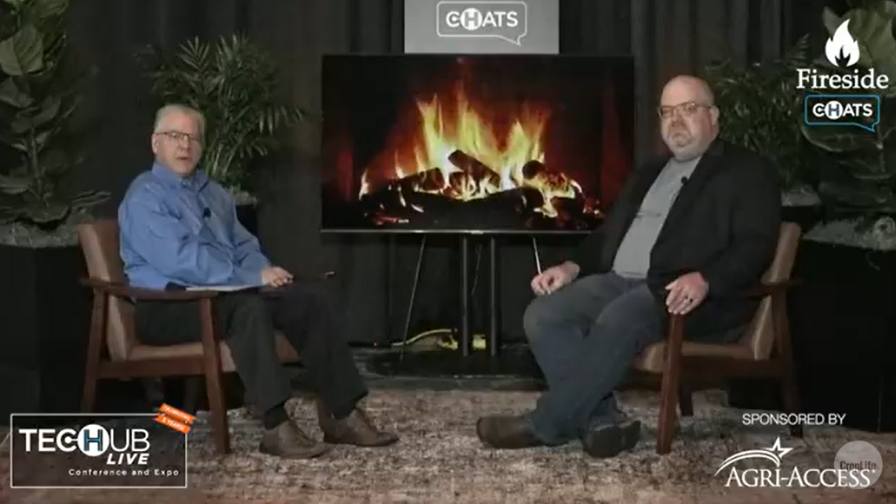
At the 2025 Tech Hub LIVE event in Des Moines, IA, CropLife sat down with Adam Farmer, Chief Technology Officer at Mercer Landmark, for a Fireside Chat that delivered valuable insights for ag retailers navigating the fast-changing technology landscape. With a career shaped by both hands-on experience and strategic leadership, Farmer offered practical advice on how to evaluate ag tech platforms, avoid burnout from vendor overload, and prepare for what’s next.
For other ag retailers, Farmer’s message was clear: success in ag tech doesn’t come from chasing every innovation — it comes from aligning technology investments with the real-world needs of growers.
“One of the biggest challenges we have in ag retail is the overwhelming number of companies that want us to help facilitate growers onto their platforms,” said Farmer. “You walk through the trade floor and see so many great ideas. But as ag retailers, we have to determine which technologies will actually provide value for our specific growers — and that varies by region.”
From Skepticism to Success
Mercer Landmark, an agricultural cooperative based in northwest Ohio, is no stranger to technology. The company is diversified across agronomy, animal feed, and grain, and has long dabbled in technology, according to Farmer.
He recalled his own entry into ag tech in the early days of yield monitors: “When I was a kid, my dad volunteered to demo the Ag Leader Yield Monitor 2000. I had to help him figure it out. That was kind of my entry into ag technology.”
Fast forward to today, and Mercer Landmark is actively evaluating AI, machine learning, and advanced platforms — but always with a healthy dose of pragmatism. Farmer shared one success story that started with doubt.
“There’s a platform that provides tools for customers to view account info, pay bills, and interact with their data,” he said. “When I first heard the pitch, I thought, ‘That sounds nice, but do we really need it?’ But after sitting down and using it, I realized it was actually pretty useful.”
The platform in question — AgVend — eventually proved itself with both the Mercer team and their customers. “One of our first customers said it was ‘Amazon easy’ to use,” Farmer noted. “That validated our decision.”
Trial, Error, and Continuous Improvement
Farmer emphasized that Mercer Landmark relies heavily on in-field trials to vet technologies before wide adoption.
“We have growers that we know are the most innovative and would be the most open to new ideas,” said Farmer. “We’ll usually go to them first. If they see benefit from it, we know we’re on to something.”
To stay ahead of the curve, Mercer Landmark also created an internal Continuous Improvement Task Force. The team regularly reviews current platforms, identifies pain points, and scouts for solutions that align with the company’s needs.
Managing Burnout and Keeping Focus
When asked how Mercer Landmark manages the nonstop stream of vendors pitching new tech solutions, Farmer was blunt.
“If all I did was talk to vendors who wanted meetings, that’s all I’d ever do,” he said. “You need the whole team involved.”
He added that the company relies on its salesforce to surface real grower challenges. Only when a solution aligns with a known problem does the team seriously engage. “It’s a lot more effective than cold calls,” Farmer explained. “Walking the trade floor and identifying a solution for a specific issue—that’s where real progress happens.”
What’s Next: AI That Actually Works
Looking ahead, Farmer said he’s most excited to see AI become genuinely useful for ag retailers and growers.
“Right now, there are so many AI-related companies saying they have solutions, but do they really solve the problems?” he asked. “Eventually, we’re going to go through that cycle — some disappointment, some failed experiments — but we’ll come out of it with real, useful implementations.”
“That might be more of a two-year horizon,” he added, “but I think within the next year, we’ll start to see meaningful applications that make a difference.”
For ag retailers looking to bring clarity to the noise of ag tech innovation, Farmer’s approach offers a proven roadmap: start with grower needs, trial solutions before scaling, and prioritize continuous internal feedback. As the technology landscape grows more complex, that kind of grounded strategy might be just what the industry needs.