The Biologicals Market Performance: Making Some Significant Headway
 March 1, 2025
 For the biologicals category, 2024 will go down as a positive year overall. Furthermore, the outlook for 2025 seems to be equally bright.
This is the underlying conclusion based upon the data collected in the 2025 CropLife Biologicals Survey of ag retailers. But before digging into some of the specific findings of this annual survey, let’s take a look at where the biologicals marketplace stands in terms of the agricultural industry.
First off, there are three individual segments that make up the biologicals market — biostimulants, biofertilizer, and biopesticides. Traditionally, biostimulants have been the leading segment among all biologicals with ag retailers and their grower-customers. And this remains the case going into the 2025 growing season.
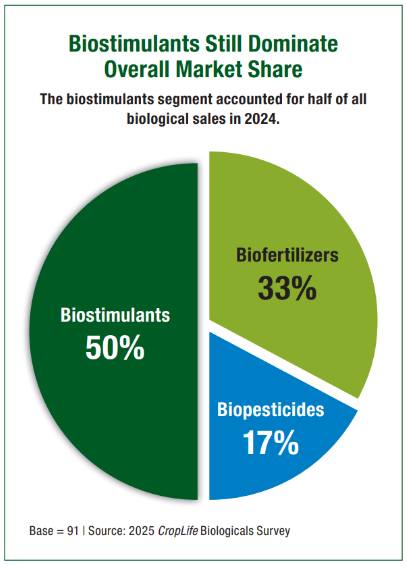 According to the survey, half (50%) of all biological products sold by ag retailers during the 2024 growing season fell into the biostimulants segment. In fact, since CropLife® magazine first started our Biologicals Survey back in 2018, biostimulants have dominated overall market share for the category each and every year.
As for the other two segments, biofertilizers are second behind biostimulants in overall popularity among ag retailers and growers, with 33% of the products sold during the 2024 growing season fitting into this segment. Biopesticides are a distant third place among all biological product segments, holding only a 17% share of the category’s sales in 2024.
However, ag retailers tend to sell multiple types of biological products to their grower-customers. Reflecting this fact, the 2025 CropLife Biologicals Survey asked respondents what kinds of biologicals they sold during the 2024 growing season. This question allowed respondents to choose all three biological product types, which a majority of them indicated was the case for their businesses (minus the 12% that said their companies didn’t currently offer any biological products to customers).
And the percentages in the 2025 survey were very positive. In terms of the three types of biological products sold among respondents, biostimulants remain the most common. According to the 2025 survey, 82% of respondents sell these products to their customers. Still, this did represent a modest 1% decline from the percentage of biostimulant sales during the 2023 growing season (83%).
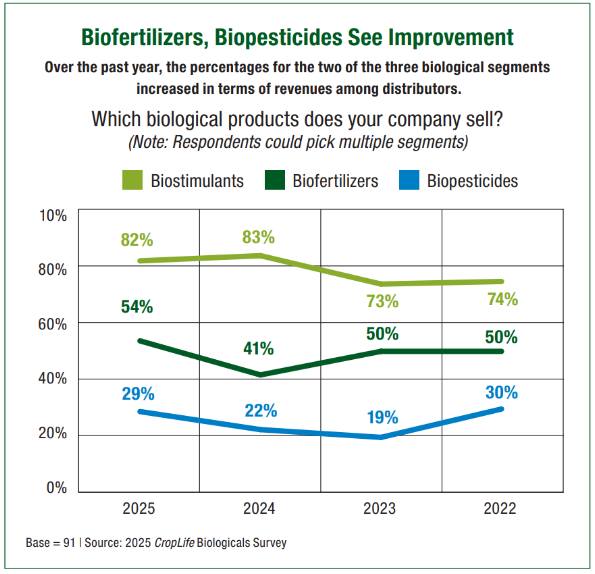 For the other two biologicals segments, the percentage news from the 2025 survey was decidedly more upbeat. For biopesticides, the segment saw its overall revenues among ag retailers improve by 7% during 2024, increasing from 22% during the 2023 growing season to 29%. This puts the biopesticides segment within striking distance of its previous high percentage for sales among ag retailers’ mark — 30%, attained during the not-too-distant 2022 growing season.
As for biofertilizers, the performance in 2024 was even stronger. For many years, this sector has held steady at 50% in terms of revenues for ag retailers, according to past surveys. In the 2025 survey, however, 54% of respondents said they were marketing these biological products in their operations — an impressive 13% from the 2024 survey results and the highest sales percentage the segment has yet recorded compared with prior CropLife Biologicals Surveys data.
Still a Matter of Trust
While everyone agrees that the future for biological products in agriculture is looking brighter than ever before going into the 2025 growing season, there are still some significant hurdles for the industry to overcome to really take off. Foremost among these is trust.
For many years, many industry critics have questioned whether or not biological products perform as advertised when being applied to grower-customer crop fields and/or actually improve overall yields. This stems from the performances (or lack thereof) of many of the earliest biologicals being introduced throughout the whole of the 2010s decade.
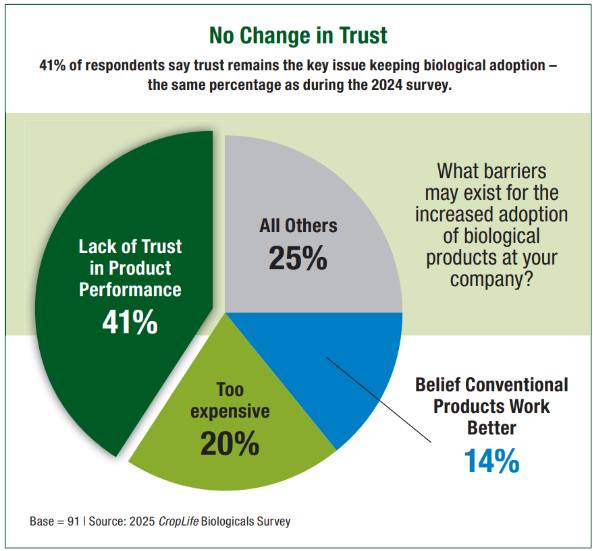 And according to the survey data, trust remains the biggest obstacle to more widespread biologicals’ adoption among ag retailers and their grower-customers.
This remains the case in 2025. According to this year’s survey results, 41% listed trust issues as the major reason biological products have had a hard time finding market acceptance. This was the same percentage cited by respondents in the 2024 CropLife Biologicals Survey for holding back biological products adoption. Still, this did represent a decline from the 2023 survey, where 54% of respondents said “lack of trust” was the key issue impacting biologicals acceptance.
In second place among barriers to biological products acceptance was cost. According to 20% of survey respondents, biological products are just “too expensive” compared with conventional agricultural products for grower-customers to use regularly. Still, this represented a 1% decline from the 2024 survey results.
Close behind this “biologicals are too expensive” criticism was the belief that “conventional products are better than biologicals in the field.” This was mentioned by 14% of respondents — a 2% increase from the 2024 survey data. The remaining 25% cited other reasons for the low biological product adoption rate with their customers. This included handling/storage concerns (10%), a fear of seller profit losses (10%), and regulatory issues (5%).
The Majors Are the Leaders
Initially when CropLife first started conducting its Biologicals Survey, start-ups were the market leaders in terms of sales volume. Over the past few years, however, the major players in the fertilizer and crop protection/seed categories have come to dominate the field. And this remains the case going into the 2025 growing season as well.
In terms of which companies respondents are getting their biological products from (another question that allowed respondents to choose multiple options), major crop protection product companies were by far the most popular suppliers. According to the 2025 survey, Corteva Agriscience is the leader in the field among respondents, being the source of biological products for 46%. BASF is a close second at 45%. This represented a reversal of fortunes for the two companies from the 2024 survey results, when BASF was No. 1 and Corteva was tied with Bayer Crop Science for second place.
Speaking of Bayer, that company now supplies biological products to 37% of 2025 CropLife Biologicals Survey respondents, a decline from 43% in 2024. This tied the company with Syngenta, which also accounted for 37% of biological products to ag retailers, according to the 2025 survey results. Rounding out the Top 5 biological products companies in the 2025 survey was FMC Corp. at 33%.
Finishing out the Top 10 biologicals companies, according to survey respondents, were WinField ranked at No. 6, supplying products to 30% of respondents. No. 7 was AMVAC at 22%. Verdesian finished in eighth place, with 21% of respondents sourcing biologicals from the company. Valent Biosciences Corp. was in the ninth spot, sourced by 20%. Finally, in tenth place at 19% was BRANDT.
The Future Looks Bright
For a category like biologicals, the outlook is almost as important as the current state of things. In this respect, the overall future for the biological products category seems very positive. For evidence of this, consider the findings regarding the category’s outlook for the 2025 growing season.
According to the 2025 survey, 86% of respondents are planning to increase the number of biological products their companies sell to grower-customers during the coming year.
This is up significantly from the 2024 survey results, where only 72% of respondents were planning such an increase in their biological product offerings for grower-customers. Another 13% plan to maintain their current level of spending on biological products. Significantly, a very tiny 1% of survey respondents indicated their companies planned to decrease the numbers/amounts they are currently spending on biological products for the 2025 growing season.
Survey Statistics
The 2025 CropLife magazine biologicals online survey was sent to readers in January 2025. In total, there were 91 surveys returned with valid answers.
In terms of breakout, 88% of the respondents identified themselves as being ag retailers/cooperatives. Another 5% said that they are fertilizer producers/suppliers. The remaining 7% identified themselves as crop consultants and advisors.
Region-wise, 40% of the respondents said their companies were located in the Midwest, 21% in the Plains, 14% in the South, 14% were in the West, and 11% in the Northeast. In terms of crops serviced (where multiple answers could be chosen), 90% of respondents dealt with corn, 82% with soybeans, and 66% with wheat.
CropLife would like to thank everyone that took part in this year’s survey. Your insights are appreciated!
Subscribe Today For
